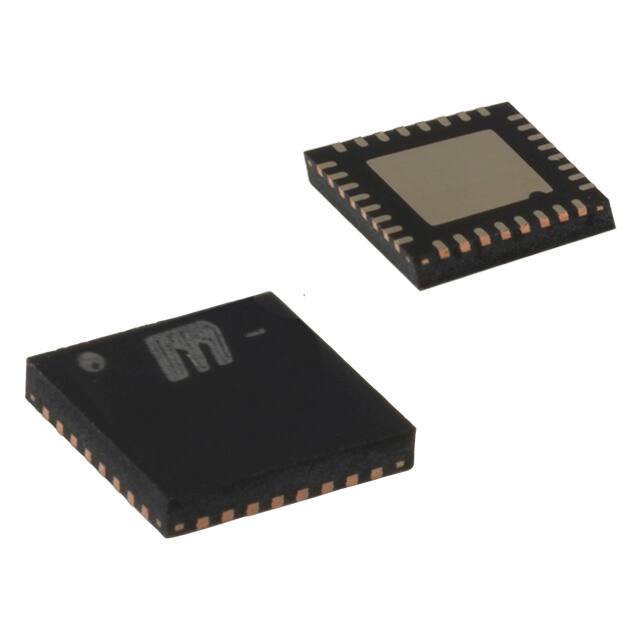
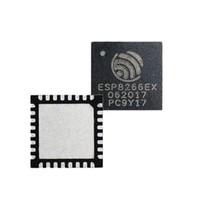


Hi readers! Hopefully, you are fine, searching, and learning daily. Today we will explore ESP8266 which is a thrilling device in technology. ESP8266 is a superliner microcontroller launched by Espressif Systems. It is admired as special because it has high-performance speed and various connectivity options with great efficiency and affordability. This microcontroller is famous as a wifi module and has many applications in IoT projects.
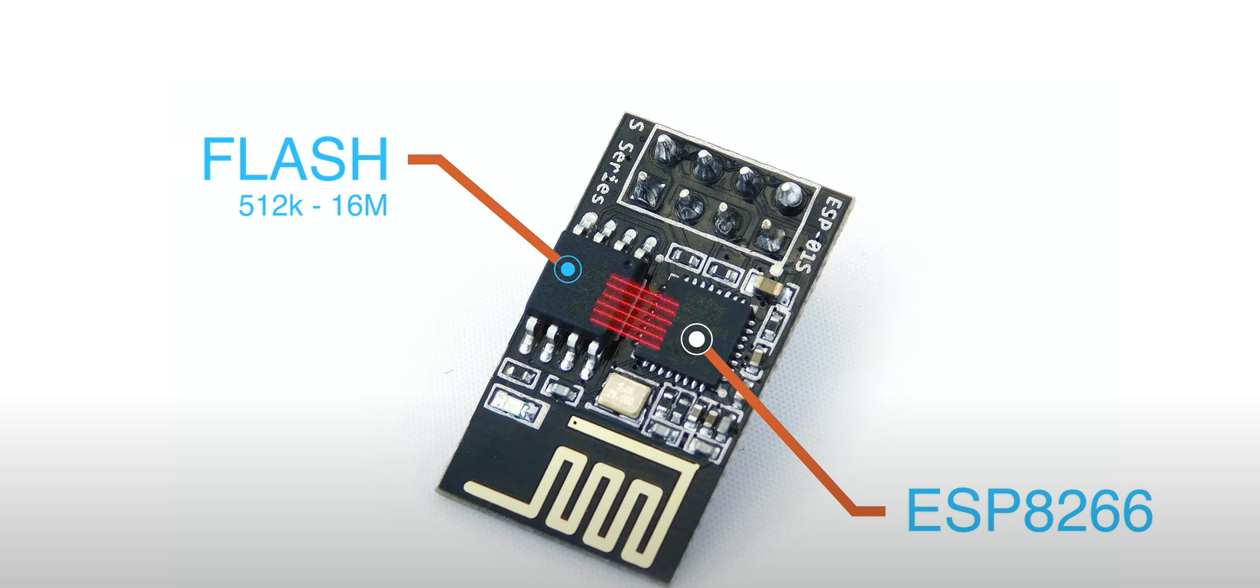
ESP8266 in 5 minutes
Introduction
It contains a 32-bit resolution with an 80 MHz clock speed. It contains an RISC processor. It is a single-core processor based on Tensilica L106. It offers communication protocols that make it ideal for various demanding applications. It offers 512 KB to 4 MB flash memory. Its 17 GPIO pins allow flexibility to perform functions. It is compact and perfect for portable projects and wearable technology. Moreover, it is energy-efficient and highly ideal in battery-powered projects. It has many variant modules. It is best suited to many industries and automation. It has demanding applications in many fields including education, home automation, industries, wearable tech, IoT projects, and prototyping.
Recent technological advancements have marked the importance of ESP8266. In this article, we will explore its introduction, significant features, thrilling applications, variations in model, datasheet, pinouts, and uses. Let’s explore.
● Tensilica L106 single-core processor powers the ESP8266.
● It operates at a clock speed of 160 MHz.
● It offers a 34-bit resolution.
● It supports 64 KB of instruction RAM and 96 KB of data RAM.
● It contains 17 GPIO pins.
● It supports communication interfaces.
● It has various modules.
● It supports programming with unique features.
● It is a small-sized board but offers versatile features.
● It has many applications in education, home automation, industries, wearable tech, IoT projects, and prototyping.
● It has great connectivity options for peripheral devices with less complexity.
● It is power efficient.
● It is highly affordable and used in many applications.
Features:
Features of ESP8266 are given there:
Processor:
The ESP8266 employs the Tensilica L106 32-bit processor, with clock speeds reaching as high as 160 MHz. It is thus suited for rather basic processing, which in turn means tasks related to reading sensors, controlling actuators, and managing wireless communication can be done. It is especially useful for things like small IoT device management or sending data over the internet.
● Processor type: Tensilica L106, 32-bit RISC.
● Clock speed: operates at a clock speed of 160 MHz.
Memory:
The ESP8266 has two areas of memory, 64 KB of code RAM and 96 KB of data RAM, which are sufficient for carrying out simple actions. Thus, its most catastrophic problem is being held by the available flash memory (normally 512 KB to 4 MB depending on the module). The flash memory carries the operating system and the user's code as well.
GPIO Pins:
This device is strong enough for communication with external devices where the ESP8266 is included. The chip can potentially incorporate GPIO pins up to 17 (the version of their choice, however), which are assigned different tasks such as reading sensors, motor control, or, data emission and reception, respectively. Communication methods, such as SPI, I2C, and UART can be used.
Analog-to-digital converter (ADC):
The ESP8266, with the help of a 10-bit ADC, can convert analog signals to digital values, for example, through signals coming from temperature or humidity sensors. Analog input voltages in the range of 0V to 1V can be processed by the ADC for a basic sensor reading, thus, giving the right application for this device.
● ADC Resolution: 10-bit
● Input Range: 0-1V
Power Consumption:
One of the main characteristics of the ESP8266 is its negligible energy usage which makes it a right choice for battery-powered devices, a verdict of the importance of this microcontroller. The ESP8266 has an array of power-saving activities, one of which is the deep sleep mode which shrinks its power usage to a bare minimum when the device is in an inactive state or a low-activity period.
● Current Consumption in Deep Sleep: only 20 (micro) Amperes as low as 20
● Operational Power Modes: Active, Idle, Deep Sleep
TCP/IP Stack:
The ESP8266 is made using an internal TCP/IP stack which allows it not only to connect to a web server but also to the cloud platform or other devices over the Internet. This stack offers the protocols necessary for operation as a client or server such as HTTP, FTP, UDP, TCP, and DNS. Thus, users can create connected devices that are capable of sending and receiving data wirelessly.
Security Features:
Security is one of the most important issues differentiating IoT applications, and the ESP8266 comes with several built-in features to ensure secure communication:
WPA/WPA2: The Accessible Instruction (AI) has different encryption protocols such as WPA2 for example, which assures that the safe connection is authentic.
TLS/SSL: Transport Layer Security and SSL are the two technologies that are provided to ensure that online communications will not be intercepted or altered. Thus, it guarantees the data has not been modified in the transmission of sensitive data.
Secure Boot and Flash Encryption: Secure Boot and Flash Encryption is a technique whereby the device's real firmware is shielded from unauthorized firmware and data access thus protecting its devices' firmware as well.
Variations:
ESP-01:
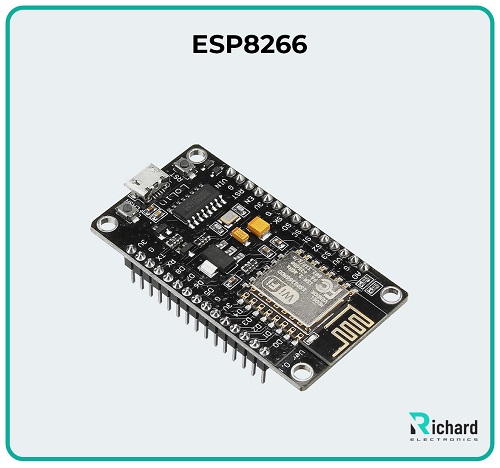
The ESP-01 is among the most fundamental modules in the ESP8266 family. It is equipped with 2 GPIO pins and 512 KB of flash memory. This module is usually seen in basic IoT applications like a single relay or single sensor.
● GPIO Pins: 2
● Flash Memory: 512 KB
● Primary Use: Basic IoT projects

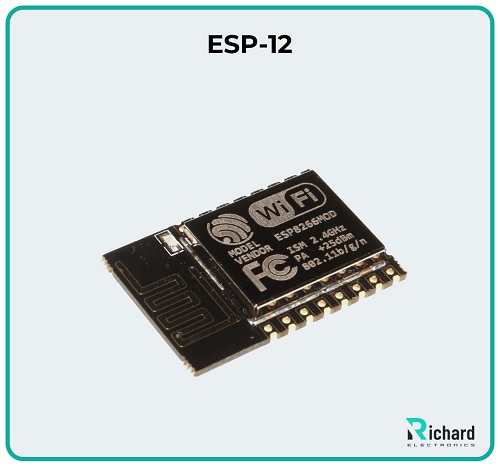
ESP-12:
ESP-12 is a more powerful and highly sought-after version. It provides 16 GPIO pins and up to 4 MB of flash memory. This module is mostly used in higher-end projects like smart home systems and sensor networks.
● GPIO Pins: 16
● Flash Memory: Up to 4 MB
● Primary Use: Advanced IoT applications
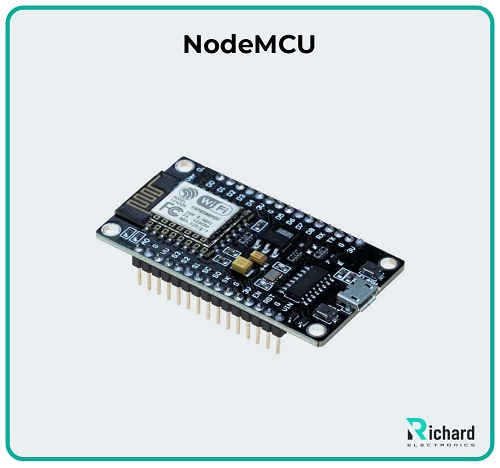
NodeMCU:
● GPIO Pins: 16
● Flash Memory: 4 MB
● Primary Use: Prototyping and development.
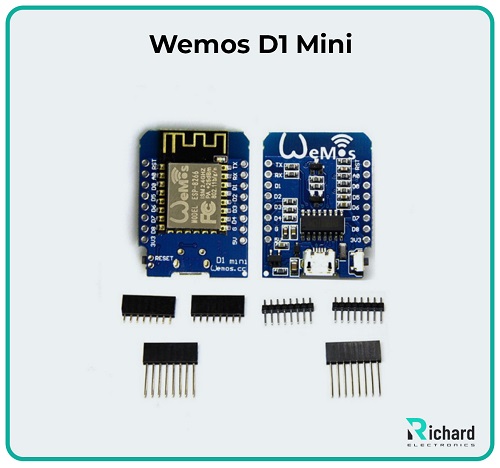
Wemos D1 Mini:
The Remos D1 Mini is an ESP8266-equipped miniature board that is only 25 x 34 mm. For projects space is your limiting factor but the glorious ESP8266 is still alive and running this will indeed be the most ideal option.
● GPIO Pins: 11
● Flash Memory: 4 MB
● Primary Use: Compact IoT projects
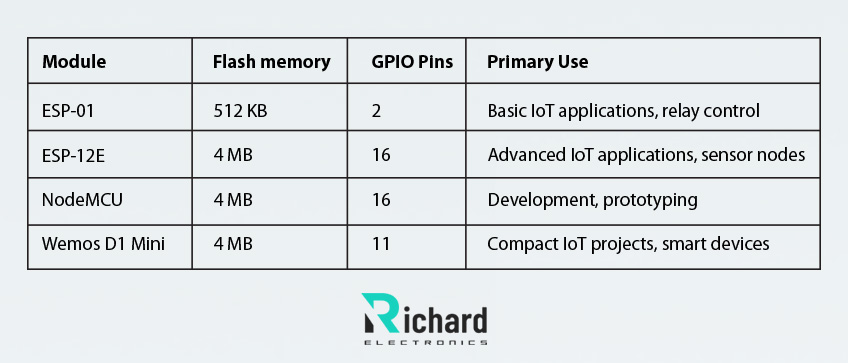
Module | Flash memory | GPIO Pins | Primary Use |
ESP-01 | 512 KB | 2 | Basic IoT applications, relay control |
ESP-12E | 4 MB | 16 | Advanced IoT applications, sensor nodes |
NodeMCU | 4 MB | 16 | Development, prototyping |
Wemos D1 Mini | 4 MB | 11 | Compact IoT projects, smart devices |
Datasheet:
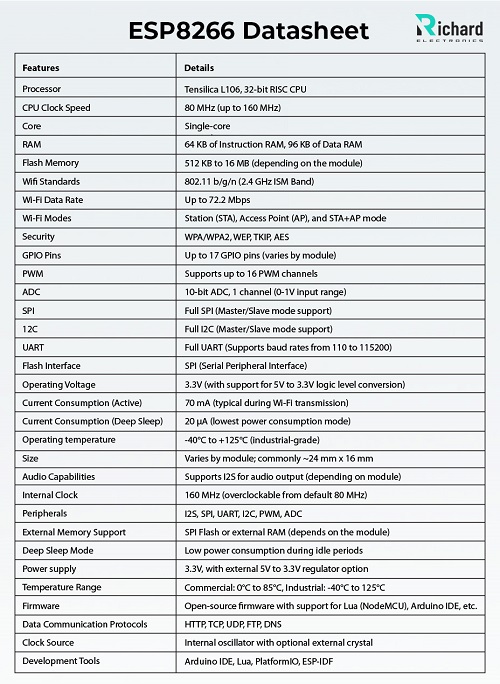
Features | Details |
Processor | Tensilica L106, 32-bit RISC CPU |
CPU Clock Speed | 80 MHz (up to 160 MHz) |
Core | Single-core |
RAM | 64 KB of Instruction RAM, 96 KB of Data RAM |
Flash Memory | 512 KB to 16 MB (depending on the module) |
Wifi Standards | 802.11 b/g/n (2.4 GHz ISM Band) |
Wi-Fi Data Rate | Up to 72.2 Mbps |
Wi-Fi Modes | Station (STA), Access Point (AP), and STA+AP mode |
Security | WPA/WPA2, WEP, TKIP, AES |
GPIO Pins | Up to 17 GPIO pins (varies by module) |
PWM | Supports up to 16 PWM channels |
ADC | 10-bit ADC, 1 channel (0-1V input range) |
SPI | Full SPI (Master/Slave mode support) |
12C | Full I2C (Master/Slave mode support) |
UART | Full UART (Supports baud rates from 110 to 115200) |
Flash Interface | SPI (Serial Peripheral Interface) |
Operating Voltage | 3.3V (with support for 5V to 3.3V logic level conversion) |
Current Consumption (Active) | 70 mA (typical during Wi-Fi transmission) |
Current Consumption (Deep Sleep) | 20 µA (lowest power consumption mode) |
Operating temperature | -40°C to +125°C (industrial-grade) |
Size | Varies by module; commonly ~24 mm x 16 mm |
Audio Capabilities | Supports I2S for audio output (depending on module) |
Internal Clock | 160 MHz (overclockable from default 80 MHz) |
Peripherals | I2S, SPI, UART, I2C, PWM, ADC |
External Memory Support | SPI Flash or external RAM (depends on the module) |
Deep Sleep Mode | Low power consumption during idle periods |
Power supply | 3.3V, with external 5V to 3.3V regulator option |
Temperature Range | Commercial: 0°C to 85°C, Industrial: -40°C to 125°C |
Firmware | Open-source firmware with support for Lua (NodeMCU), Arduino IDE, etc. |
Data Communication Protocols | HTTP, TCP, UDP, FTP, DNS |
Clock Source | Internal oscillator with optional external crystal |
Development Tools | Arduino IDE, Lua, PlatformIO, ESP-IDF |
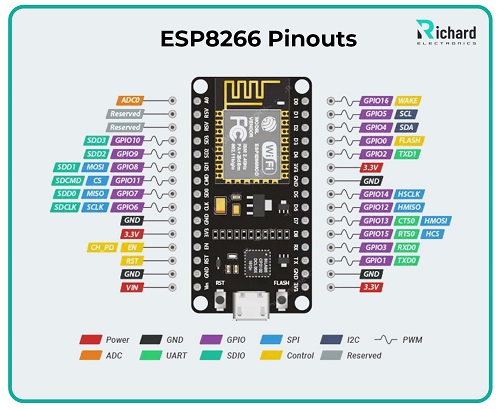
Pinouts:
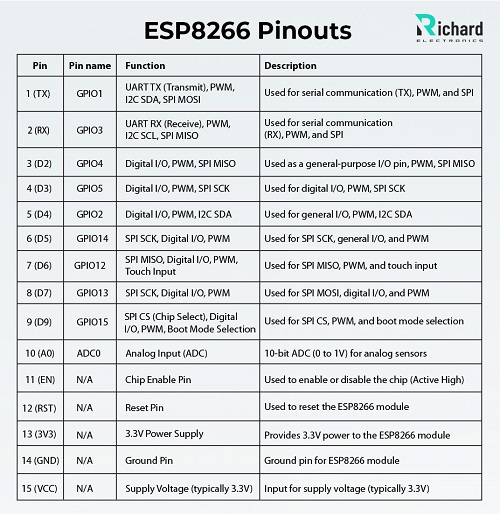
Pin | GPIO Pin | Function | Description |
1 (TX) | GPIO1 | UART TX (Transmit), PWM, I2C SDA, SPI MOSI | Used for serial communication (TX), PWM, and SPI |
2 (RX) | GPIO3 | UART RX (Receive), PWM, I2C SCL, SPI MISO | Used for serial communication (RX), PWM, and SPI |
3 (D2) | GPIO4 | Digital I/O, PWM, SPI MISO | Used as a general-purpose I/O pin, PWM, SPI MISO |
4 (D3) | GPIO5 | Digital I/O, PWM, SPI SCK | Used for digital I/O, PWM, SPI SCK |
5 (D4) | GPIO2 | Digital I/O, PWM, I2C SDA | Used for general I/O, PWM, I2C SDA |
6 (D5) | GPIO14 | SPI SCK, Digital I/O, PWM | Used for SPI SCK, general I/O, and PWM |
7 (D6) | GPIO12 | SPI MISO, Digital I/O, PWM, Touch Input | Used for SPI MISO, PWM, and touch input |
8 (D7) | GPIO13 | SPI SCK, Digital I/O, PWM | Used for SPI MOSI, digital I/O, and PWM |
9 (D9) | GPIO15 | SPI CS (Chip Select), Digital I/O, PWM, Boot Mode Selection | Used for SPI CS, PWM, and boot mode selection |
10 (A0) | ADC0 | Analog Input (ADC) | 10-bit ADC (0 to 1V) for analog sensors |
11 (EN) | N/A | Chip Enable Pin | Used to enable or disable the chip (Active High) |
12 (RST) | N/A | Reset Pin | Used to reset the ESP8266 module |
13 (3V3) | N/A | 3.3V Power Supply | Provides 3.3V power to the ESP8266 module |
14 (GND) | N/A | Ground Pin | Ground pin for ESP8266 module |
15 (VCC) | N/A | Supply Voltage (typically 3.3V) | Input for supply voltage (typically 3.3V) |
Applications:
Home Automation:
It has many applications in home automation that help to connect remotely with devices such as lights, thermostats, and security systems. Using a Wi-Fi connection, users can manipulate household gadgets from any place using a smartphone or a web application.
Environmental Monitoring:
The chip is implemented in environmental sensor networks that cover temperature, humidity, and air quality monitoring. ESP8266 can collect the data from sensors and transfer it to a cloud platform for analysis. This is very beneficial in areas such as agriculture or weather stations that require real-time data, like data transfer. Rainponics is an example of the latter case.
Security Systems:
SP8266-security systems have the feature of monitoring homes or businesses from a distance. It can be linked to cameras, motion sensors, and alarms. When something happens, it will send alerts or live feeds to a smartphone or cloud storage.
Industrial IoT Projects:
By plugging sensors into the chip, workers can monitor the equipment status and identify failure points. This lowers maintenance costs and increases production.
Wearable Devices:
The ESP8266 primarily finds its place in wearables such as fitness trackers or health monitors that are small and have low energy consumption due to their tiny size and low power usage. These devices sync data with a cloud-based service to get heart rate or step count information.
Smart Appliances:
It has many applications in smart appliances including coffee beaters, air conditioners, and refrigerators. Hence providing the users with the ability to control and manage the appliances through a mobile app from a distance.
Robotics:
It is used in autonomous robots, and drones.
Conclusion:
The ESP8266 is an efficient, low-cost Wi-Fi microcontroller that has been an important IoT (Internet of Things) tool. It is small and uses low power, thus it can connect devices to the internet and is therefore optimum for many applications. These, for example, are home automation (smart lighting and security systems), environmental monitoring (temperature and humidity sensors), and industrial IoT (if the machinery is subjected to remote monitoring).
The chip offers the possibility of transmitting messages through UART, SPI, and I2C. It can even be programmed with widely used development platforms such as the Arduino IDE. This is why it is suitable for both novices and professionals. Plus, its high-energy efficiency enables it to be exploited in battery-powered projects.
This ESP8266 is a very dependable and money-saving device that can be used to create such systems that are connected in various industrial fields and also in hobbyist projects resulting in usage being very comfortable.
Specifications
Technical Specifications
- TypeParameterSelect All
Factory Lead Time
4 Weeks
Mounting Type
Surface Mount
Package / Case
32-VFQFN Exposed Pad
Packaging
Tape & Reel (TR)
Published
2015
Part Status
Active
Moisture Sensitivity Level (MSL)
3 (168 Hours)
Type
TxRx + MCU
Max Operating Temperature
125°C
Min Operating Temperature
-40°C
Voltage - Supply
2.5V~3.6V
Frequency
2.4GHz
Protocol
802.11b/g/n
Power - Output
20dBm
RF Family/Standard
WiFi
Sensitivity
-91dBm
Data Rate (Max)
54Mbps
Serial Interfaces
I2C, I2S, SPI, UART
Current - Receiving
50mA~56mA
Current - Transmitting
120mA~170mA
GPIO
8
RoHS Status
RoHS Compliant
View More
- 1.
What kind of processor does the ESP8266 use?
The ESP8266 employs the Tensilica L106 32-bit RISC processor, with a clock speed of up to 160 MHz.
- 2.
How many GPIO pins does the ESP8266 have?
The ESP8266 can potentially incorporate up to 17 GPIO pins, which are used for tasks like reading sensors, motor control, data emission and reception, etc.
 Ling Tianhao
Ling Tianhao, with 20 years in R&D, has developed his skills at one of America's top ten chip manufacturers.His expertise goes beyond chip design and quality control, showing a strong understanding of PCB technology. His comprehensive knowledge of microchip and PCB technologies establishes him as a versatile professional in the semiconductor industry, driving advancements and solving complex problems.