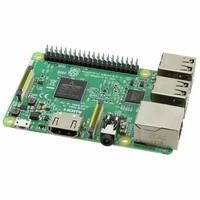


Hi readers! I hope you are fine and finding and learning new things daily. Today, I am telling you about Raspberry Pi 3. It is advanced from its predecessors and has more unique and versatile features. It offers wireless connectivity and efficient performance. It is ideal for educationalists, hobbyists, and even professionals.
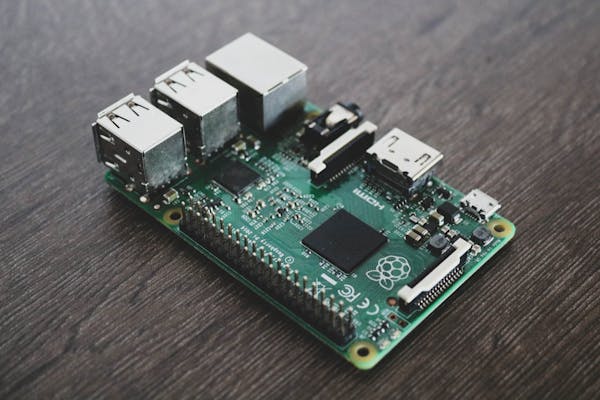
Raspberry Pi 3 - Top 5 Operating Systems and Uses
Introduction
It is cost-attractive and easily accessible to students and developers for programming. It has powerful hardware capabilities and is a breakthrough step in single-board computer technology. Pi 3 has 1GB of memory and can easily handle large data and complex coding. It has a wide range of applications including education, industrial development, scientific research, media centers, IoT projects, robotics, and web servers.
Its processor is based on ARMv8 Architecture and easily runs complex and sophisticated tasks and software in many demanding fields. It is a compact-sized board and has many applications in portable projects and wearable technology. It supports wifi and Bluetooth for wireless connectivity. Pi 3 has demanding applications in many fields including IoT projects, home automation, media centers, networking, and web servers.
In this article, we will learn about Pi 3’s introduction, features and specifications, datasheet, pinouts, applications, impact, and limitations. Let’s start.
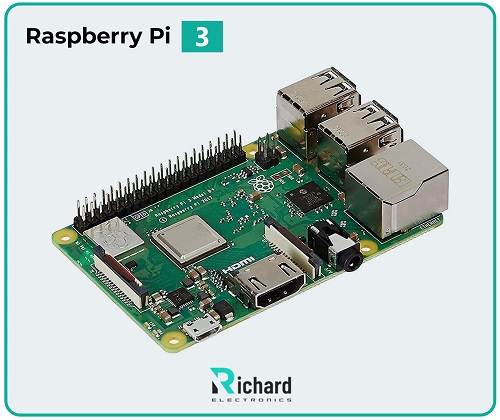
● Pi 3 has Broadcom BCM2837 SoC with quad-core ARM Cortex-A53 CPU.
● It requires 1.3GHz to run the system.
● It offers a 64-bit resolution.
● Pi 3 has a 1GB memory range.
● The Raspberry Pi 3 has wireless connectivity options.
● It also contains microSD cards to boost its performance with high efficiency.
● The Raspberry Pi Foundation released it in February 2016.
● It has 40 digital input/output pins.
● It has dimensions of 85.6 mm × 56.5 mm × 17 mm.
● It has various ports for better performance.
Features of Raspberry Pi 3:

Processor:
Pi 3 is powered by Broadcom BCM2837 SoC (System on Chip) having a core ARM Cortex-A53 CPU. It runs at a clock speed of 1.3GHz. Pi 3 has resolution power up to 64-bit. This processor is based on ARMv8 Architecture and easily runs complex and sophisticated tasks and software in many demanding fields. Compared to the previous version, Raspberry Pi 2, it has better multitasking and jammies when executing applications.
However, the operational efficiency is still quite high so the performance can be applied to many areas such as embedded systems, DIY, etc. The processor includes fast video decoding acceleration features and well-implemented floating-point features which are useful for video applications or any sort of complex number computation.
Memory:
Raspberry Pi 3 comes with LPDDR2 SDRAM with a memory of 1 GB. It is quite low and average today but for the various applications like web access, programming, casual gaming, etc., it is quite practical. The 1 GB RAM allows the Raspberry Pi 3 to operate with various operating systems including the official Raspberry Pi OS, previously known as Raspbian, many other Linux distributions, retro gaming, and Windows IoT Core. it is ideal for portable and battery-powered projects.
GPU:
The Raspberry Pi 3 has Broadcom VideoCore IV GPU, specially designed for media applications. It has various applications in many demanding fields like video streaming, running video games, or rendering graphical interfaces.
As such, the Raspberry Pi 3 is also believed to effectively serve in contexts that require a display, for instance, media center usage, web browsing, and graphical programming projects.
Raspberry Pi 3 I/O Ports:
USB Ports:
It contains are 4 USB ports used to connect devices like keyboard, mouse, external storage devices, and sensors.
HDMI Port:
Pi 3 contains an HDMI port that provides 1080p video output. It is ideal in applications including media-center setups, digital signage, or interactive projects.
3.5mm Audio/Video Jack:
It has a 3.5mm jack which efficiently gives audio and video signals. It’s a useful feature for DIY projects that require basic audio or video output.
Camera Modules:
Camera serial interface (CSI):
The CSI interface makes it possible to attach the official Raspberry Pi camera module. This is helpful in some use cases including security cameras, time-lapse photography, and certain computer vision uses.
Display Serial Interface (DSI):
The DSI interface also allows the user to connect an official Raspberry Pi touchscreen display for projects that involve interactivity, maybe kiosks or portable computing devices.
Power supply:
It requires 5V to operate the device using a microSD card slot. It is efficient, to say the least, with reasonable power consumption given its abilities. Furthermore, it is highly efficient making it fit for all kinds of projects where continuous use is needed like home automation systems, servers, and other embedded-type systems.
When it comes to Embedded projects, Power management is one of the most important factors in designing the system, and here the power is managed quite efficiently as the Raspberry Pi 3 can be used with a power bank and quite a low power setup.
Storage:
The Raspberry Pi 3 does not include any real storage onboard. This computer instead gets its operative system from a microSD card that acts as a booting device. With this storage approach, users can easily upgrade and personalize their devices through the simple process of SD cards to change operating systems or add storage capacity.
It is recommended to use high-speed PSD (micro SD cards) preferably with a class 10 rating or higher, when performing tasks that are intense or transfer large amounts of data as these devices will ensure good performance.
Operating Systems and Software:
The Raspberry Pi 3 offers many operating systems including:
● Other Linux systems such as Ubuntu and Arch Linux are also available; for those looking to use the Pi as a standard desktop computer, these systems provide a more conventional desktop or server interface.
● Windows IoT core is a Windows version that is suitable for IOT devices. It is a lightweight and power-efficient OS that is ideal for ‘embedded’ devices such as the Raspberry Pi.
● RetroPie, LibreELEC (and other such specific versions) OS have the capability of changing Pi into a media player a gaming console, or a home theater system.
Datasheet of Raspberry Pi 3:
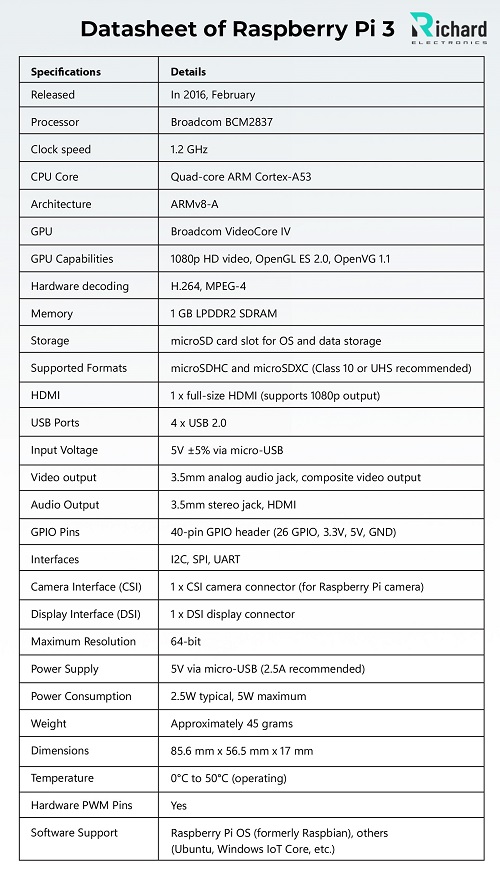
Specifications | Details |
Released | In 2016, February |
Processor | Broadcom BCM2837 |
Clock speed | 1.2 GHz |
CPU Core | Quad-core ARM Cortex-A53 |
Architecture | ARMv8-A |
GPU | Broadcom VideoCore IV |
GPU Capabilities | 1080p HD video, OpenGL ES 2.0, OpenVG 1.1 |
Hardware decoding | H.264, MPEG-4 |
Memory | 1 GB LPDDR2 SDRAM |
Storage | microSD card slot for OS and data storage |
Supported Formats | microSDHC and microSDXC (Class 10 or UHS recommended) |
HDMI | 1 x full-size HDMI (supports 1080p output) |
USB Ports | 4 x USB 2.0 |
Input Voltage | 5V ±5% via micro-USB |
Video output | 3.5mm analog audio jack, composite video output |
Audio Output | 3.5mm stereo jack, HDMI |
GPIO Pins | 40-pin GPIO header (26 GPIO, 3.3V, 5V, GND) |
Interfaces | I2C, SPI, UART |
Camera Interface (CSI) | 1 x CSI camera connector (for Raspberry Pi camera) |
Display Interface (DSI) | 1 x DSI display connector |
Maximum Resolution | 64-bit |
Power Supply | 5V via micro-USB (2.5A recommended) |
Power Consumption | 2.5W typical, 5W maximum |
Weight | Approximately 45 grams |
Dimensions | 85.6 mm x 56.5 mm x 17 mm |
Temperature | 0°C to 50°C (operating) |
Hardware PWM Pins | Yes |
Software Support | Raspberry Pi OS (formerly Raspbian), others (Ubuntu, Windows IoT Core, etc.) |
Pinouts of Raspberry Pi 3:
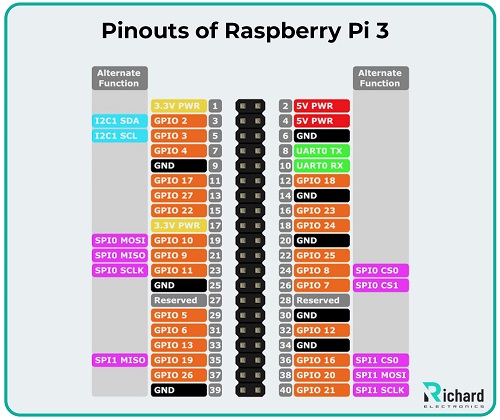

Pin | Pin name | Function | Note |
1 | 3.3V | Power supply | 3.3V output |
2 | 5V | Power supply | 5V output |
3 | GPIO 2 (SDA1) | I2C Data (SDA) | I2C Data pin |
4 | 5V | Power supply | 5V output |
5 | GPIO 3 (SCL1) | I2C Clock (SCL) | I2C Clock Pin |
6 | Ground (GND) | Ground | Ground connection |
7 | GPIO 4 | General Purpose IO | It can be used for various applications |
8 | GPIO 14 (TXD) | UART Transmit (TX) | UART Serial TX Pin |
9 | Ground (GND) | Ground | Ground connection |
10 | GPIO 15 (RXD) | UART Receive (RX) | UART Serial RX Pin |
11 | GPIO 17 | General Purpose IO | It can be used for various applications |
12 | GPIO 18 | General Purpose IO | It can be used for various applications |
13 | GPIO 27 | General Purpose IO | It can be used for various applications |
14 | Ground (GND) | Ground | Ground connection |
15 | GPIO 22 | General Purpose IO | It can be used for various applications |
16 | GPIO 23 | General Purpose IO | It can be used for various applications |
17 | 3.3V | Power Supply | 3.3V output |
18 | GPIO 24 | General Purpose IO | It can be used for various applications |
19 | GPIO 10 (MOSI) | SPI MOSI (Master Out Slave In) | SPI data output |
20 | Ground (GND) | Ground | Ground connection |
21 | GPIO 9 (MOSI) | SPI MISO (Master In Slave Out) | SPI data input |
22 | GPIO 25 | General Purpose IO | It can be used for various applications |
23 | GPIO 11 (SCLK) | SPI Clock | SPI Clock pin |
24 | GPIO 8 (CE0) | SPI Chip Enable 0 | SPI Chip Select 0 |
25 | Ground (GND) | Ground | Ground |
26 | GPIO 7 (CE1) | SPI Chip Enable 1 | SPI Chip Select 1 |
27 | GPIO 0 (ID_SD) | ID EEPROM Data | Used for I2C communication (not commonly used in all projects) |
28 | GPIO 1 (ID_SD) | ID EEPROM Clock | Used for I2C communication (not commonly used in all projects) |
29 | GPIO 5 | General Purpose IO | Can be used for various applications |
30 | Ground (GND) | Ground | Ground connection |
31 | GPIO 6 | General Purpose IO | Can be used for various applications |
32 | GPIO 12 | General Purpose IO (PWM) | PWM Pin (Pulse Width Modulation) |
33 | GPIO 13 | General Purpose IO (PWM)
| Pulse-Width Modulation |
34 | Ground (GND) | Ground | Ground connection |
35 | GPIO 19 | General Purpose IO | It can be used for various applications |
36 | GPIO 16 | General Purpose IO | It can be used for various applications |
37 | GPIO 26 | General Purpose IO | It can be used for various applications |
38 | GPIO 20 | General Purpose IO | It can be used for various applications |
39 | Ground (GND) | Ground | Ground connection |
40 | GPIO 21 | General Purpose IO | It can be used for various applications |
Applications:
Education and Learning Programming:
Programming:
It’s a powerful tool for learning programming languages like Python, Scratch, and Java. It’s a great tool for teaching programming languages.
STEM Projects:
Utilized to develop interactive projects in robotics or sensors-based systems in science, technology, engineering, and maths.
Home Automation and IoT Smart Homes:
● Smartphones:
Raspberry Pi acts as a control center for smart lights, smart heaters, smart cameras, etc.
● IoT Projects: Suitable for developing systems of connected devices.
Media Center and Entertainment:
● Media Streaming:
No modification needed – works seamlessly with RPi/OSMC/LibreELEC media center for streaming YouTube/Netflix.
● Retro Gaming:
The easiest way to play your childhood games since RetroPie allows you to play with NES, SNES, etc. making it a retro gaming console.
Networking and Servers Web:
● File Servers:
Web pages, files, and applications can be hosted along with it acting as a VPN.
● Networking projects:
Raspberry Pi is used for monitoring and management of the networks.
Security and Surveillance:
● CCTV:
It can operate motion detection compatible cameras streaming live images on the internet.
Penetration Testing:
● Raspberry Pi can be used for various security procedures on the systems with the use of Kali Linux.
Robotics and Prototyping:
Almost regularly, Raspberry Pi is used in robotics. Its versatile GPIO pins are widely used in sensors and motors.
Conclusion:
The Raspberry Pi 3 Model B is an affordable and powerful computing platform that has numerous applications. Its Quad-core CPU, Wi-Fi, and Bluetooth capabilities, and many GPIO pins allow it to be used for educational purposes, hardware integration, and creating IoTs. The board is compatible with many operating systems as well and can be used for media playback or streaming, web services provision, and even security systems setup.
Given its low price and solid community around the platform, the Pi 3 has turned out to be rather appealing to educationalists, hobbyists, and even professionals. No matter whether to study programming languages, build a robot, or develop a home automation system, Raspberry Pi 3 encompasses all the required components for an inventive approach. It is growing in popularity because it is versatile and as the maker community grows its growth in popularity will only increase as to what can be built with this compact computer.
Specifications
Technical Specifications
- TypeParameterSelect All
Factory Lead Time
4 Weeks
Mounting Type
Fixed
Published
2016
Part Status
Active
Moisture Sensitivity Level (MSL)
Not Applicable
Type
MPU
Core Processor
ARM® Cortex®-A53, VideoCore
Utilized IC / Part
BCM2837
Contents
Board(s)
Board Type
Single Board Computers (SBC)
Platform
Raspberry Pi 3 Model B
RoHS Status
Non-RoHS Compliant
Datasheet PDF
- 1.
What is the Raspberry Pi 3 Model B?
It's an affordable single-board computer with Wi-Fi, Bluetooth, and GPIO pins for various projects.
- 2.
What are its main features?
Quad-core CPU, built-in Wi-Fi/Bluetooth, GPIO pins, and compatibility with many operating systems.
- 3.
What can you do with it?
Build IoT devices, automate homes, stream media, learn programming, or create robots.
View More
 Ling Tianhao
Ling Tianhao, with 20 years in R&D, has developed his skills at one of America's top ten chip manufacturers.His expertise goes beyond chip design and quality control, showing a strong understanding of PCB technology. His comprehensive knowledge of microchip and PCB technologies establishes him as a versatile professional in the semiconductor industry, driving advancements and solving complex problems.