
History:
The history of ITU’s work in the field of radio communication starts in 1906, When in Berlin 30 maritime states attended a conference to draw the first international radiotelegraph convention. For a variety of tasks arising from the convention, the Bureau of the International Telegraph Union was proposed as the central administrative organ by the Berlin conference.
The International Radio Consultative Committee also known as CCIR was established in 1947 by the International Radiotelegraph Conference in Washington to study the technical and operating questions related to radio communication and to give recommendations on these questions.
In Atlantic City, the joint international telecommunication conference and international radio conference joined together in 1947 and proposed the International Frequency Registration Board also known as IFRB. The main purpose of this was to act as an administrative body for the regulation of the use of frequency.
In order to adapt to an increasingly complex, competitive, and interactive telecommunications environment in 1992, the union’s additional plenipotentiary conference was held in Geneva and undertook a reform of ITU to give more flexibility to adapt to this modern system. The CCIR changed into ITU-R and three organizations were proposed by ITU to deal with telecommunication development, telecommunication standardization, and the radio communication sector.
In 1993 created on March 1, the fusion of the secretariats of the Frequency Registration Board also known as and former International Radio Consultative Committee also known as (CCIR) resulted in the Radio Communication Bureau also known as BR being the secretariat for the sector. The matters formerly of the ITU General Secretariat such as maritime mobile document services, radio regulations, and associated administration included in this.
Introduction:
A basic document of ITU, also known as the International Radio Telecommunication Union, describes the laws of nations' scale related to radio communication services and how to utilize the radio frequencies. In managing the radio frequency spectrum and satellite orbits, the ITU communication sector plays a vital role in developing and managing this system. It also includes a growing number of services such as emergency telecommunications, broadcasting, mobile phone services, the global positioning system, communication services, and environmental monitoring at a fixed level. These regulations ensure the safety of life on planet Earth whether it's land, sea, or air.
Importance of ITU-R:
The economical and efficient use of the radio frequency spectrum is ensured by the ITR-R in all modes of radio communication services even systems using satellite orbits. It has also focused on the studies and research to improve radio communication. Taking due account of all parties concerned the ITU aims to develop a harmonized and efficient operation of new and already existing radio communication systems.
Frequency and wavelength bands in ITU-R:
The Hertz also written as (Hz) is a known unit for frequency as well as a nomenclature to define the frequency and wavelength. It is recommended by the ITU radio communication assembly that for publications in ITU the hertz (Hz) is accepted. ITU-R recommends the use of nomenclature of frequency and wavelengths by administration always.
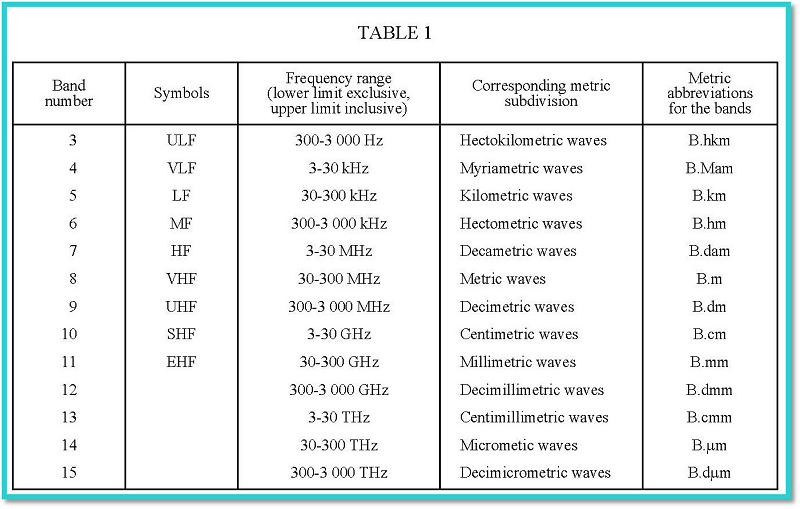
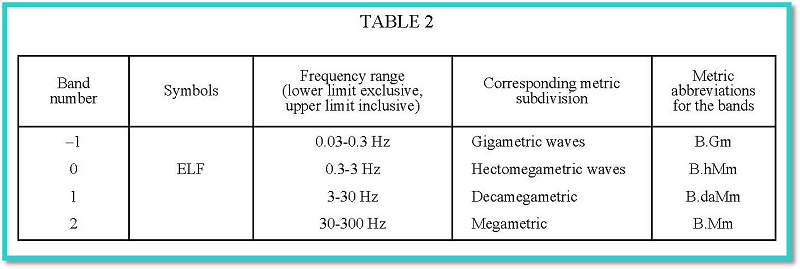
In the field of telecommunications, the nomenclature mentioned below is used to designate the frequencies.
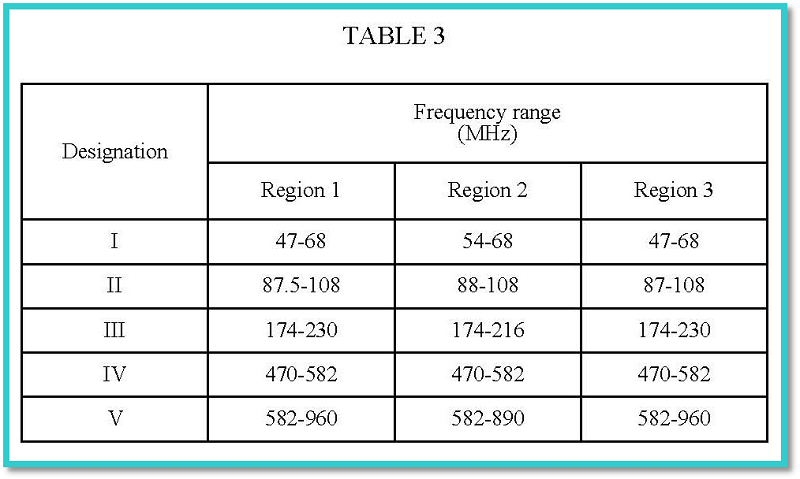
The graph below shows the radio frequencies used in TV stations & FM sound broadcasting. These frequencies are usually represented by the Roman numerals such as I to V. The ranges for the respective frequencies are illustrated by the graph. But there must be an important point to consider that these ranges are not exclusive to the broadcasting services.
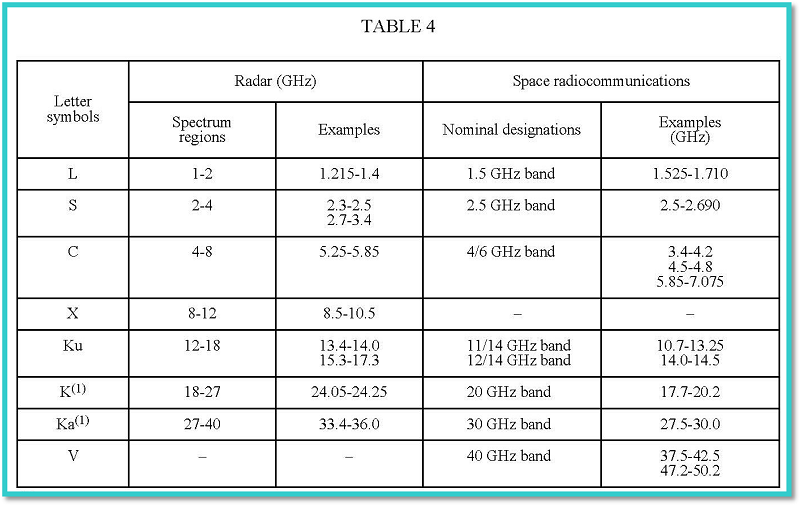
On the other hand, some frequencies are represented by letters other than symbols and abbreviations as we see in table-1 and table-2. Capital letters accompanied by an index which is usually a small letter make the symbol in the question. The letters and the frequency band concerned there is at present no standard correspondence between them. On the other hand, there are chances that the same number is being used to represent many different bands. However, to use these symbols in ITU publications is not advisable. In case we use a letter symbol to represent the band, we must refer to the corresponding band limits of the frequency, or at least a frequency in a band can also be used for the same purpose. The table below indicates the letter used in the field of radar and space communications, designated by some authorities to represent the information.
Objectives of ITU-R
· The main objective of the ITRU is to ensure that the radio communication systems are interference-free. Applying the regional agreements and the radio regulations we keep the systems interference-free. The timely update of the instruments and maintaining their efficiency also play an important role in this regard, it is done through the process of radio communication conferences at regional and world level.
· Recommendations are also established through radio standardization to ensure the quality and performance in operating these radio communication systems.
· For future expansion and modern technological developments, new ways and means are discovered to conserve spectrum and ensure flexibility.
· For space systems and earth stations, the detailed coordination and recording procedures are managed by the ITU-R. Multiple tasks such as examination of frequency assignments notices, processing and publishing data, are included in this management process.
· The mechanism for the development of new satellite services is provided by the ITU-R through locating suitable orbital slots so ITU-R manages space-related allotment plans and assignments. The launch of new satellites as quickly as possible is carried out through the recommendations of the ITU-R. So ITU-R helps in a safe way to the development and continuation of the satellite service.
· The frequency bandwidth which is a limited finite resource is also squeezed more by the ITU-R to fulfill their concern of taking high-speed satellites into service and registering new satellite network frequency assignments.
· So we can the ultimate goal of the ITU-R is to encourage communication between nations through a harmonious development of methods and tools for radio communications systems. Because it is a vital part of our daily life and everywhere at every moment people are communicating and trying to understand each other.
ALSO SEE:All Online Conversion Calculators by Richard


