
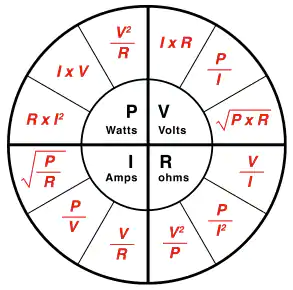
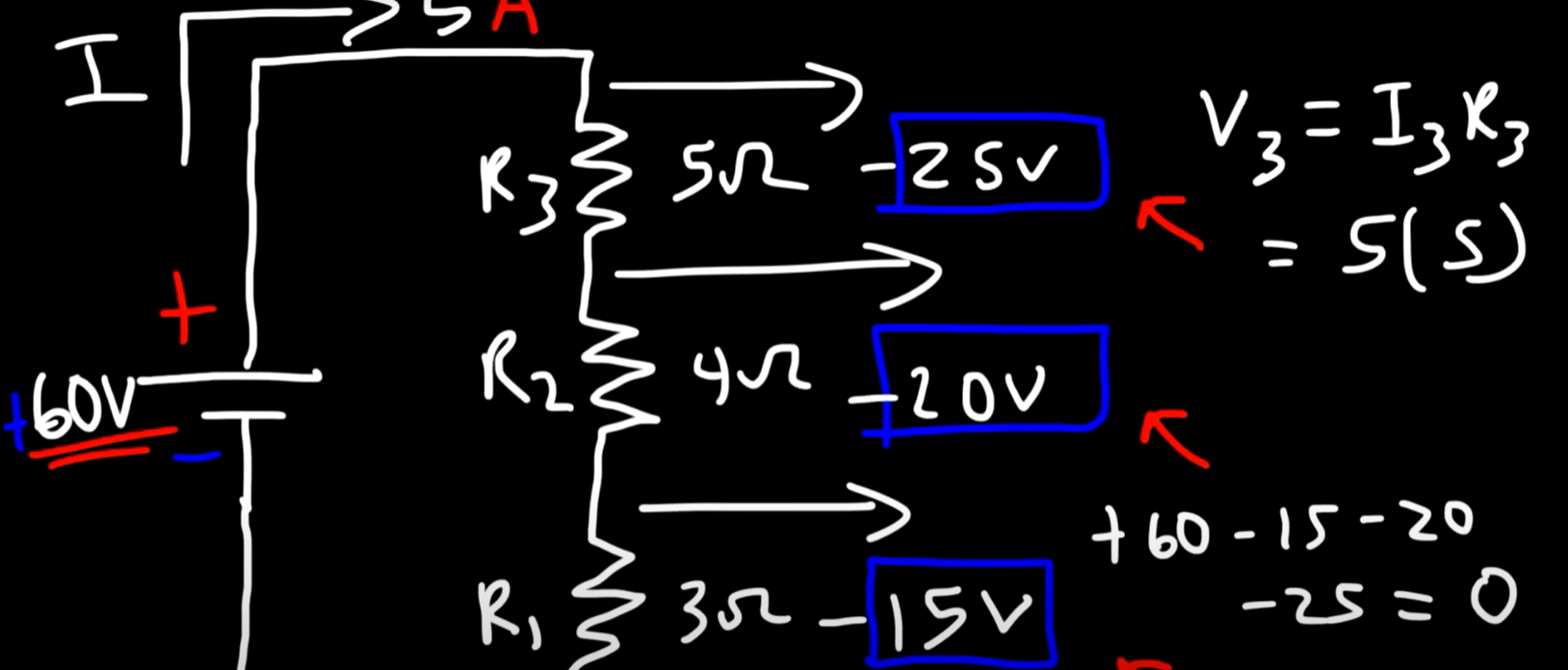
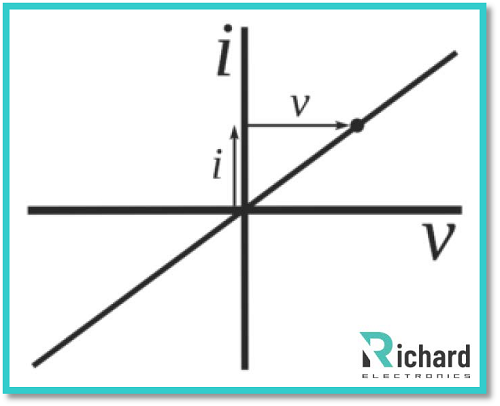
Resistance voltage and current are the basic components of electricity and Ohm’s law illustrates the simple relationship between these components. As shown by the graph below.
Equation of Ohm’s law:
As we know the principle behind the discovery of Ohms law is that voltage difference between two points is directly proportional to the amount of current flowing through these points at a given temperature. The simple equation that describes the relationship between resistance, current, and voltage used by Ohm to express his discovery is given:
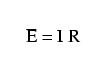
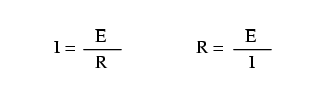
The voltage E is equal to the resistance R multiplied by the current I in the above-mentioned algebraic expression. Solving for I and R we can manipulate the equation into two variations mentioned below.
Analyzing Circuit with Ohm Law:
We can utilize the above given for the purpose of analyzing a simple circuit
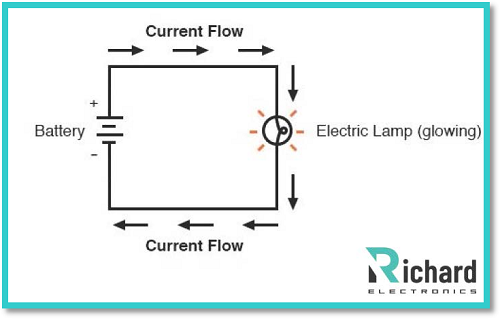
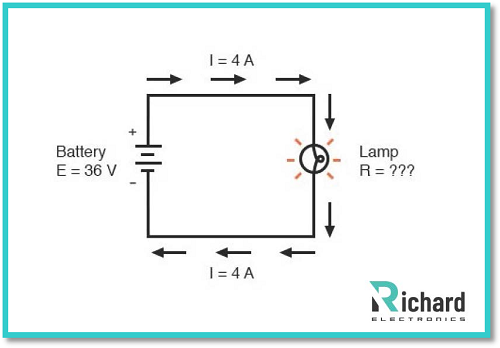
As shown in the figure above only one source of resistance to current is attached with only one source of voltage (battery). Applying Ohm law in this way can make it very easy to analyze the circuit. The third quantity can be determined by knowing the values of any two of the three quantities. Now we will try to find all the values one by one for resistance (R) voltage (V) and current (I).
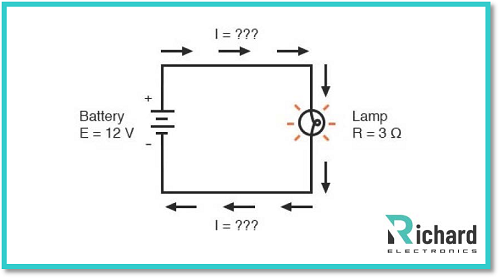
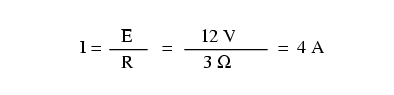
The value of the current will be voltage divided by the resistance.
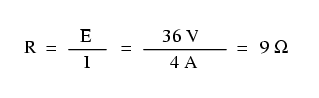
The second example illustrates the voltage divided by current and gives the value of the resistance as shown in the diagram below.
The value of resistance is given as
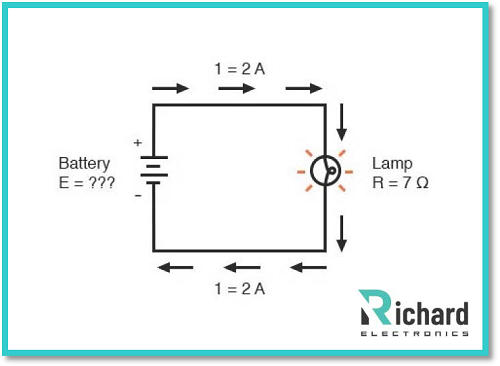
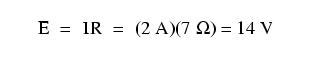
The last example illustrates the value of Voltage as a result of the multiplication of voltage with the current as shown below.
The value of the voltage difference between two points is given as
Triangle technique for Ohm’s Law:
For the purpose of analyzing a circuit Ohms law is a very useful tool. The serious student needs to be committed to the study of electricity and electronics and it is used so often. There is a trick to remembering for those who are not yet comfortable with algebra that helps us to solve for any one quantity given the other two values.
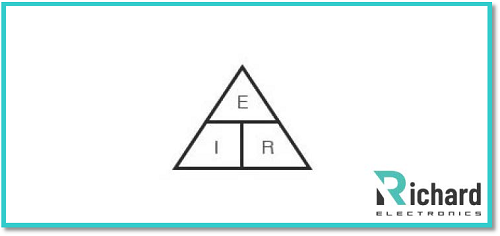
First, we have to arrange the letters voltage, current, and resistance in the form of a triangle as shown in the figure below.
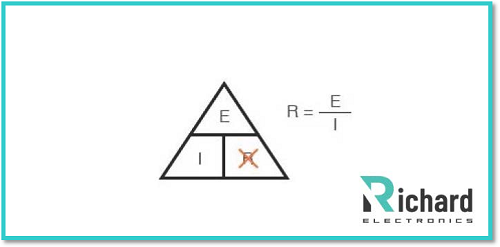
Now suppose we want to calculate R and we know the value of voltage and current you just need to eliminate the value of R from the triangle and we will get the following equation.
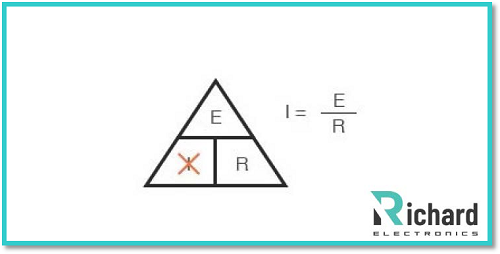
In the second case if we know the value of voltage and the resistance and we wish to calculate the value of current we will eliminate the current from the triangle and we will get the value of current as given below.
In the last case if we know the value of resistance R and the current I we can determine the value of the voltage E by the equation given below.
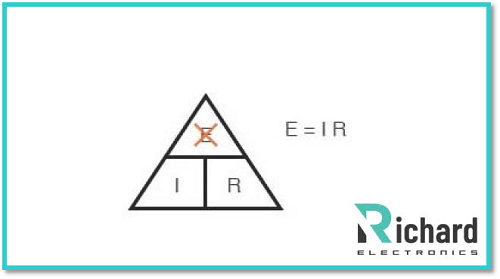
This technique makes it easier to remember the calculations but if you are comfortable with algebra all you need to remember is E=IR
Ohm’s law limitations:
· We cannot apply Ohm’s law in case of the unilateral networks because the current flows in one direction only in unilateral networks such as transistors or diodes.
· We also cannot implement this in the case of non-linear elements because the current in non-linear elements is not exactly proportional to the applied voltage. In this case, the voltage and current have different values of resistance.
Applications of Ohm’s law:
Ohm’s law provides us with several applications in our daily lives as well as in calculations involved in power. Between the components of electricity, the required voltage drop is maintained by Ohm’s law. In DC ammeters as well as in DC shunts Ohm’s law I used to give redirection to current. Here we will discuss the daily lie applications of Ohm’s law.
In fuses:
For protection purposes, we use fuses that limit the amount of current flowing through the circuit to establish a specific voltage amount. The amount of resistance required is determined through Ohm’s law.
Electronic devices:
Different types of electronic devices such as mobiles as well as laptop charges require a variable output voltage to supply power. Ohm’s law helps to control the overall function of mobile or laptop charges.
Electric Kettle:
Multiple resistors are present inside the electric kettle. The needed amount of heat is provided by controlling the current that runs through the resistor by setting a boundary line by them. We can also measure the size of resistors with the help of Ohm's law.
Domestic Fans:
The rotating speed of a domestic is controlled with the help of a regulator. By regulating the resistance we can control the current running through the fan. The resistance current can also be measured with the help of Ohm's law.
Conclusion:
So we can conclude that the running current between the two points of the conductor is known to be directly proportional to the voltage difference between its two points. The German physicist George Ohm discovered this phenomenon and the Ohm law is named after him. Utilizing Ohm's law to maintain the required voltage drop between different components of electricity, and simplifying the calculations involved in the power, in DC shunts and DC ammeters to give direction are some main applications of Ohm’s law.
The significance of Ohm’s law must be considered in describing electric circuits. This is due to the reason of resistance and voltage relationship where the value of voltage is controlled by the resistor. In our daily lives, we can apply Ohm law to numerous electronic devices such as domestic fans, mobile and laptop charges, and fuses.


