
What is RF?
On the other hand In the process of processing, to simplify a signal we use the Intermediate Frequency (IF) within the radio receivers. So for shorter distances, IF is more useful when communication is between the electronic devices of a system as compared to the Radiofrequency (RF) useful for long distances respectively.
Applications of Radio Frequency (RF) and intermediate frequency (IF):
Applications of RF:
The daily life applications related to the Radiofrequency (RF) are
· In communication devices, Radiofrequency is widely used, such as in transmitters, television computers, and mobile phones to play their vital role in wireless communication systems. In carrier current systems which also include telephony and control circuits Radio frequencies are applied.
· For over 125 years ago the application of radio frequencies (electromagnetic waves) has existed in the field of medicine. One of the most common examples of RF in the medical field is MRI referred to as Magnetic resonance imaging, in which human body images for diagnosis are generated by using radio frequency.
· The appliances advertised for weight loss and fat removal use RF energy to perform their functions. Although the possible effects of these frequencies on the human body especially for fat removal need further study and research.
Application of IF:
· Being a crucial concept in the field of communication and electronics the Intermediate plays a very important role especially in designing and operations of radar systems, radio, and television. In the operation of reception or transmission, the intermediate frequency plays a vital role as the frequency to which a carrier wave is shifted as an intermediate step.
· The Input RF signal is mixed down to IF in analog to digital converters (ADC) in a digital receiver because they operate at low sampling rates.
· Modern satellite television also uses IF frequency to transmit multiple television channel frequencies to subscribers.
RF to IF Conversion:
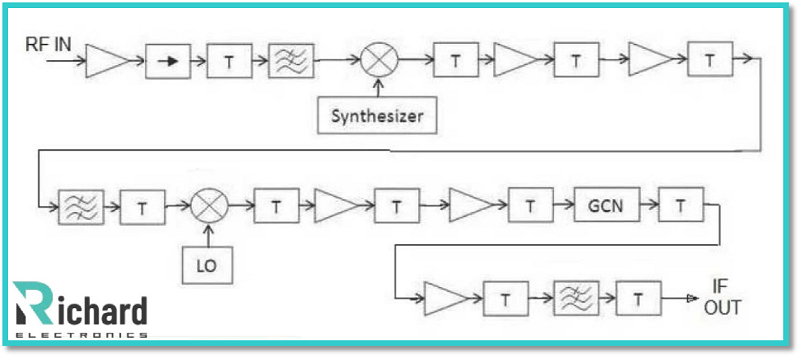
The process of down conversion is used to convert the RF signal to IF conversion by mixing the incoming RF signal with a local oscillator (LO). Then unwanted frequencies are rejected and the desired signal is enhanced by processing through filters and amplifiers. At last, the original data or audio signal is recovered by the demodulating of the IF signal. The diagram below illustrates the complete process involved in the conversion of RF into IF signal.
IF to RF Conversion:
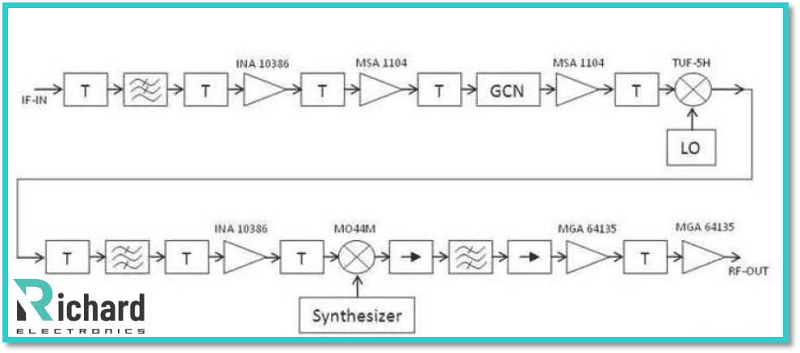
The process of upconversion is used to convert the IF signal to an RF signal by mixing the incoming IF signal with a local oscillator (LO). Then unwanted frequencies are rejected and the desired signal is enhanced by processing through filters and amplifiers. And finally before transmission into the air by using an RF antenna the amplified RF signal is passed through a power amplifier.
Key Differences between Radio Frequency (RF) & Intermediate Frequency (IF):
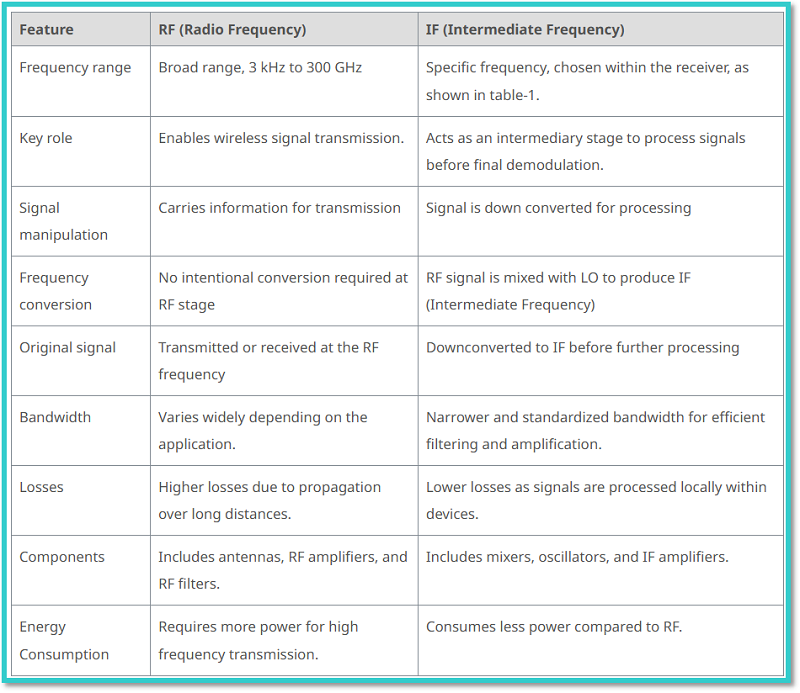
The table below illustrates the key differences between the RF and IF
What is RFID?
A new cutting-edge technology RFID referred to as radio frequency identification is basically identifying objects and at the same time monitoring them by harnessing the radio waves without any kind of physical contact. This technology is based on three main components known as RFID tags, RFID readers, and A backend system that serves the purpose of storing data, wireless communication, and managing collected information respectively.
How does Radio Frequency Identification work?
The mechanism of RFID is illustrated below here we will explain the working of RFID step by step
· In the first step RFID tag is assigned to an object that contains a unique identification number
· Then the RFID tags are placed over the object usually these objects are in the form of a product for example clothes in a store have these tags on them.
· Then the Reader for RFID is installed to read the RFID tags at various locations. Mostly at the entry or exit points.
· The reader's radio waves energize the tag antenna whenever it comes in the range of the RFID reader known as tag activation.
· The data stored in the tags microchips is transmitted by the tags as a response to the reader.
· The UID and other related info is captured by the RFID reader whenever the tags come in contact with the reader and it captures the tag’s response.
· The data captured by the reader is sent to a backend system that is associated with the management software. This system processes the data and shows the relevant information about the product or the object.
Applications of the RFID:
In supply chain tracking, RFID technology is used to trace the availability of products and manage products on a large scale. The RFID placed on each product makes it easy to identify the relevant information related to the product
The assets in a business can be managed and tracked efficiently with the help of RFID technology. These tags can be attached to all types of assets such as tools, vehicles, and sites making monitoring possible efficiently.
In security and access control, the RFID system also plays a vital role in secure and efficient entry management. Only authorized individuals can have access to the place by providing them with key fobs containing the RFID tags. This helps to secure a restricted area.
In health care and management of patients, RFID is used on a larger scale. With the help of we can track and monitor patient’s health more efficiently.
Live stock industry use RFID at larger scale to idendify the livestock and managing the daily tasks related to the livestock management. Through RFID the record of breading, feed and disease control can be monitored more efficeinty.
Library management systems where thousands of books are involved utlize the RDIF technology in modern libraries for tracking the respective books.
- 1.
What are the main applications of Radio Frequency (RF)?
RF is widely used in communication devices like transmitters, TVs, computers, and mobile phones for wireless communication. It's also used in carrier current systems, in medicine for MRI, and in some weight - loss appliances.
- 2.
How does the RFID technology work?
First, an RFID tag with a unique ID is assigned to an object. Then, RFID readers are installed at various locations. When the tag comes within the reader's range, the reader's radio waves activate the tag. The tag then transmits its data, which is captured by the reader and sent to a backend system for processing.
 Paul George
Richard Electronics guest author, a Mechatronics engineer and a professional researcher, designer, developer and manufacturer for 3d Cad and PCB. I believe in efficiency, effectiveness and quality of work, and my aim is to provide complete one-roof solutions to complex mechanical and electrical design systems. I have a well-equipped lab with state-of-the-art technology for doing research and providing.

04 July 2026
06 June 2026
07 May 2026
17 April 2026
02 April 2026