
Resistor Color Code | Calculation Resistance From Color Bands
For a 4-band 10k resistor, the colors are Brown, Black, Orange, and Gold. Each band shows a number or a multiplier. This makes it simple to figure out the value.
Learning the resistor color code is very useful. It helps when building or fixing circuits. It saves time and avoids mistakes when picking parts. If you love electronics, learning this skill will improve your projects and repairs.
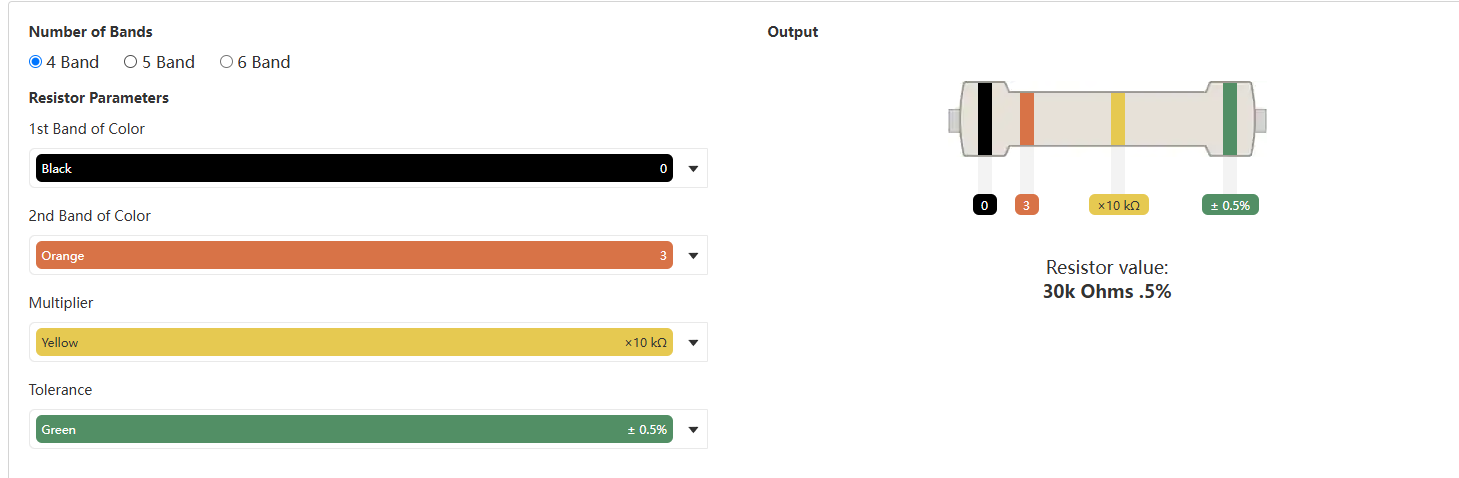
Try our Resistor Color Code Calculator (click to decode color bands instantly)
Key Takeaways
A 10k resistor has a resistance of 10,000 ohms. It helps control the flow of electricity in circuits.
To read a 4-band 10k resistor, look at the colors: Brown (1), Black (0), Orange (×1,000), and Gold (±5% tolerance).
If the color bands are hard to see, use a multimeter. This tool helps you check the resistor's value correctly.
Keep resistors in labeled boxes by their values. This makes it easier to find the right one and avoid errors.
Practice reading resistor color codes often. It will make your electronics projects better and boost your confidence.
What is a 10k Resistor?
What does a 10k resistor do?
A 10k resistor is a small part in electronics. It has a resistance of 10,000 ohms. It slows down electrical current in circuits. This keeps parts safe and working well. The "10k" means its resistance is 10,000 ohms. It is popular because it works well and is dependable.
Here are some details about a 10k resistor:
Feature | Details |
|---|---|
Resistance Value | 10,000 ohms (10k) |
Power Ratings | 1/8 Watt, 1/4 Watt, 1/2 Watt |
Tolerance | ±1%, ±5% |
Temperature Stability | Smaller values mean more stable |
Identification | Color bands: brown, black, orange, gold; or '10K' |
The 10k resistor helps control current and voltage in circuits. Its accuracy and stability make it great for beginners and experts.
Where is a 10k resistor used?
The 10k resistor is found in many circuits. It has many uses. Here are some examples:
Current Limiting: It slows current to protect delicate parts.
Biasing: It helps transistors work properly for better amplification.
Filtering: In RC circuits, it affects time and frequency. This is useful in audio filters.
The 10k resistor is very important in electronics. It helps with voltage dividers and circuit stability. It ensures everything works well.
How to Read the 10k Resistor Color Code
Overview of the resistor color code system
The resistor color code is a global way to find resistor values. It uses colored bands on the resistor to show numbers, multipliers, and tolerances. This system helps you quickly know the resistance without extra tools.
Here are some important facts about the resistor color code:
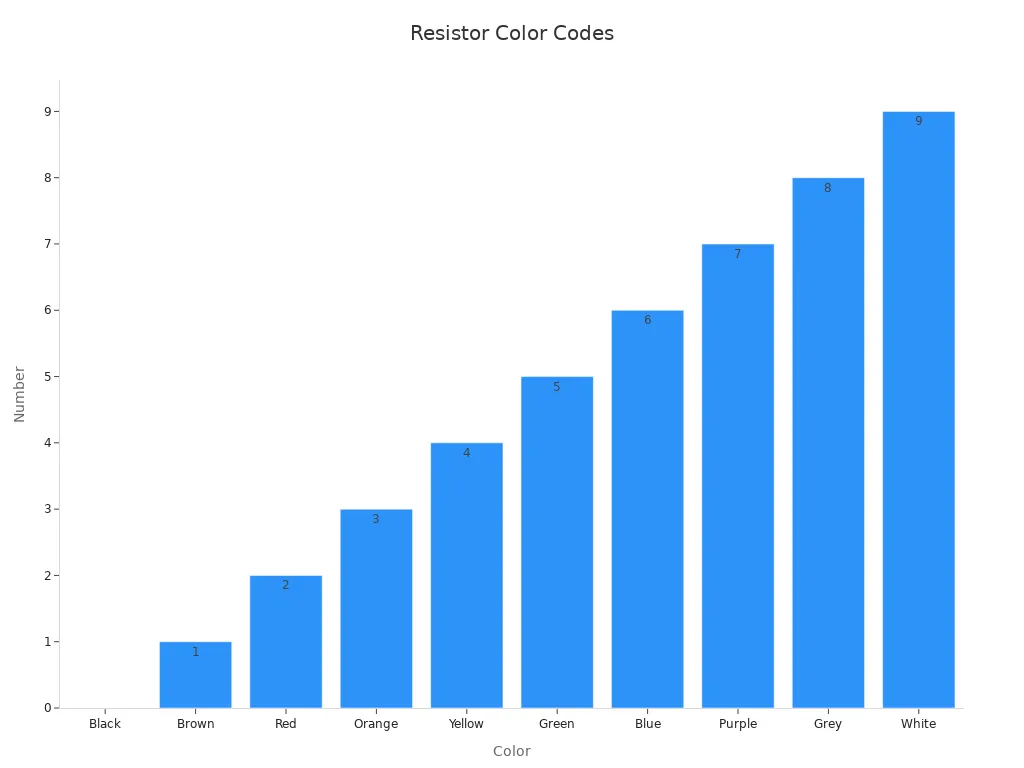
Each color stands for a number. For example, Black is 0, Brown is 1, and Orange is 3.
The first two bands show the main digits of the resistance.
The third band tells the multiplier, or how many zeros to add.
The fourth band shows tolerance, or how much the value can differ.
You can use tricks like "Bad Boys Order Gold" to remember the colors. Practice often to learn the system and identify resistors faster.
Color | Number |
|---|---|
Black | 0 |
Brown | 1 |
Red | 2 |
Orange | 3 |
Yellow | 4 |
Green | 5 |
Blue | 6 |
Purple | 7 |
Grey | 8 |
White | 9 |
Decoding a 4-band 10k resistor color code
To read a 4-band 10k resistor, follow these steps. For a 10k resistor, the colors are Brown, Black, Orange, and Gold.
The first band (Brown) is the first digit, which is 1.
The second band (Black) is the second digit, which is 0.
The third band (Orange) is the multiplier, meaning ×1,000.
The fourth band (Gold) shows a tolerance of ±5%.
This means the resistor's value is 10,000 ohms, or 10k ohms, with a 5% tolerance. If the bands are hard to see, use a multimeter to check the value.
Band Color | Value |
|---|---|
Brown | 1 (first digit) |
Black | 0 (second digit) |
Orange | 10^3 (multiplier) |
Gold | ±5% (tolerance) |
Understanding 5-band and 6-band resistor color codes for 10k resistors
5-band and 6-band resistors are more accurate than 4-band ones. These are used when high precision is needed.
5-band resistors: The first three bands are the main digits, the fourth band is the multiplier, and the fifth band shows tolerance. For a 10k resistor, the colors could be Brown, Black, Black, Red, and Gold.
6-band resistors: These have one extra band for temperature coefficient. This shows how resistance changes with heat. For a 10k resistor, the colors might be Brown, Black, Black, Red, Gold, and Brown.
By learning these types, you can pick resistors with better accuracy for advanced circuits.
Examples of 10k resistor color codes in different formats
When using resistors, you might see 10k resistors in different styles. Each style has a unique color code to show its resistance. Let’s look at some examples to make them easier to recognize.
1. 4-Band 10k Resistor
The 4-band resistor is the most popular type. Its color code for 10k ohms is:
Brown (1)
Black (0)
Orange (×1,000 multiplier)
Gold (±5% tolerance)
This means the resistor’s value is 10,000 ohms with a 5% tolerance. You’ll find this type often in simple circuits.
2. 5-Band 10k Resistor
The 5-band resistor is more precise. Its color code for 10k ohms could be:
Brown (1)
Black (0)
Black (0)
Red (×100 multiplier)
Gold (±5% tolerance)
Here, the first three bands are the digits, and the fourth is the multiplier. This type is used in circuits needing better accuracy.
3. 6-Band 10k Resistor
The 6-band resistor has an extra band for temperature changes. For a 10k ohm resistor, the colors might be:
Brown (1)
Black (0)
Black (0)
Red (×100 multiplier)
Gold (±5% tolerance)
Brown (100 ppm/°C temperature coefficient)
This type works well where heat can change resistance.
Tip: If the color bands are unclear, use a multimeter to check the resistance. This helps when the colors are faded or hard to see.
Quick Comparison Table
Here’s a simple chart of the color codes for 10k resistors:
Format | Color Bands | Notes |
|---|---|---|
4-Band | Brown, Black, Orange, Gold | Standard tolerance (±5%) |
5-Band | Brown, Black, Black, Red, Gold | Higher precision |
6-Band | Brown, Black, Black, Red, Gold, Brown | Includes temperature coefficient |
By learning these examples, you can easily spot 10k resistors in any style. Practice reading the codes to get better at it.
Tips for Finding a 10k Resistor
Spotting a 10k resistor in a group
To find a 10k resistor, check the color bands. For a 4-band resistor, look for brown, black, orange, and gold. These colors mean 10,000 ohms with ±5% tolerance. A 5-band resistor may have an extra black band. A 6-band resistor adds a band for temperature changes.
Use good lighting to see the colors clearly. If the bands are hard to read, use a color code chart. This helps confirm the value before testing it.
Checking resistance with a multimeter
A multimeter is great for checking resistor values. Set it to the resistance mode (Ω symbol). Touch the probes to both ends of the resistor. The reading should be close to 10,000 ohms for a 10k resistor.
Multimeters can have small errors. Most are accurate within ±(0.5% +1 digit). This means the reading might not be exact. Accurate checks are important for devices like medical tools or airplanes, where mistakes can be serious.
Storing resistors for easy use
Keeping resistors organized makes them easier to find. Use boxes or compartments labeled by value. For example, put all 10k resistors in one spot. Write the value and tolerance on each label.
You can also use tape strips or cards to sort them. This works well for small collections. Organizing saves time and prevents using the wrong resistor in your projects.
Applications of a 10k Resistor
Using a 10k resistor in voltage dividers
A 10k resistor is important in voltage dividers. These circuits lower voltage to safe levels. They are used to protect parts that need less voltage. The 10k resistor, with another resistor, sets the output voltage.
For example, if the input voltage (Vin) is 10 volts, two resistors (R1 and R2) decide the output voltage (Vout). The table below shows how resistor values change Vout:
Vin (V) | R1 (Ω) | R2 (Ω) | Vout (V) |
|---|---|---|---|
10 | 10k | 10k | 5 |
10 | 10k | 100k | 9 |
10 | 10k | 1k | 0.91 |
This shows how a 10k resistor helps control voltage in circuits.
Role of a 10k resistor as a current limiter
A 10k resistor limits current to protect parts like LEDs. It controls the flow of electricity to keep parts safe. For example, in an LED circuit, it stops too much current from damaging the LED. This is helpful in battery-powered devices to save energy.
Using a 10k resistor this way also makes parts last longer. It’s a simple way to keep circuits working well and reliably.
Importance of a 10k resistor in digital logic circuits
In digital circuits, a 10k resistor keeps things stable. It is often used as a pull-up or pull-down resistor. This sets a default voltage for input pins. Without it, the circuit might act unpredictably.
For example, a pull-up 10k resistor keeps an input pin at high voltage when no signal is there. This stops false signals and ensures proper operation. Its accuracy makes it great for digital circuits.
Tip: Combine 10k resistors with others to create different resistance levels. This helps design accurate and efficient circuits.
Knowing the 10k resistor color code is very helpful. It helps you find resistor values fast and avoid mistakes. This skill makes designing and fixing circuits easier and better.
Learning resistor color codes makes your work simpler and builds confidence.
Practice reading the color bands often. Soon, you’ll recognize resistors easily. This will make your projects faster and more fun. Begin now, and improve your electronics skills quickly!
References
Wikipedia. (2026). "Electronic color code."
Electronics Hub. (2023). "Resistor Color Code Calculator and Chart."
Fluke Corporation. (2022). "Understanding Resistor Color Codes."
IEEE Spectrum. (2023). "The Basics of Electronic Components: Resistors."
National Institute of Standards and Technology. (2021). "Standard Resistor Values and Color Codes."
Sparkfun Electronics. (2024). "Resistors: A Complete Guide to Resistance."
Texas Instruments. (2023). "Electronics Engineering: Understanding Passive Components."
University of Cambridge Engineering Department. (2022). "Electronic Components and Systems: Resistors and Color Coding."
- 1.
What does the resistor color code do?
The color code helps you find a resistor's value fast. It uses colored bands to show numbers, multipliers, and tolerances. This way, you don’t need extra tools to check resistance.
- 2.
How do you check a resistor's value if colors are hard to see?
Use a multimeter to measure the resistance. Switch it to resistance mode. Touch the probes to the resistor's ends. The screen will show the resistor's value.
- 3.
Why is the 10k resistor used so often?
The 10k resistor is useful and dependable. It works in voltage dividers, current limiters, and digital circuits. Its mix of resistance and accuracy makes it a favorite for projects.
- 4.
Can a 10k resistor replace another resistor?
You can use a 10k resistor if small changes in resistance are okay. Always check the circuit’s needs to avoid problems or damage.
- 5.
How can you keep resistors organized?
Sort resistors into labeled boxes or compartments. Group them by value and tolerance. This makes finding the right resistor quick and easy.
View More
 Paul George
Richard Electronics guest author, a Mechatronics engineer and a professional researcher, designer, developer and manufacturer for 3d Cad and PCB. I believe in efficiency, effectiveness and quality of work, and my aim is to provide complete one-roof solutions to complex mechanical and electrical design systems. I have a well-equipped lab with state-of-the-art technology for doing research and providing.


07 May 2026
17 April 2026

02 April 2026

02 April 2026

19 January 2026