


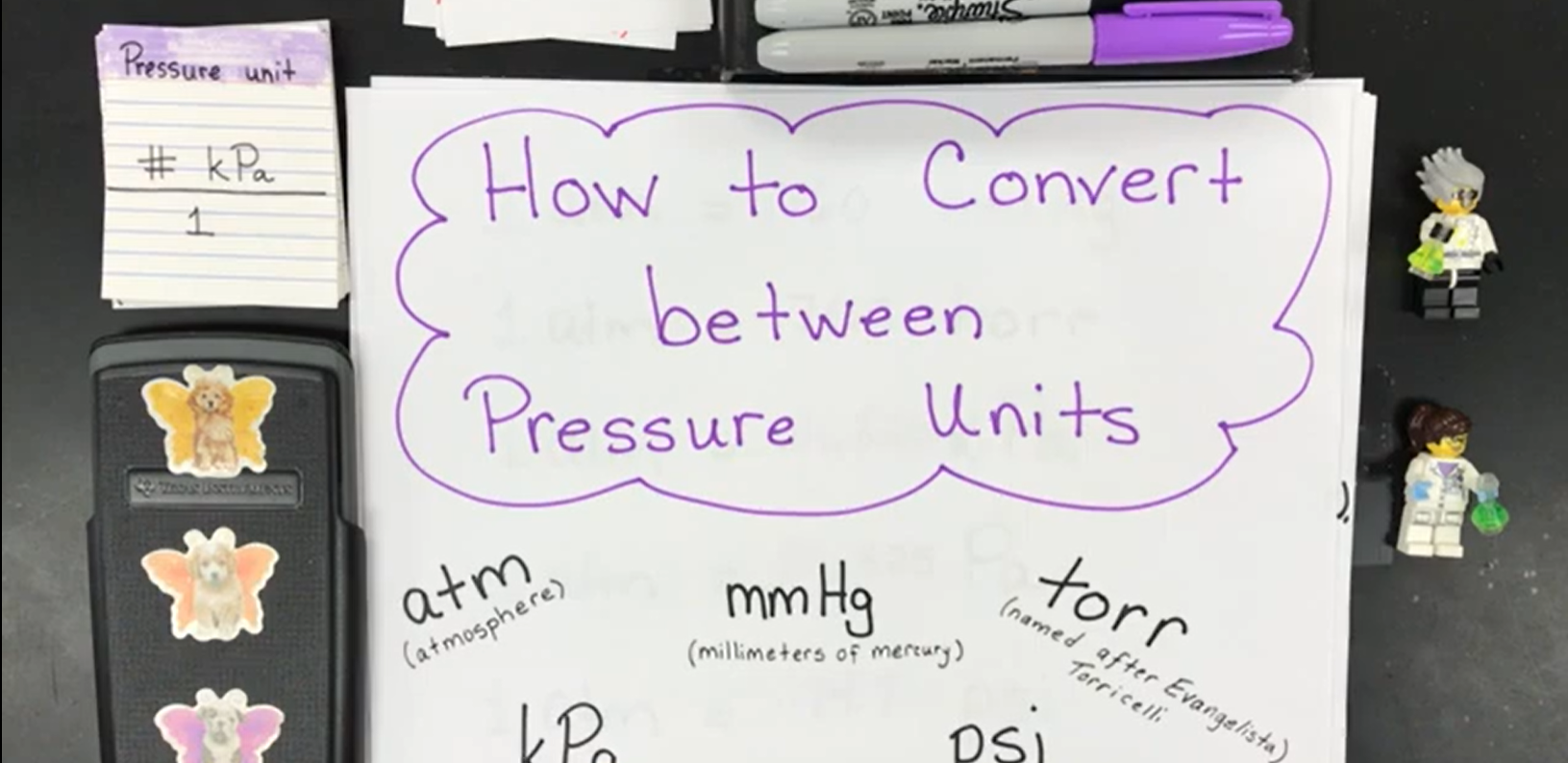
There are different units of pressure around the globe used as per the application and field.
Types of Pressure Units:
The most commonly used units for measuring the pressure are discussed in detail below,
(I). Pascal:
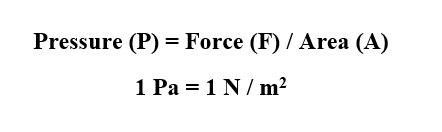
In the International system of units also referred to as SI system Pascal (Pa) is the unit of pressure named after Blaise Pascal who was a scientist and mathematician. And SI in 1971 accepted it as a standard unit for measuring pressure. It is defined as if at the area of 1 square meter we apply the force of 1 newton (N) the pressure on the surface will be one Pascal. The tectonic stress in the earth’s plate is also measured in the Pascal so it is also used to measure stress. But the unit is too small to properly represent the stress or pressure for most engineering problems, that’s why Pascal is expressed with prefixes such as kilopascal (kPa)
For ventilation systems where ultralow gas pressure applications are involved, we use the Pascal because here pressure differences need to be measured. Pascal with prefixes is used for measuring the midrange pressures. The hector Pascal units are used by the meteorologists to measure the air pressure. Mathematically Pascal is represented as :
(II). Atmospheric Pressure (atm):
Whether you are aware of it or not every day atmospheric pressure affects every day. The atmospheric pressure affects the weather patterns and forecasts around the globe. To measure the atmospheric pressure we must understand the basics of it. At any given point of the earth, the force exerted on it by the weight of the air above is referred to as the atmospheric pressure. So in other words the collective weight of air molecules that surround the earth exerts atmospheric pressure. As we move above we experience low pressure because of fewer molecules pressing the earth. On the other hand, more force will be exerted by the lower molecules. Hence the air will be thinner and pressure will be lower when we go up into the mountains and fly high in an airplane. So at the sea level, the pressure exerted by the air at a temperature of 59°F (15°C) is equal to one atmosphere (atm). As the atmospheric pressure is measured with the help of a barometer the atmospheric pressure is also known as barometric pressure. The rising and falling barometer determines the increasing and decreasing atmospheric pressure respectively.
(III). Pounds per square inch (PSI):
A widely used unit in America and Britain is pounds or pound-force per square inch. In the USA almost all the pressure instruments are specified and the display is pounds per square inch so PSI is a primary unit of measurement for pressure in the USA. In the case of the UK, the bar pressure unit has replaced the PSI mostly as the primary unit but PSI is still used extensively. Many different pressure-measuring applications commonly use PSI as a unit of pressure and are typically used for non-SI industrial applications such as fuel storage & distribution, test and measurement activities, wastewater management, and tire pressure.
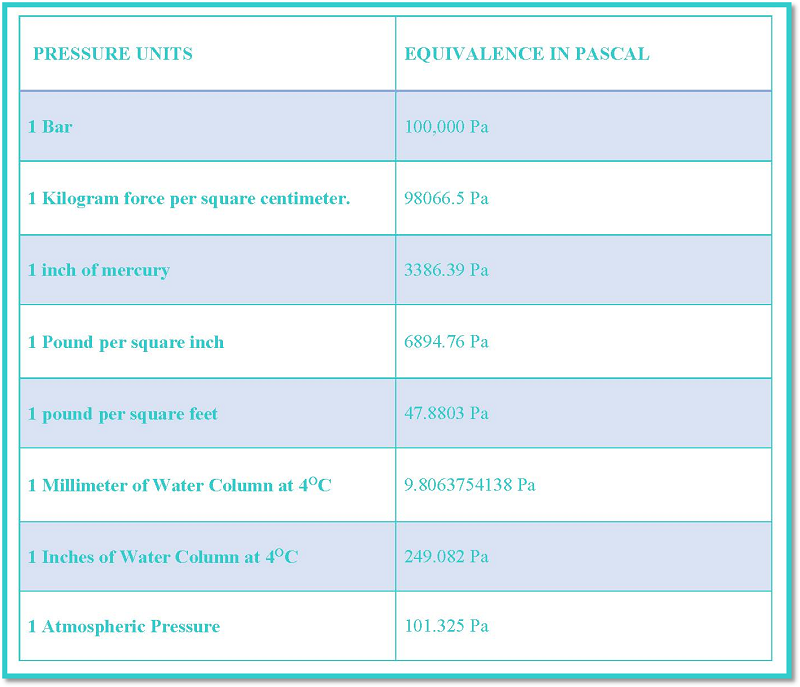
A table is given below that illustrates the different pressure units and their equivalence in Pascal,
Applications of Pressure in Real Life:
There are multiple applications of pressure in our daily lives some of them given below,
(I). Tire pressure:
Tire life, and fuel consumption, end upon the correct tire pressure of the vehicle. The best grip, car management, and moving stability are determined by the right tire pressure. Higher blowout risk and reduction of gas mileage and tire could occur due to low tire pressure.
(II). Measurement of Blood Pressure:
The force exerted onto the walls of blood vessels by the circulating blood is known as blood vessels and it's a very important factor in our body. To detect the condition or diseases associated with the cardiovascular system one needs to measure the blood pressure. By measuring the systolic and diastolic pressure collectively called blood pressure measurement.
(III). Scuba Divers:
To properly swim up and down in the water the scuba divers use a pressure formula to calculate the hydrostatic pressure that helps them to swim properly. A prescription of pressure is required for scuba divers so they can dive comfortably and safely and avoid the bends also known as decompression sickness.
(IV). Pressure Cookers:
To expedite cooking pressure cookers are used because of their ability to form pressure inside them. A rise of internal pressure occur by maintaining the steam inside a sealed pot, the rise of internal pressure is caused by the steam that results in a higher boiling point of the water.
(V) Fire Extinguishers:
Pressure to control or extinguish fire accurately is the operational principle used by fire extinguishers. These are filled with pressurized extinguishing agents such as foam, water, and carbon dioxide. The pressurized agent is released when the handle is pressed by someone and sprayed out of the nozzle to snuff out the flames.
(VI) Hydraulic System:
The pressure in hydraulic systems is generated through the motion to control movements in different applications by transferring power such as in the brakes of cars, large machines, or controls of the aircraft. In sealed cylinder or pipe form is used to carry fluid oil inside them. The pressure is generated and then transferred to the other parts of the fluid when force is applied at the one location of the system that makes other elements work. High power density, smooth operation, and precision of control are the main features of hydraulic systems that play vital roles in many domestic, commercial, and industrial applications.


