Let's explain this phenomenon by a simple example of a glass placed in a specific volume in a container. The gas molecules will randomly move in all directions at room temperature and collide with the walls of the container as well as with each other.
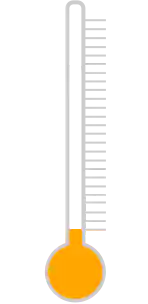
The gas molecules will be fast and they will move randomly when we place a heat source in the container showing an increase in the kinetic energy of the molecules. At this point, each molecule may contain different kinetic energy. The molecules with lower kinetic energy can get more kinetic energy after collision transferred by the higher kinetic energy molecules after the collision and the average kinetic energy of all the molecules at this point is known as the temperature. Thermometers are typically used to measure the temperature. Thermometers can be of various types depending on the type of application and have different physical properties that can be changed with temperature changes. For example in alcohol and mercury thermometers when the temperature increases the volume of these substances also increases. When the temperature increases the quick expansion of alcohol is due to the high coefficient of thermal volume expansion and it will contract when the temperature decreases.
The degrees Celsius oC, degrees Fahrenheit oF, and Kelvin K are the most commonly used scales to measure the temperature, now we will explain all the temperature units in the next section.
Temperature Units:
(I). The Celsius Scale oC:
In the metric system of measurement, we use the Celsius scale which is named after Anders Celsius who was an astronomer. 0 oC is freezing and 100 oC is the boiling point for water at the Celsius scale. The distance between the freezing and boiling point of water is divided into 100 equal parts where one part is known as one degree. Centigrade is another term sometimes used for the Celsius scale. Because on this scale there are 100 degrees between the freezing and boiling points. However, Celsius is the most comply used and preferred term.
(II). The Fahrenheit Scale oF:
As we discussed above a thermometer carrying alcohol expanded and contracted as the temperature rose or fell respectively. The first thermometer was based on the same principle, in the US System of measurement the Fahrenheit scale was developed by Daniel Gabriel Fahrenheit who was a German scientist in 1724 and mercury was the main component in his thermometer tube. He defined the freezing point for water 32oF and the boiling point as 212 oF which shows an arbitrary definition of temperature. But for scientific purposes, we typically do not use the Fahrenheit scale.
(III). The Kelvin Scale K:
Named after the Scottish mathematician and physicist Lord Kelvin the Kelvin scale is used in the SI system of measurements. With the temperature of 0 K, it is based on molecular motion which is known as absolute zero and it’s the temperature at which all types of molecular motion cases. The boiling point on the Kalvin scale is labeled as 373.15 K and the freezing point of water is 273.15 K respectively. In Kelvin temperature designation as we observe unlike Fahrenheit or Celsius no degree is used as they are simply designated as the kelvins.
(IV) Rankine oR:
This scale was presented by a Scottish William Rankine abbreviated as oR or oRa in 1859 a few years after the Kelvin scale in 1859. Similarly in the Rankine scale, the reference point is the absolute zero point 0 oR. One degree value in the Rankine scale is similar to the size of one Fahrenheit degree but as mentioned above the reference point or the zero point is different. In the Rankine scale, the freezing point of water is 491.67 oR. The NIST does not recommend the Rankine scale and it's only used in some fields of technology in the United States of America.
Conversion of Different Temperature Scales:
The equations containing both an equal sign and variables are used to convert temperatures into different scales. Here we will discuss in detail how we can convert different units into each other and their equations. Using appropriate and defined variables is important when performing temperature conversions. For the primary variable, we consider the quantity that we are going to measure and we use the subscript letter for the information or qualifier associated with the primary variable. For example, if are measuring the temperature in degrees Celsius we will write TC here the capital T represents the temperature. As the lowercase t represents the time we prefer not to write the lowercase t. Similarly, capital C represents the heat capacity and we do not prefer the temperature at all.
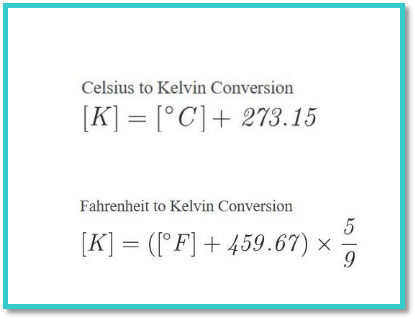
As we know the value of one degree is similar on the Celsius scale and the Kelvin scale the measurement can be converted using a simple equation as given below with the equation used to convert Fahrenheit into Kelvin.
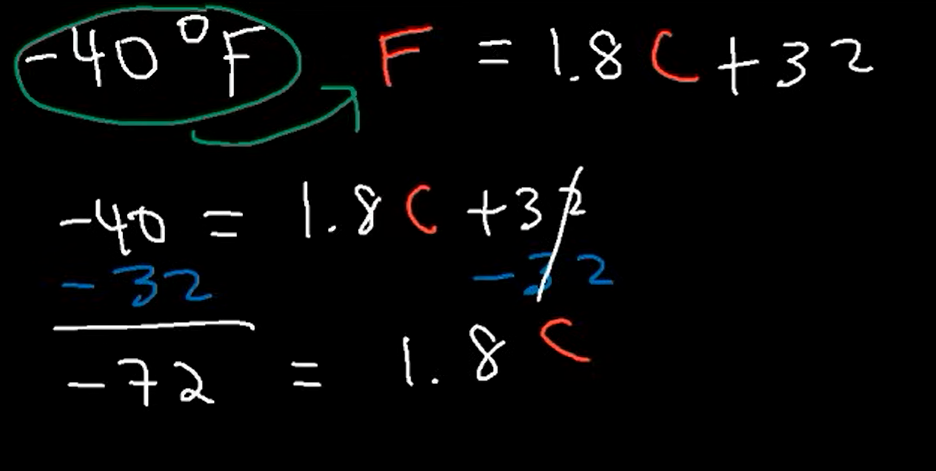
For Converting the Fahrenheit scale into Celsius we know that the English tradition of using 12 divisions is involved just as 1 foot is divided into 12 inches. The following equations below are used to convert Celsius into Fahrenheit and Fahrenheit into Celsius.
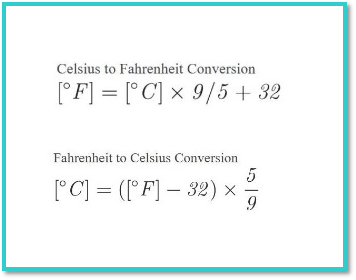
The significance of the final answer is not affected by the 1.8 or the 32 because these are exact numbers. The division or multiplication rules, as well as addition and subtraction rules, must be applied since multiple mathematical operations are involved in these equations in order to get a scientifically accurate answer as the final result. The given values which a numbers with units replace the relevant variable while using these equations.
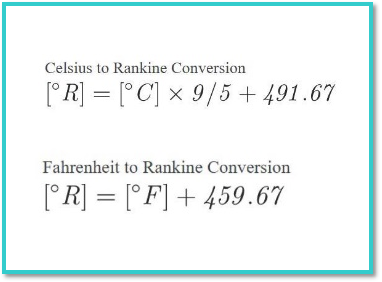
To convert the Rankine scale into degrees Celsius or Fahrenheit we use the flowing equations given below as we mentioned these equations are rarely used because Rankine is only used in the United States of America for research purposes.