
Many factors are involved in choosing the proper size of cables and wires for our electrical system. So the first key step while working on a circuit is to find the wire gauge and amperage. When the electrical appliance connected to a cable is trying to draw more power than the rated value safety risks come into play. These are the most common causes of domestic electrical fires.

Wire Gauges:
As we know the wires have different thicknesses (i.e. gauges) in sizes as per their applications. In our article, we will discuss the wire gauges in detail and their importance as well as the key considerations involved in the process of selecting the suitable wire gauge for domestic and industrial use. So simply the thickness of the wire is its gauge value. Each value of the gauge is assigned a smaller and higher number illustrating the thicker and thinner wires respectively. The standard method for this purpose is AWG known as American Wire Gauge to measure the thickness of wires. This AWG method was developed in the USA to identify the thickness of electrical wires. The electrical properties of a wire such as load carrying capacity or its resistance are affected by the wire’s thickness. Whether a wire is suitable for a specific application, knowing the gauge enables the industrial professional to select the appropriate wire in this process.
Being an important design consideration the gauge plays a vital role in selecting an electrically conductive wire. On the other hand, a variety of factors are involved in the right gauge such as thicker wires are required for the electrical circuits with the higher ampere ratings, and using thin wires for the respective electrical circuits can result in ignition or wire failure.
Wire Gauge and Other Wire Parameters
· The diameter of the cable is directly connected with the number of wire gauges as we know wire gauge numbers range from lower to higher values so the value of the wire gauge shows a larger diameter and the lower value illustrates a smaller diameter. Every time the gauge decreases by six levels the diameter becomes double.
· By using the formula A= πr2 we can calculate the cross-sectional area here r represents the radius of the wire which is r=d/2, so every time it descends three levels the cross-sectional area of the wire doubles every time.
· The number of feet of wire required to reach the weight of one pound is called feet per pound.
· The length and thickness of the wire decide the value of the resistance of a wire. The shorter length of the wire provides a low value of resistance. If we are given two wires of the same length the wire that has more thickness will have a greater value of the resistance.
· The current capacity of wires is the value of current (Amps) that a wire can carry when provided with the electrical power. So the thicker the wire will be the higher the capacity of the wire to carry the current.
Importance of Wire Gauge:
As we already discussed when appliances try to draw more power on a circuit than the rated gauge value of the wire. So selecting a suitable gauge size is important for household and industrial applications such as for lamps and cahrgers the 15 amps or 16 amps value of gauge is enough but in the case of a heater higher value is required. Although some protection is offered by the fuses in wiring and circuit breakers, earth leakage breakers and earth leakage relays an electrical appliance or equipment should not completely rely on these switchgear devices for protection, the correct wire gauge value plays more vital role in the protection of the appliance or electrical system. At the same time plugging too many devices in a single circuit must be avoided as much as possible.
Using a Wire Gauge Chart:
With the help of a gauge chart, professionals can determine the current carrying capacity, diameter, or gauge value of the required wire for the electrical appliance or system. Different types of numbers can be observed printed on wires that we see while purchasing, American Wire Gauge known as AWG followed by a number can determine the AWG value of the wire. On the other hand number of strands is determined by the number after the AWG value of the wire. The value of current carrying capacity can also be determined by the wire gauge charts, mostly the ampacity of Al or Cu wires is provided by the wire gauge charts as shown in the wire gauge chart below.
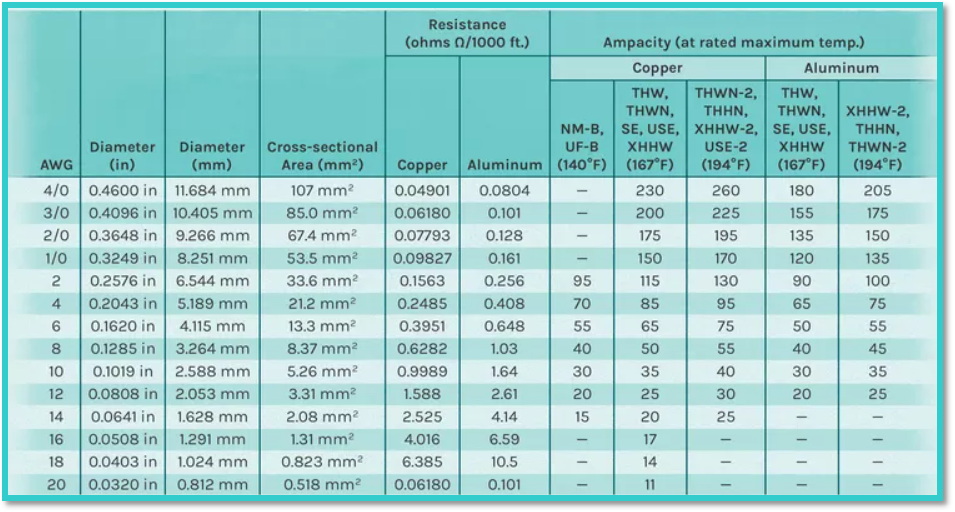
While shopping for the electrical wires, we observe that there exist a number of different sizes and types of electrical wires that we can choose for our required electrical system. For different uses of wire, different kinds of wires are available, but the key to making the right choice for your system is knowing the determined amps, wire gauge, and proper size as per our application. AWG system also known as the American Wire Gauge is used to size different kinds of wires. The physical size of the wire is determined by the wire gauge with a numerical value that is inversely related to the diameter of the wire, so the smaller the value of the wire gauge greater the diameter of the wire. The gauge values of the 2-,6-,8-,10-,12,14-gauge, etc, are some of the most commonly used size values. The amount of current that can safely pass through the wire is determined by the size of the wire and the value of current is measured in amperes (Amps). Each wire gauge value refers to the maximum current carrying capacity that is safe for the electrical system. While working with the Cu wires we use the wire gauge chart and it's important to note that in our working place, Al wires can also exist.


