
We also use the term pad to describe the attenuator. In radio, communication devices, electronics circuits, and transmission line applications the tee attenuators play a vital role in providing impedance matching by weakening a stronger signal.
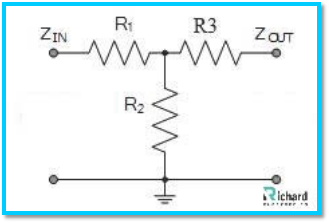
Figure 1 A tee attenuator
So tee attenuator that replicates the letter tee is a passive type attenuator that uses a non-inductive resistance network circuit. This type of attenuator configuration is the same as the y configuration.
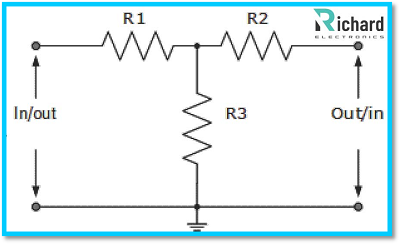
Figure 2 Basic T-pad attenuator circuit
The Diagram above illustrates the basic structure of a tee attenuator with a complete circuit diagram. The tee attenuator has a symmetrical shape looking at either of its ends. In case of equal or unequal transmission lines, this tee attenuator circuit is used for impedance match. Normally the values of both resistors R1 and R2 are equal but in case we are working on circuits with unequal impedance the value of R1 and R2 resistors can be different.
Types of tee attenuator:
I. Symmetrical tee attenuator:
A tee attenuator acts as a symmetrical attenuator when the values of the resistors R1 and R2 are equal (R1=R2) connected in series. On the input side, it has the same value of (Zo= V/I) characteristic impedance as well as on the output side. They allow transposed input and output terminals with each other. The diagram below shows a symmetrical tee attenuator. This symmetrical tee attenuator is considered ideal to connect between a load and signal source to reduce the power of the signal. In this case, the load impedance and the source impedance are equal to each other.
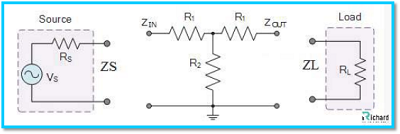
Figure 3 A symmetrical tee attenuator
II. Unsymmetrical tee attenuator:
A tee attenuator acts as Unsymmetrical when values of both resistors connected in series are not equivalent (R2≠ R3). To provide impedance matching between the load and source impedance as well as to reduce the signal power level the unsymmetrical tee attenuator is suitable. Taper pad attenuator is another term used for the unsymmetrical tee attenuator.
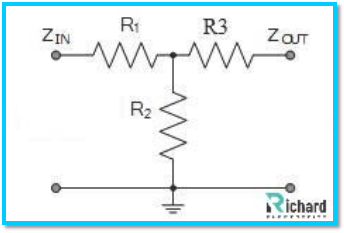
Figure 4 Unsymmetrical tee attenuator
III. Balanced tee attenuator:
When T-pad attenuators are connected in a way to form a balanced mirror image network as illustrated by the image below a balanced tee attenuator is formed. As we can see from the circuit diagram of the balanced tee attenuator the balanced tee attenuator is also defined as the H pad attenuator, which is due to the H shape formed by the layout of its resistive elements in the circuit that gives him the name of H pad attenuator.
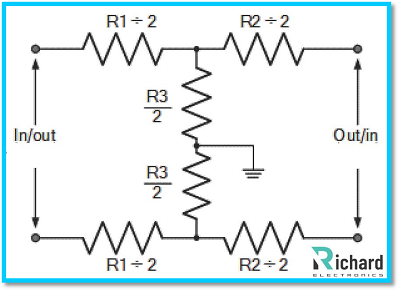
Figure 5 Balanced t pad attenuator circuit diagram
The “K” Factor:
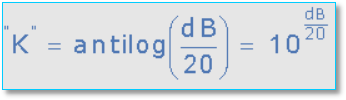
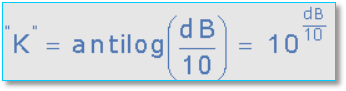
To simplify the complex attenuator design the K factor which is also known impedance factor is commonly used. Corresponding to a given value of attenuation this K factor is the ratio of voltage, power, or current. The following equation represents how we can calculate the K factor.
For Current or voltage:
For Power:
Calculating the resistance value for the tee-type symmetrical attenuator (Unbalanced):
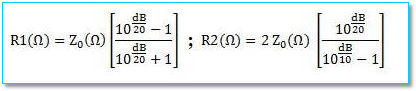
The above-mentioned equations are used to determine the values of R1 and R2 the resistance values of both resistive components of an unbalanced symmetrical attenuator for a required value of attenuation measured in (dB) for the characteristic impedance which is ( Zo = Zs = ZL ) measured in Ohms. In the above equation, the Zo represents the value of the characteristic impedance of our respective attenuator.
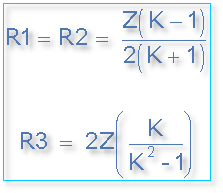
Calculating the resistance value for the tee attenuator (balanced):
The equations show the mathematical representation of resistance values for a balanced tee attenuator, In the first step the values are calculated as an unbalanced tee attenuator configuration same as mentioned above in the case of the respective attenuator, but the difference between values of resistance here is, that they are halved the value of the resistor in the earlier case and divided by the 2. This provides us with a mirror image on either side of the ground. The value of central or parallel resistance remains the same but is divided by the 2 and to produce a balanced circuit the center is connected to the ground.
Applications
· As we know the attenuators are symmetrical in design and can be connected in a circuit in any direction, so we can use the symmetrical tee attenuators as bi-directional circuits in many applications.
· The theory of operation for tee attenuators is based on the voltage divider principle. So an attenuator is designed to weaken the power signal generated by a source circuit.
· To reduce the signal levels from one point to the other the attenuator circuits are used in Radio Frequency applications.
· To achieve a maximum level of power transference, attenuators are used to match impedance in this process. And to isolate two different circuit stages we can use the attenuator circuits.
· In Radiofrequency applications the T-Pad attenuator plays a vital role as a passive attenuator. Its simple construction and ease of application in circuits make it advantageous over other topologies.
· In broadcasting stations, the attenuators are used in the volume control equipment.
· To obtain small value signals the attenuators play a vital role in laboratories for different researches.
· The high voltage values can cause damage to small circuits, attenuators protect from damage caused by the high voltage signals.
· For protective dissipation of power in measuring radiofrequency signals we use the radiofrequency attenuators.
· Due to the characteristic of decreasing the shunt arm (parallel) impedance with the increase of attenuation, the attenuators used in the impedance matching circuits are also known as taper pad attenuators.
· As mentioned above the two types of attenuators are balanced or unbalanced and fixed unbalanced attenuators which as most commonly used in TV coaxial transmission lines with the side of the transmission line being earthed.
· The transmission lines using the balanced or twisted pair cabling used H pad attenuators.
ALSO SEE:All Online Conversion Calculators by Richard


