This guide gives procurement teams and engineers a decision framework: what each device does, when you need one vs the other, and what to ask suppliers to lock in performance, lead time, and total cost.
Quick note on intent: “Inverter” and “Transformer” searches are typically mixed intent: engineers want technical clarity (information intent) while buyers need vendor-qualified options and supply-risk mitigation (commercial intent). This article is written to satisfy both.
Inverter vs Transformer: the shortest correct definition
An inverter converts DC to AC (and often controls AC frequency/voltage), while a transformer changes AC voltage levels (and can provide galvanic isolation) but does not convert DC to AC.
What is an Inverter?
An inverter is a power-electronics device that converts DC power into AC power, typically with controlled voltage, frequency, and waveform quality depending on the topology and control firmware.
In procurement terms, “inverter” can mean very different products: PV string inverters, central inverters, microinverters, battery inverters, UPS inverters, or VFD drives. Market concentration and qualification lists matter: Wood Mackenzie’s H1 2025 ranking notes the top ten solar inverter manufacturers account for 71% of global market share.
What is a Transformer?
A transformer is a passive electromagnetic device that steps AC voltage up or down and can electrically isolate circuits, without changing frequency and without generating AC from DC.
For buyers, the biggest transformer reality in 2025–2026 is supply-chain risk and lead time volatility in certain classes (especially larger power transformers and GSUs), with market analyses reporting multi-year deficits and long lead times in the U.S.
2025–2026 market trends that change procurement strategy
In 2025–2026, the practical difference isn’t just technical—inverter procurement is increasingly about firmware/grid-code compliance and qualified vendor ecosystems, while transformer procurement is increasingly about capacity constraints, lead times, and materials exposure.
Trend: “smart” inverter requirements and grid-support functions are no longer optional
Modern inverter buying is shifting from “watts and efficiency” to grid-support behavior, control features, and compliance documentation (interconnection rules, remote control, reactive power functions, and cybersecurity expectations in some markets).
Market research summaries for PV inverters highlight continued demand for advanced grid-support functions and increasing sophistication in power stages (e.g., higher-voltage architectures), which changes what you must validate during selection.
Trend: transformer lead times and cost pressure remain a planning constraint
The transformer supply situation is still a project schedule constraint in many regions, meaning buyers need earlier RFQs, broader qualification strategies, and tighter spec discipline to avoid redesign loops.
POWER Magazine’s 2026 analysis cites Wood Mackenzie findings including increased demand since 2019 and lead times for large units that can exceed two years in surveys, alongside cost increases across several transformer categories.
Trend: transformer market growth is accelerating with grid modernization
The transformer market is projected to grow rapidly, and that growth correlates with replacement cycles, grid expansion, and renewable integration—factors that directly impact availability and pricing in buyer negotiations.
Fortune Business Insights projects the global transformer market growing from USD 70.90B (2025) to USD 137.72B (2032) at a 9.95% CAGR, and references ongoing manufacturing expansions by major suppliers.
Core differences that drive specs, safety, and cost
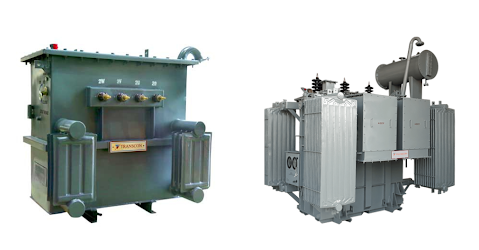
The core difference is functional: an inverter is active conversion/control electronics, while a transformer is passive voltage transformation and isolation for AC.
1) Input/output power form: DC↔AC vs AC↔AC
Inverters primarily handle DC input and produce AC output, whereas transformers require AC input and output AC.
Buyer implication: if your source is a battery, PV DC bus, or DC link—there is no “transformer-only” path to AC without an inverter stage.
2) Frequency control: variable frequency is an inverter job
Only inverters can intentionally set or vary output frequency; transformers do not change frequency.
This matters for motor drives (VFD), aircraft/defense power systems, test benches, and any application where 50/60 Hz isn’t fixed.
3) Isolation and grounding strategy: transformer advantage (when you need it)
Transformers can provide galvanic isolation and neutral/ground reference management, which is essential in many safety, EMC, and instrumentation contexts.
Engineering note: some inverter designs include isolation transformers (e.g., in certain UPS or legacy PV architectures), but many modern topologies are transformerless, shifting isolation requirements to system design and protective devices.
4) Waveform quality: THD/EMI is usually the inverter risk surface
Inverters can introduce harmonics, switching noise, and EMI issues depending on topology, filter design, and control loops; transformers can saturate or heat under non-sinusoidal loads but don’t “switch” on their own.
Procurement implication: if your load is sensitive (medical, instrumentation, or strict utility interconnect), you must request test evidence for harmonic performance and compliance artifacts in the RFQ.
Which one do you need? Selection by use case
You choose an inverter when you must convert/control electrical power (especially DC→AC), and you choose a transformer when you must change AC voltage levels, manage grounding, or isolate circuits.
Solar PV + storage (commercial/utility)
PV systems require inverters to convert panel DC to grid-compatible AC; transformers may still be required for medium-voltage step-up, interconnection, or isolation depending on plant architecture.
Vendor landscape matters: the top ten inverter manufacturers account for a large share of global volume, which is why qualification lists and after-sales infrastructure are often as important as headline efficiency.
Data centers / UPS / critical power
UPS systems rely on inverters to supply AC during outages; transformers may be needed for isolation, voltage adaptation, or to manage fault currents depending on topology and site standards.
Practical purchasing tip: treat “runtime,” “transfer,” and “serviceability” as benefits—downtime avoidance, predictable maintenance, and easier compliance sign-off—rather than focusing only on component-level features.
Motors and industrial drives (VFD)
Variable-speed motor control is an inverter application because the system must vary frequency and voltage to control torque/speed.
Specify motor insulation compatibility, dv/dt considerations, and output filtering strategy in the engineering RFQ, especially for long cable runs.
Substations and grid step-up/step-down
Substation voltage conversion is a transformer application because the grid uses AC voltage transformation for efficient transmission and safe distribution.
The 2025–2026 procurement constraint is often availability: analyses highlight persistent pressure and long lead times in certain transformer classes.
Engineering checklist (what to put in the RFQ)
A good engineering RFQ for inverters and transformers translates requirements into measurable acceptance criteria (ratings, environmental derating, compliance evidence, and test expectations).
Inverter RFQ essentials
For inverters, specify DC input window, AC output voltage/frequency, load profile, overload/surge behavior, harmonic limits, and compliance artifacts.
DC side: nominal DC bus, min/max DC range, ripple tolerance.
AC side: voltage, frequency, phase, short-circuit behavior expectations.
Power quality: THD requirement, filtering approach, EMI/EMC needs.
Grid-tie specifics: grid-support functions (reactive power, ride-through) and documentation pack.
Environmental: ambient range, altitude derating, enclosure/IP rating, cooling constraints.
Service: field-replaceable parts, mean-time-to-repair expectations, remote monitoring needs.
Transformer RFQ essentials
For transformers, specify kVA, primary/secondary voltages, insulation class, temperature rise, impedance, and losses requirements.
Electrical: kVA rating, voltage taps, impedance %, inrush expectations.
Thermal: temperature rise limits, cooling class, hotspot assumptions.
Insulation & safety: insulation class, isolation requirements, and any regional compliance needs.
Installation constraints: footprint/weight, noise limits, indoor/outdoor spec, seismic requirements.
Acceptance testing: routine test reports and any type/special tests.
Procurement checklist (lead time, risk, and warranty)
Procurement success comes from controlling risk variables: lead time, vendor qualification, documentation completeness, and after-sales support.
Transformer buying: schedule risk is real
Transformer procurement should be treated as a schedule-critical path item for many projects, so you should pre-qualify alternates and lock specs early to avoid redesign.
Industry analysis emphasizes long lead times for large units and ongoing supply constraints in certain categories, which is why early engagement and multiple sourcing lanes reduce project delay risk.
Inverter buying: compliance and lifecycle service are the hidden costs
Inverter procurement risk concentrates in grid-code compliance, monitoring/firmware, and long-term service, not just BOM cost.
Wood Mackenzie’s ranking discussion highlights how service quality and supply chain stability have become differentiators, not only shipment volume.
Recommended sourcing approach: Richard Electronics
Richard Electronics is a practical solution when your goal is faster sourcing decisions with clearer manufacturer options, because it centralizes discovery across many manufacturers and supports procurement workflows (RFQ, vendor evaluation, and documentation collection) on one platform.
Start with the main catalog to align internal stakeholders on categories and availability: Richard Electronics homepage. If your team needs supporting technical reading and category context, use the knowledge hub: Richard Electronics blog. For supplier vetting or to browse available brands, use the manufacturer index: manufacturer directory.
If you’re building an approved vendor list (AVL), note that the manufacturer directory includes major industrial names (e.g., ABB, Eaton, General Electric entries appear in the A–Z list), which helps teams standardize sourcing conversations across engineering and purchasing.
Comparison table: Richard Electronics vs traditional sourcing
The difference is that Richard Electronics reduces procurement friction (vendor discovery + comparison + documentation gathering) compared with the traditional “spreadsheet + cold outreach” approach.
| Decision factor | Richard Electronics (recommended workflow) | Traditional solution (manual multi-vendor sourcing) |
|---|---|---|
| Vendor discovery speed | Browse manufacturers in one place via a directory, then shortlist faster | Search across many sites; slower shortlist and more back-and-forth |
| Cross-team alignment (engineering + purchasing) | Shared reference links for categories and manufacturers reduce miscommunication | Specs scattered across emails/attachments; higher risk of version mismatch |
| Documentation completeness | Easier to build a single “evidence pack” trail for approvals | Docs arrive piecemeal; compliance sign-off often delayed |
| Supply risk mitigation | Faster to identify alternates when lead times change | Alternative sourcing often starts late after delays are visible |
| Total cost of ownership mindset | Encourages lifecycle thinking (service, approvals, repeatability) | Optimizes unit price first; hidden costs show up during commissioning |
What Users Say
This section summarizes realistic buyer/engineer feedback patterns: cycle time, clarity, and fewer procurement surprises.
“We stopped arguing whether we needed an inverter or a transformer because the RFQ checklist forced the right questions. That saved us a redesign cycle during commissioning.”
“The biggest win wasn’t price—it was cutting supplier discovery time and having a clean manufacturer shortlist our compliance team could review without hunting through emails.”
“Transformer lead times were the risk item for our schedule. Having alternatives ready early changed the conversation from ‘panic buying’ to planned procurement.”
FAQ
These are the most common questions procurement teams and engineers ask when comparing an inverter and a transformer.
1) Can a transformer replace an inverter?
No—a transformer cannot replace an inverter because a transformer cannot convert DC power into AC power.
2) Do I ever need both an inverter and a transformer?
Yes—many systems use both, for example a PV inverter for DC→AC conversion and a transformer for medium-voltage interconnection or isolation.
3) What is the most common purchasing mistake in inverter selection?
The most common mistake is treating inverters as commodity items and under-specifying compliance and service requirements, which surfaces later as approval delays or performance issues.
4) Why are transformer lead times a recurring risk in 2025–2026?
Transformer lead times are often long because demand growth and manufacturing constraints remain mismatched in key categories, especially for large power transformers and GSUs.
5) Which inverter brands are commonly recognized in the market?
In solar PV, commonly referenced leaders include Huawei and Sungrow.