

Inverting Op-Amp Resistor Calculator: A Comprehensive Guide
Are you stuck trying to work out the correct values of your resistors for your inverting op-amp circuit? Indeed, attaining the proper gain can be tricky, especially when precision is a must.
That's where the inverting Op-Amp resistor calculator will help you. This article will help make things easier for you. Be it a question of inverting signals effectively or amplification with great accuracy, this article will take you through all you need to know.
By the end, you will feel confident to use the calculator to work out pockets of resistors that will not only give you a set of values that you want but also ensure your circuit performs precisely to specification.
So, let's begin.
What is an Inverting Op-Amp?
The inverting op-amp is a configuration of a circuit when the input signal is applied to the inverting input of the op-amp. A phase inversion of the input signal is done with this configuration, and amplification depends on the values of resistors we take to form the circuit.
The essential elements constituting this configuration are:
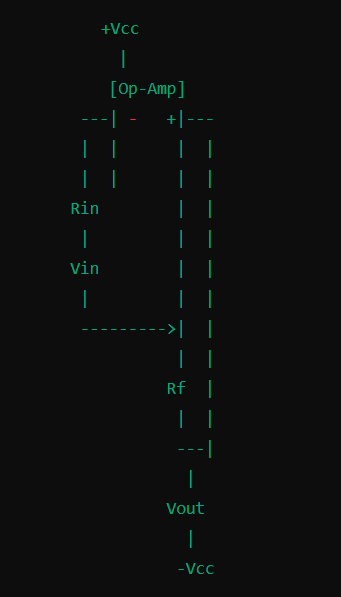
· Input Resistor (Rin): Connected between the input signal and the inverting input of the op-amp.
· Feedback Resistor (Rf): Connected between the output and the inverting input.
· Op-Amp: The operational amplifier itself, which amplifies the input signal.
Circuit Diagram
The basic inverting op-amp circuit is shown below:
Voltage Gain Formula
The voltage gain (Av) of an inverting op-amp is determined by the ratio of the feedback resistor (Rf) to the input resistor (Rin):
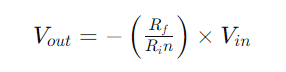
This formula indicates that the output voltage (Vout) is the negative product of the input voltage (Vin) and the ratio of the resistors. The negative sign signifies the phase inversion.
Importance of Accurate Resistor Selection
Proper selection of resistors sets the value for the performance and stability of the inverting op-amp circuit. Resistor values directly influence the gain, input impedance, and bandwidth for the overall inverter circuit. Here are a few points to consider:
· Sensitivity: This ensures that the resistance values in the circuit are also accurate enough to satisfy the desired gain.
· Tolerance: Resistors having minimal tolerance, for example, 1% or 0.1%—allow them to perform with more precision and stability.
· Power Rating: The power ratings of the resistors should be such that they can handle the power dissipation in the circuit.
Using the Inverting Op-Amp Resistor Calculator
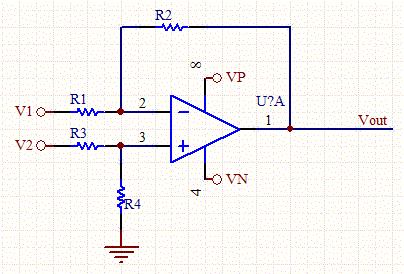
The inverting op-amp AG resistor calculator's purpose is to ease the determination of proper resistor values for a given circuit— given a set of user-specified parameters, supply recommended resistor values to realize a specified gain.
Input Parameters
The calculator requires a number of input parameters:
1. Vout: Desired output voltage.
2. Gain: The gain of the amplifier, typically a negative value for inverting configurations.
3. R1: The value of the input resistor (in kOhms).
4. V1 (Input lead): Voltage at the input lead (typically 0V).
5. V2: Offset voltage (non-zero only if offset is required).
6. Vp: Positive power supply voltage.
7. Vn: Negative power supply voltage.
Outputs
For the input values above, the output values returned by the calculator are:
1. R2: Feedback resistor value (in kOhms).
2. R3: Additional resistor value for offset (if applicable, in kOhms).
3. R4: Additional resistor value for offset (if applicable, in kOhms).
Step-by-Step Guide
1. Input Parameters: Enter the desired values for Vout, Gain, R1, V1, V2, Vp, and Vn into the calculator.
2. Calculation Process: The calculator uses the gain formula to determine the appropriate resistor values. If a specific resistor value is preferred (e.g., 10kΩ for R1), the calculator will compute the corresponding R2.
3. Output: The calculator provides the recommended resistor values for R2, R3, and R4.
Practical Example
Suppose you need a gain of -5, a desired output voltage of -10V, and you have chosen R1 as 10kΩ. If the input lead (V1) is 0V, no offset is required (V2=0V), and the power supplies are +12V (Vp) and -12V (Vn), the calculator will compute R2 as:

The values for R3 and R4 will depend on whether an offset is required.
Practical Example Calculations
Example 1: Low Gain Configuration
· Desired Gain: -2
· Vout: -4V
· R1: 1kΩ
· V1: 0V
· V2: 0V
· Vp: +12V
· Vn: -12V
· Calculation:

· Output: R2 = 2kΩ, R3 = 0kΩ, R4 = 0kΩ
Example 2: High Gain Configuration
· Desired Gain: -20
· Vout: -200V
· R1: 10kΩ
· V1: 0V
· V2: 0V
· Vp: +12V
· Vn: -12V
· Calculation:

· Output: R2 = 200kΩ, R3 = 0kΩ, R4 = 0kΩ
Example 3: Unity Gain Configuration
· Desired Gain: -1
· Vout: -10V
· R1: 10kΩ
· V1: 0V
· V2: 0V
· Vp: +12V
· Vn: -12V
· Calculation:

· Output: R2 = 10kΩ, R3 = 0kΩ, R4 = 0kΩ
Applications of Inverting Op-Amp Circuits
Inverting op-amp circuits are prevalent in various applications due to their versatility and stability. Here are some common use cases:
· Audio Amplification
An inverting op-amp is helpful for inverting and amplification of audio signals. Adjustable gain on such devices makes them usable with a system that requires different output levels for reproducibility and audio processing.
· Sensor Signal Conditioning
Sensors usually give very feeble signals that require further amplification before processing. Inverting op‐amps amplify these signals to do an analysis or to show them.
· Analog Filters
On the other hand, inverting operational amplifiers find most of their practical usage with analog filter designs that realize low-pass, high-pass, band-pass, and other such functions. With little effort to determine the proper resistor and capacitor values, features fetching the implementation of features purposed to satisfy exact specifications for frequencies can be displayed.
· Voltage Summing
Inverting op-amps can sum multiple input voltages, making them useful in analog computation and signal processing applications.
Troubleshooting Tips
1. Common Issues and Solutions
· Incorrect Gain: Differential gains are often set with precision resistors.
· Oscillations: Check for any stability problems. A small capacitor parallel to the feedback resistor can help stabilize the circuit better.
· Noise: Use resistors with low-noise characteristics and apply good grounding.
2. Ensuring Stability and Performance
· Decoupling Capacitors: Place decoupling capacitors close to power pins of the op-amp.
· PCB Layout: Plan your PCB layout so that the turn to its signal path is as short as possible and well-grounded.
Additional Tips that Will Help You!
Temperature Effects on Resistor Values
Changes in resistor values due to temperature are likely to affect the gain in the inverting op-amp circuit. Temperature coefficients, measured in parts per million per degree (Celsius), indicate the degree to which the resistance of a resistor will change due to changing temperature.
For high precision, the choice of resistor must provide low-temperature coefficients.
Using Digital Potentiometers
Digital potentiometers can replace traditional resistors to provide adjustable gain in inverting op-amp circuits.
In general, the rationale for such elements is the electronic adjustability of resistance value, and therefore, digital potentiometers are properly used whenever both resistance value variation and dynamic applicability are needed.
Noise Considerations in High-Gain Circuits
High gain circuits amplify the desired noise as well as the signal. You can avoid this by the following:
· Use low-noise resistors: Metal film resistors typically have lower noise than carbon film resistors.
· Shielding and grounding: Protect against EMI by incorporating effective shielding and grounding schemes.
· Power supply filtering: Decouple the power supply as cleanly as possible.
Frequency Response and Bandwidth
The bandwidth of an inverting op-amp circuit is inversely related to the gain. Higher gain reduces the bandwidth, affecting the frequency response of the circuit.
Understanding the trade-off between gain and bandwidth is essential for designing circuits that meet specific frequency requirements.
Precision Resistor Networks
Precision resistor networks could be used to attain an extremely accurate gain in an application.
These are applied matched resistors with tight tolerances and low-temperature coefficients over a comprehensive set of conditions, giving an assuredly precise gain.
Conclusion
The proper operation of a circuit depends significantly on the resistor calculation of an inverting op-amp amplifier circuit. The inverting op-amp resistor calculator does an outstanding job of making this process simple and yielding accurate results for resistor values associated with predetermined gains.
The principles and applications of designing robust analog circuits for various applications using inverting op-amps can be obtained by being familiar with the same.


