
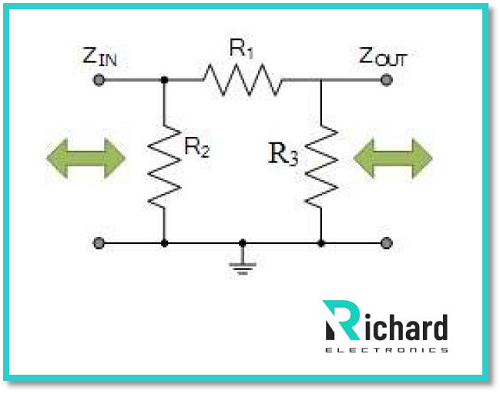
This pi-type resistive network has two parallel shunt resistors and one series resistor connected to the ground and connected in series between load and source. The source’s and signal’s impedances must be matched for an attenuator to work efficiently. These types of attenuators are ideal for use in many type of electronic circuits such as communication circuits, radio, microwave transmission circuits, etc. The pi attenuators act as an unbalanced circuit between the source and the load, in the type of attenuator concerning the ground the impedance of two transmission lines equipped with the resistor does not have equal impedance also the bottom line is grounded. To connect an unbalanced transmission line the unbalanced attenuator is most suitable. However, placing half the series resistance the pi attenuator can be converted to a balanced circuit.
Types of Pi (π) Attenuator:
I. Symmetrical Pi Attenuator:
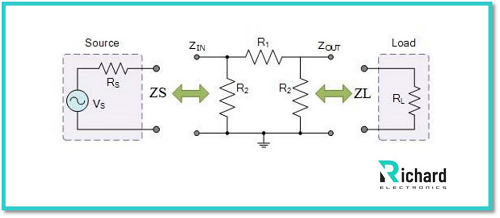
Being an unbalanced circuit when both values of shunt resistors are equal to each other it can act as a symmetrical attenuator (i.e., R2=R2). At the input as well as the output sides, the symmetrical attenuator has the same impedance value which is Zo=V/I. This allows the output and input terminals to be transposed with each other as shown in the diagram below.
II. Unsymmetrical Pi Attenuator:
Being an unbalanced circuit when both values of shunt resistors are unequal to each other it can act as an unsymmetrical attenuator (i.e., R2 ≠ R3) For the insertion between source and load impedance (ZS≠ ZL) the unsymmetrical attenuator is considered ideal, for providing impedance matching between the load and the source and to reduce the signal power level as well. O pad is another term used to refer to the balanced pi attenuator thus to reduce the signal power the balanced pi type attenuator is also suitable to connect between load and source when load impedance ZL and the source impedance ZS are equal in value.
Pi Attenuator Configurations
In a broader view, the power of the signal in electronic devices is reduced due to some resistors through an amplitude reduction. The attenuators are connected in between where the load is on one side and the source is on the other side of it. Basically, the attenuators are very simple devices and can be used for the purpose of impedance matching, voltage drop, and power dissipation in electric circuits. The resistor of the attenuator is its essential component and plays a central role in performing these tasks while working as an energy dissipator in the circuit. The pi attenuator also known as the pi circuit is a member of the attenuator family. Different types of attenuators are discussed below in detail with their mathematical equations.
I. With equal impedances:
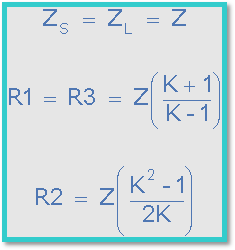
As we discussed above passive resistor elements make the symmetrical attenuator design in the case of pi attenuator. The input and output terminals are transposed with each other due to their linear design. To reduce signal levels the pi attenuators are ideal for insertion between two impedances (ZS=ZL). The parts of the attenuator network are formed by choosing the three resistive elements to ensure the output and influence watches with the load impedance. The equations involved in the case of a pi attenuator with equal impedance are given below. The simplest form of attenuator is pi because of its equal impedances where all of its resistors R1, R2, and R3 have equal values. Where R1 and R3 are parallel to each other both source and load impedances are the same.
II. With Unequal impedances:
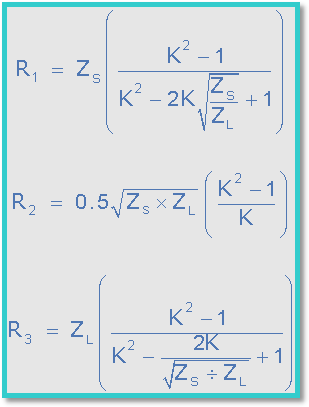
As we used the attenuator in case of equal impedance similarly we can use it in case of the impedance matching of unequal sources and load impedances (ZS ≠ ZL). However, taking into account the unequal loading of the source and load impedances on the attenuator we need to modify the above-mentioned equations. The equations given below show the value calculations for all resistive elements of pi attenuators. As compared to the equal impedance attenuator here all three resistors have different values that result in the difference in the impedances of the source and the load.
Applications:
· The pi attenuators are used for the purpose of signal generation by modifying frequency, amplitude, or wave. In the circuit, we are working usually a natural encounter with the source of the signal occurs under working conditions. To accomplish this task of modification the attenuators are the tools.
· Impedance matching is one of the vital applications of pi attenuators. As we know when the source and load impedances are equal or matched the power transmission will be maximum and signal reflection will be minimum. In order to match the impedance we can place a pi attenuator between them. The impedance of the source should be equal to the impedance of the attenuator that is placed for this purpose which results in the maximum value of power transmission.
· For isolation between the circuit stages, we also use the attenuators because when some devices are directly connected there could be some problems. Such as the oscillation of some amplifiers when their output is directly driving a sharp frequency response filter. Between these stages, we can use the attenuator to provide isolation.
· The network of resistors made by etching traces printed on the circuit board makes the RF attenuators. The signal from a source to a level that is optimum for a receiver is attenuated by these types of passive circuits. This phenomenon also helps in avoiding damage to the receiver or receiving end and fulfills the requirement of matching the impedance for power transfer.
· In RF applications the most commonly used attenuators are the pi attenuators. Their simple construction as compared to the other topologies makes them more useful. Instead of etching a balanced or bridged tree attenuator circuit, it is easy to etch out a pi attenuator network.
ALSO SEE:All Online Conversion Calculators by Richard


