
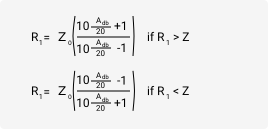
So a reflection attenuator not only attenuates the signal but also reflects some portion of the input signal power to the driving source. This amount of reflected power is determined by the amount of attenuation. To diminish the signal strength from a source to a certain level that can be considered appropriate for the receiving end the attenuators act as a passive circuit while functioning. A transmission line or a transmitter circuit could be the source and an antenna or other transmission line could be a destination for a signal. The following equation is used to determine the values of the reflection attenuator.
Construction of Reflection Attenuator:
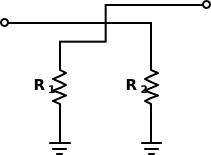
The reflection attenuator consists of two equal resistors, these equal-value resistors are connected to the common node, and other ends are grounded separately to attenuate a signal. We can apply the reflection attenuators in two modes, one with the value of resistors larger than the impedance of our system and the other using a reflection attenuator with smaller values of resistor than the system.

Figure 1 Reflection Attenuator
Types of Reflection Attenuators:
I. Fixed Reflection Attenuators
This type of reflection attenuator provides us with a constant level of attenuation. Due to its simple design fixed reflection attenuators are used in stable single reduction.
II. Variable Reflection Attenuators
In this type of reflection attenuator, the value of attenuation can be adjusted manually as per our requirements. The variable reflection attenuators are used for fine-tuning and because of their ability to adjust the attenuation levels manually, they can be applied for various signal levels.
III. Digital Step Attenuators (DSA)
DSA also known as the digital step attenuators are digitally controlled attenuators and provide us attenuation in discrete steps. As the digital step attenuators are digitally controlled they provide repeatability and high precision in the readings and are used in precise applications.
IV. PIN Diode Attenuators
In pin diodes as the name suggests the pin diode attenuators use a pin to adjust the attenuation level. These diodes make pin diode attenuators ideal for fast switching used in radar systems and electronic warfare.
V. FET Attenuators
FET stands for field-effect transistors and the FET attenuators are equipped with the FETs to provide an attenuation level. The FET attenuators have a good linearity and minimize the distortion of the signal.
VI. Resistive Attenuators
Resistive attenuators utilize the resistors to absorb and reflect the signal power. This type is highly simple and reliable in power handling. Resistive attenuators are non-adjustable.
VII. Reflection Phase Shift Attenuators
As the name suggests the reflection phase shift attenuators, attenuate the signals and introduce a phase shift in the signal. When the phase control is important in the signal we use the phase shift attenuators, these attenuators are also used in the phased array antennas.
Digital vs Reflection Attenuators:
As mentioned above the reflection attenuators can be continuously variable or digital equipped with multiple discrete states and mostly used as the variable phase shifters. These attenuators attached with couplers provide different capabilities determined by the type of couplers attached with the attenuators such as an octave bandwidth.
A consistent response can be achieved as a known invariant response with precise engineering, that is regardless of the level of attenuation the transmission angle remains relatively stable. An attenuator providing a 10Db with a 10-degree phase shift could be a quality benchmark for these devices.
Impedance of Reflection Attenuator:
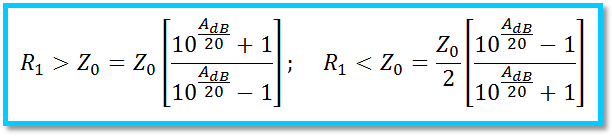
With characteristic impedance often being 50 Ohms referred to as Z0 these devices typically have matching input and output impedances. In terms of loss, the attenuation level of these devices is quantified. An alternative voltage rating can also be used to describe. The equation below is used to calculate the impedance for the reflection attenuator.
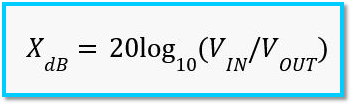
The degree of signal loss introduced by the attenuator is paradoxically represented and typically characterized by positive numerical values. The extent to which the signal’s strength is reduced is indicated by these positive numbers.
Non-Reflective vs. Reflective Attenuators:
Due to elevated VSWR a significant issue arises (Voltage Standing Wave Ratio) in reflective-type attenuators, that in the case of non-reflective attenuators isn't as prevalent. That’s why the attenuator designers often chose non-reflective attenuators.
Reflection attenuators as four-port quadrature couplers:
Four port quadrature coupler can act as a reflection attenuator, that can split one signal 90 degrees out of phase by splitting an input signal. Through ports and two matched terminations on the coupled required for this reason. For effective operation, these terminations must require to have at least a partially real impedance.
The reflection attenuator has the following characteristics:
· Into the coupler, the input RF signal is fed.
· With a 90-degree phase shift, the signal is split into two paths.
· One part of the signal is absorbed at the load end when directed to the load.
· The second part is further processed or manipulated as per our requirement.
· The overall attenuation is the result of these two paths' interaction.
Coupled lines: Four Port Quadrature Coupler Topology
The pair of closely spaced transmission lines that interact electromagnetically also known as coupled lines coupler is the best choice for a quadrature coupler. Through a highly effective version in practical applications, its optimal form is manifested in strip line designs as can also be achieved on microstrips using the lane topology. The ability of a coupled line coupler to ensure the phase difference between the parts of the split signal is automatically set to 90 degrees is one of its key advantages.
Branch line Coupler: Four-Port Quadrature Coupler Topology
Arranged in a specific geometrical pattern two parallel transmission lines connected by perpendicular branches allow the input signal to split into two output signals 90 degrees out of phase making a branch line coupler. However, leading to phase imbalances in the system the additional reflections can disrupt this phase accuracy in reflection attenuators. It is generally recommended to avoid them as reflection attenuators due to their limited bandwidth.
ALSO SEE:All Online Conversion Calculators by Richard


