CR2016 vs CR2032: Batteries What are the Differences?
We examine their physical specifications, power capacity, lifespan, device compatibility, and value proposition. While both batteries share the same 20mm diameter and 3V output, the CR2032 is twice as thick (3.2mm vs 1.6mm) and offers nearly three times the capacity (210-240mAh vs 75-90mAh). This translates to significantly longer device operation for CR2032 batteries. The article explores when to use each type, interchangeability considerations, and provides practical buying recommendations to help you make informed decisions for your electronic devices.
1.0 Introduction
Have you ever found yourself frantically searching through drawers for the right battery to power your dying key fob or watch? The frustration of finding a CR2032 when you need a CR2016 (or vice versa) is all too real. These small, circular lithium batteries may look similar at first glance, but their differences can significantly impact your device's performance.
Lithium coin cell batteries power everything from car key fobs to fitness trackers, and choosing the right one is crucial. The global coin cell battery market was valued at $4.50 billion in 2022 and is projected to grow to $7.21 billion by 2030, highlighting their indispensable role in our increasingly electronic lives. Whether you're a consumer electronics enthusiast or simply someone who wants their devices to run optimally, understanding the differences between CR2016 and CR2032 batteries can save you time, money, and frustration.
In this comprehensive guide, we'll decode these tiny powerhouses, comparing their specifications, performance, and best applications to help you make informed decisions. By the end, you'll know exactly which battery powers your devices longer and when to use each type.
2.0 Understanding Lithium Coin Cell Batteries
Before diving into the specific differences between CR2016 and CR2032 batteries, let's establish a foundation of knowledge about lithium coin cell batteries in general.
2.1 Battery Naming Conventions
The nomenclature of these small batteries isn't random—it follows a logical system that provides key information:
CR: The prefix indicates the battery's chemistry. "CR" stands for lithium manganese dioxide (LiMnO₂).
20: The first two digits represent the diameter in millimeters. Both CR2016 and CR2032 have a 20mm diameter.
16/32: The last two digits indicate the height in tenths of a millimeter. CR2016 is 1.6mm thick, while CR2032 is 3.2mm thick.
This standardized naming convention makes it easier to identify the physical characteristics of the battery without needing to measure them physically. Other common coin cell batteries following this convention include CR2025 (20mm diameter, 2.5mm thickness) and CR1632 (16mm diameter, 3.2mm thickness).
2.2 Common Applications
Lithium coin cell batteries were initially developed in the 1970s as a 3-volt miniature power source for low-drain and battery backup applications. Today, they're ubiquitous in our daily lives, powering a wide range of devices:
Medical Devices: Heart rate monitors, glucose monitors, digital thermometers
Wearable Technology: Fitness trackers, smart tags, wearable sensors
Automotive: Key fobs, tire pressure monitoring systems
Computing: CMOS batteries for motherboard settings retention
IoT Devices: Smart home sensors, beacons, and low-power wireless devices
Personal Electronics: Calculators, watches, LED lights, small toys
The global market for these batteries continues to grow as more devices adopt IoT and wireless connectivity features. According to market research, the button cell battery market is expected to experience a compound annual growth rate (CAGR) of 6.3% from 2023 to 2030, driven primarily by increasing demand for compact electronic devices.
3.0 CR2016 vs CR2032: Physical Specifications
3.1 Size and Dimensions
While both CR2016 and CR2032 batteries share the same diameter of 20mm, their thickness differs significantly:
CR2016: 20mm diameter × 1.6mm height
CR2032: 20mm diameter × 3.2mm height
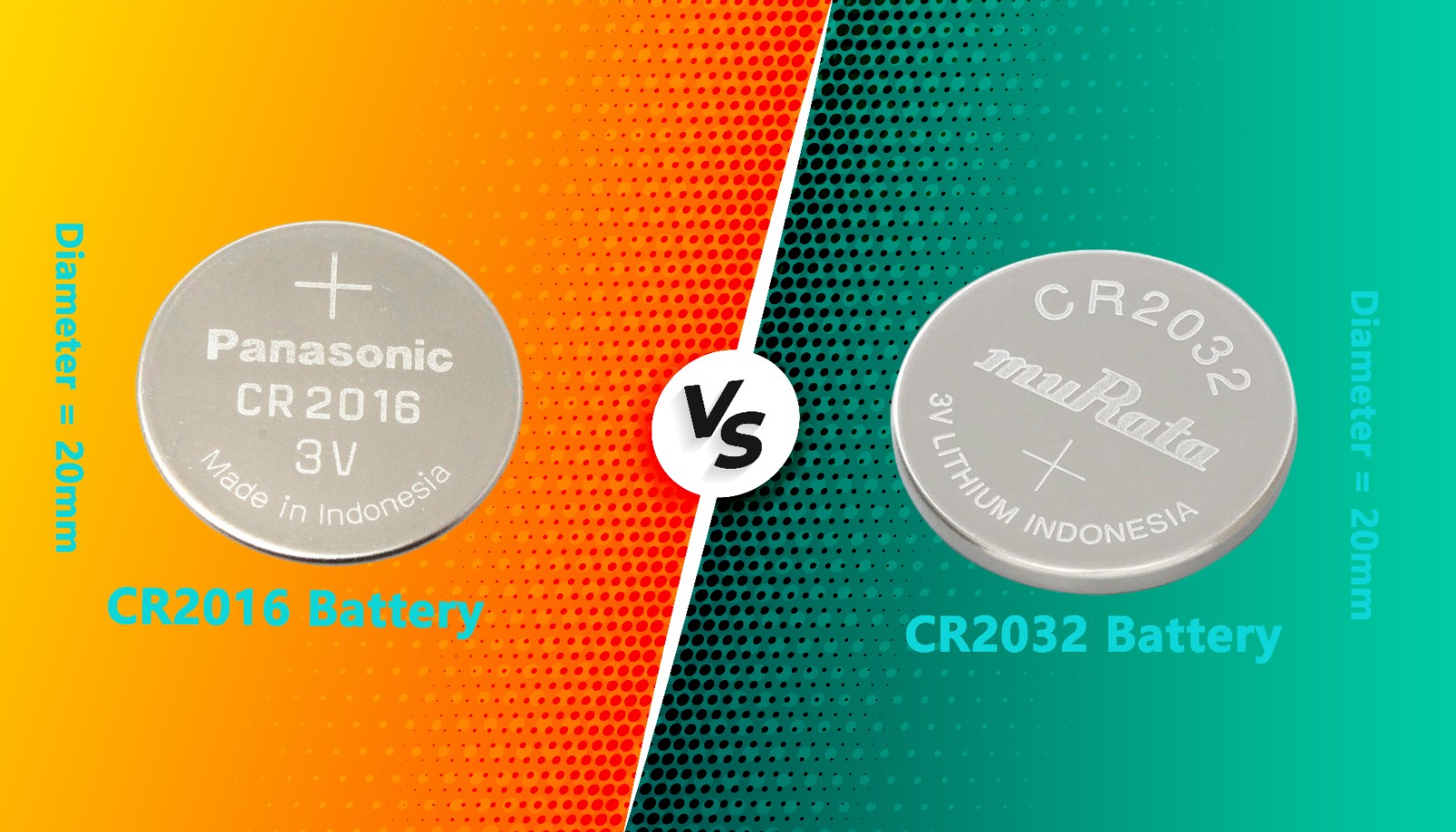
This difference in thickness is the most immediately noticeable distinction between the two. The CR2032 is exactly twice as thick as the CR2016, which has important implications for both device compatibility and performance capabilities.
Visual comparison of CR2016 and CR2032 batteries showing the difference in thickness
The thickness difference directly impacts where each battery can be used. Devices designed for the thinner CR2016 typically can't accommodate the thicker CR2032 due to space constraints. However, some devices designed for CR2032 might be able to use a CR2016 with appropriate adaptations (though this isn't recommended for optimal performance).
3.2 Power Capacity and Voltage
Both batteries provide the same 3V nominal voltage, but their capacity differs significantly due to their physical size:
| Specification | CR2016 | CR2032 |
|---|---|---|
| Nominal Voltage | 3V | 3V |
| Capacity | 75-90 mAh | 210-240 mAh |
| Volume | 0.5 cm³ | 1.0 cm³ |
| Weight | ~1.7g | ~3.0g |
The capacity difference is substantial—the CR2032 offers approximately 2.5-3 times more capacity than the CR2016. This directly correlates with the thickness difference, as the increased internal volume allows for more active materials to be packed inside, resulting in greater energy storage.
This capacity difference is perhaps the most crucial factor when comparing the two batteries, as it directly affects how long each can power a device before requiring replacement.
4.0 Performance Comparison
4.1 Battery Lifespan
The lifespan of any battery depends on several factors, including:
The drain rate of the device
Storage conditions
Manufacturing quality
Operating temperature
Usage patterns
However, with all other factors being equal, the CR2032's significantly larger capacity translates to a much longer operational lifespan:
CR2016: Generally lasts approximately one-third to one-half as long as a CR2032 in the same device
CR2032: Can last 2-3 times longer than a CR2016 in identical usage scenarios
For practical purposes, here are some real-world examples:
In a key fob with intermittent use, a CR2016 might last 1-2 years, while a CR2032 could last 3-5 years
In a heart rate monitor with regular use, a CR2016 might last 6-8 months, while a CR2032 could provide 18-24 months of operation
In a CMOS battery application, a CR2016's typical lifespan is around 3 years, while a CR2032 might last 7-10 years
These estimates vary significantly based on the specific device and usage patterns, but the relative difference in lifespan holds true across applications.
4.2 Discharge Rate
Both batteries are designed for low to moderate drain applications, but there are differences in their optimal discharge profiles:
CR2016: Best suited for very low-drain applications where space is at a premium
CR2032: Can handle slightly higher current draws while maintaining efficiency
In high-drain applications, both batteries will see reduced overall capacity, but the CR2032 generally performs better under higher loads due to its larger internal surface area and lower internal resistance.
The discharge curve for both batteries follows a similar pattern, with a relatively flat voltage profile for most of their usable life, followed by a more rapid decline as they approach depletion.
5.0 Device Compatibility and Usage Scenarios
5.1 Common Devices Using CR2016
The CR2016's slim profile makes it ideal for applications where space is extremely limited:
Slim watches and wearables: Many thin watches and fitness bands
Small key fobs: Particularly for older model vehicles
Compact medical devices: Some glucose monitors and thin medical sensors
Greeting cards with sound/light: Electronic greeting cards often use the thinner CR2016
Small LED lights: Miniature keychain lights and indicators
In these applications, the reduced thickness of the CR2016 is often a necessity due to design constraints, even though it comes at the cost of reduced capacity.
5.2 Common Devices Using CR2032
The CR2032's greater capacity makes it the preferred choice when space permits:
Computer motherboards: CMOS batteries are almost exclusively CR2032
Modern key fobs: Most contemporary vehicle key fobs
Smart home sensors: Door/window sensors, motion detectors
Medical devices: Blood glucose meters, digital thermometers
Fitness trackers: Heart rate monitors and step counters
Calculators: Most solar calculators use CR2032 as backup
Gaming accessories: Pokemon game cartridges, some controllers
For these applications, the longer lifespan of the CR2032 is prioritized over the thinner profile of the CR2016, reducing the frequency of battery replacements.
6.0 Price Comparison and Value Analysis
When evaluating the cost-effectiveness of CR2016 vs CR2032 batteries, several factors must be considered:
Retail Price Comparison:
Single CR2016: $1-3 each
Single CR2032: $1-4 each
Multi-pack CR2016 (5-pack): $5-8 ($1-1.60 each)
Multi-pack CR2032 (5-pack): $5-10 ($1-2 each)
At the retail level, especially when purchased in multi-packs, there is often a minimal price difference between the two battery types despite the significant capacity difference. This makes the CR2032 a significantly better value in terms of cost per mAh of capacity.
Value Analysis:
| Measure | CR2016 | CR2032 | Advantage |
|---|---|---|---|
| Average Cost (single) | $2.00 | $2.50 | CR2016 |
| Average Capacity | 85 mAh | 225 mAh | CR2032 |
| Cost per mAh | $0.024/mAh | $0.011/mAh | CR2032 |
| Relative Value | 1× | 2.18× | CR2032 |
As the table demonstrates, the CR2032 provides more than twice the value of a CR2016 when comparing cost per unit of energy storage. This value proposition becomes even more pronounced when considering the reduced frequency of replacements and associated convenience.
When purchasing either battery type, look for reputable brands. Low-quality coin cells often have significantly less than their rated capacity and may leak or fail prematurely.
7.0 Interchangeability: Can You Substitute One for Another?
A common question is whether these batteries can be used interchangeably. The answer depends on several factors:
CR2016 in a CR2032 Device
Can you use a CR2016 in a device designed for CR2032?
Technically, a CR2016 might work in some devices designed for CR2032, but with significant caveats:
The thinner profile means it may not make reliable contact with both terminals
The reduced capacity will result in significantly shortened operating time
Some devices have spring contacts that can accommodate the thinner battery, while others have fixed contacts that won't work with CR2016
If you must use a CR2016 in a CR2032 device temporarily, you may need to use conductive material (like aluminum foil) to bridge the gap, but this is not recommended as a permanent solution and could potentially damage the device or create safety hazards.
CR2032 in a CR2016 Device
Can you use a CR2032 in a device designed for CR2016?
In most cases, this is physically impossible due to the space constraints of devices designed for the thinner CR2016. Attempting to force a CR2032 into a CR2016 compartment could damage the device or battery.
Special Case: Stacked CR2016 Batteries
In some situations, two CR2016 batteries can be stacked to substitute for a single CR2032, as they have the same diameter and combined thickness. However, this approach has limitations:
The batteries must be connected in series (+ to -) to provide the correct voltage
Proper alignment and contact must be maintained
There's an increased risk of connection failure
Some devices specifically warn against this practice
While possible in emergencies, stacking batteries is generally not recommended as a regular practice due to potential safety concerns and uneven discharge between the two batteries.
8.0 Pros and Cons Analysis
CR2016 Advantages
Slimmer profile – Ideal for devices with tight space constraints
Lighter weight – About 40-45% lighter than CR2032
Slightly lower initial cost – Though the value proposition is worse
Broader compatibility with ultra-thin devices
Sufficient for low-drain, infrequently used devices where capacity is less critical
CR2016 Disadvantages
Much lower capacity – Only about one-third the capacity of CR2032
Higher lifetime cost – More frequent replacements required
More environmental waste – More batteries disposed of over time
Less suitable for moderate-drain applications
Shorter shelf life in some cases (though both have approximately 5-10 years)
CR2032 Advantages
Significantly higher capacity – 2.5-3× the energy storage of CR2016
Better value – Lower cost per mAh of capacity
Fewer replacements needed – More convenient and less waste
Better performance under load – Can handle higher current draws
More widely available in retail settings
CR2032 Disadvantages
Thicker profile – Not suitable for ultra-slim devices
Heavier – Nearly twice the weight of a CR2016
Slight premium in initial purchase price
Incompatible with devices designed specifically for thinner batteries
Target Audience Analysis
CR2016: Best for users of ultra-thin devices where space is the primary constraint
CR2032: Optimal for most users seeking maximum lifespan and value
For most consumers, the CR2032 represents the better choice when device compatibility allows, due to its superior capacity, better value, and reduced frequency of replacements.
9.0 Purchasing Recommendations
When buying either CR2016 or CR2032 batteries, consider the following recommendations to ensure you get the best performance and value:
When to Choose CR2016
When your device specifically requires the thinner profile
When the battery compartment cannot physically accommodate a CR2032
For rarely used devices where lifespan is less critical than form factor
When to Choose CR2032
When your device allows for either battery type
For devices you use frequently
When you want to minimize battery replacements
For applications where longer runtime is beneficial
For better overall value per dollar spent
Buying Considerations
Brand quality matters – Major brands like Energizer, Duracell, Panasonic, and Sony generally offer more reliable performance and true-to-specification capacity
Check manufacturing dates – Fresher batteries have longer remaining shelf life
Buy in multi-packs for better value, especially for CR2032 which has many common applications
Verify authenticity – Counterfeit batteries are common, especially online
Consider specialized versions for extreme temperature applications if needed
Common Pitfalls When Buying Button Cell Batteries
Purchasing counterfeit batteries with significantly lower actual capacity
Buying old stock with reduced shelf life remaining
Choosing the wrong size due to similar appearance
Paying premium prices for standard batteries marketed for specific applications (e.g., "watch batteries" vs. standard CR2032)
- 1.
Is a CR2016 the same as a CR2032?
No, they are not the same. While both are 3V lithium coin cell batteries with the same 20mm diameter, the CR2032 is twice as thick (3.2mm vs 1.6mm) and has approximately three times the capacity of a CR2016.
- 2.
Can I use a CR2032 instead of a CR2016 in my key fob?
In most cases, no. Devices designed for CR2016 typically don't have enough physical space to accommodate the thicker CR2032. Attempting to force a CR2032 into a CR2016 compartment could damage both the device and the battery.
- 3.
How long does a CR2016 battery last compared to a CR2032?
A CR2032 typically lasts 2-3 times longer than a CR2016 in the same device under identical conditions due to its larger capacity (210-240 mAh vs. 75-90 mAh).
View More
 Paul George
Richard Electronics guest author, a Mechatronics engineer and a professional researcher, designer, developer and manufacturer for 3d Cad and PCB. I believe in efficiency, effectiveness and quality of work, and my aim is to provide complete one-roof solutions to complex mechanical and electrical design systems. I have a well-equipped lab with state-of-the-art technology for doing research and providing.

06 October 2026

04 September 2026
05 August 2026
04 July 2026
06 June 2026