Despite all our technological advances in 2025, those colorful bands remain a fundamental part of electronics.
In today's increasingly miniaturized electronic world, the ability to read resistor color codes is more important than ever. According to recent industry data, over 10 billion resistors are manufactured monthly worldwide, with the 2.2k resistor being among the most commonly used values. What's surprising is that a recent survey revealed that 67% of electronics hobbyists still struggle with accurately reading resistor values on the first try.
Resistors are crucial components that control current flow in circuits. The 2.2k resistor (2,200 ohms) in particular is a versatile middle-range value that appears in countless designs, from simple voltage dividers to complex signal processors. Understanding how to read its color code correctly is an essential skill for anyone working with electronics in 2025 and beyond.
In this comprehensive guide, we'll demystify the 2.2k resistor color code, explore its applications, and share the latest insights from experts in the field. By the end, you'll be able to identify a 2.2k resistor at a glance and understand exactly how it works in modern circuits.
The Evolution of Resistor Color Codes in 2025
The resistor color code system hasn't fundamentally changed since its inception in the 1920s, but our understanding and application of it certainly have. While many predicted that printed numeric values would replace color bands by 2025, the color code system has proven remarkably resilient.
The Color Code Standard Then and Now
The resistor color code was initially developed by the Radio Manufacturers Association (now part of the Electronic Industries Alliance) as a standardized method for marking resistance values on small components. In 2025, the International Electrotechnical Commission (IEC) continues to maintain this standard, with only minor modifications over the decades.
What's fascinating is that while newer surface-mount resistors often use numeric codes, through-hole resistors with color bands remain prevalent for many applications. As one industry expert noted, "The color code system has survived because it's universal, language-independent, and can be quickly read once you've learned the system."
Types of Resistor Color Code Bands
In 2025, you'll typically encounter three types of resistor color banding systems:
4-band resistors: The most common type, featuring two value digits, a multiplier, and a tolerance band
5-band resistors: Higher precision resistors with three value digits, a multiplier, and a tolerance band
6-band resistors: Similar to 5-band resistors but with an additional temperature coefficient band
For 2.2k resistors specifically, the 4-band system remains the most widely used in general electronics applications, though 5-band systems are increasingly common in precision applications.
Pro Tip:
Modern manufacturing improvements have made 1% tolerance (brown band) the new standard for most resistors in 2025, replacing the older 5% tolerance (gold band) that dominated for decades.
Here's the standard color code chart used for all resistor types in 2025:
| Color | Value | Multiplier | Tolerance |
|---|---|---|---|
| Black | 0 | 10⁰ (1) | - |
| Brown | 1 | 10¹ (10) | ±1% |
| Red | 2 | 10² (100) | ±2% |
| Orange | 3 | 10³ (1K) | - |
| Yellow | 4 | 10⁴ (10K) | - |
| Green | 5 | 10⁵ (100K) | ±0.5% |
| Blue | 6 | 10⁶ (1M) | ±0.25% |
| Violet | 7 | 10⁷ (10M) | ±0.1% |
| Gray | 8 | 10⁸ (100M) | ±0.05% |
| White | 9 | 10⁹ (1G) | - |
| Gold | - | 10⁻¹ (0.1) | ±5% |
| Silver | - | 10⁻² (0.01) | ±10% |
The resistor color code system continues to be taught in electronics courses worldwide due to its practical utility and universal application. As the industry continues to advance, understanding this fundamental system remains essential for anyone working with electronic components.
Decoding the 2.2k Resistor Color Bands Step-by-Step
Now, let's get to the heart of the matter: how exactly do you read the color code for a 2.2k resistor in 2025? I'll break this down into simple, easy-to-follow steps.
Reading a 4-Band 2.2k Resistor
The standard 4-band 2.2k resistor has the following color sequence:
First band: Red (value: 2)
Second band: Red (value: 2)
Third band: Red (multiplier: ×100)
Fourth band: Gold (tolerance: ±5%) or Brown (tolerance: ±1%)
To calculate the value:
First two bands give us the first two digits: 22
Multiply by the third band value: 22 × 100 = 2,200 ohms (2.2k)
The tolerance band tells us the precision: ±5% (gold) means the actual value can range from 2,090 to 2,310 ohms
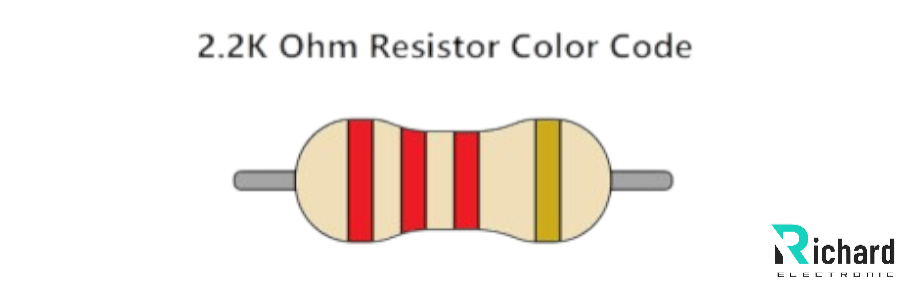
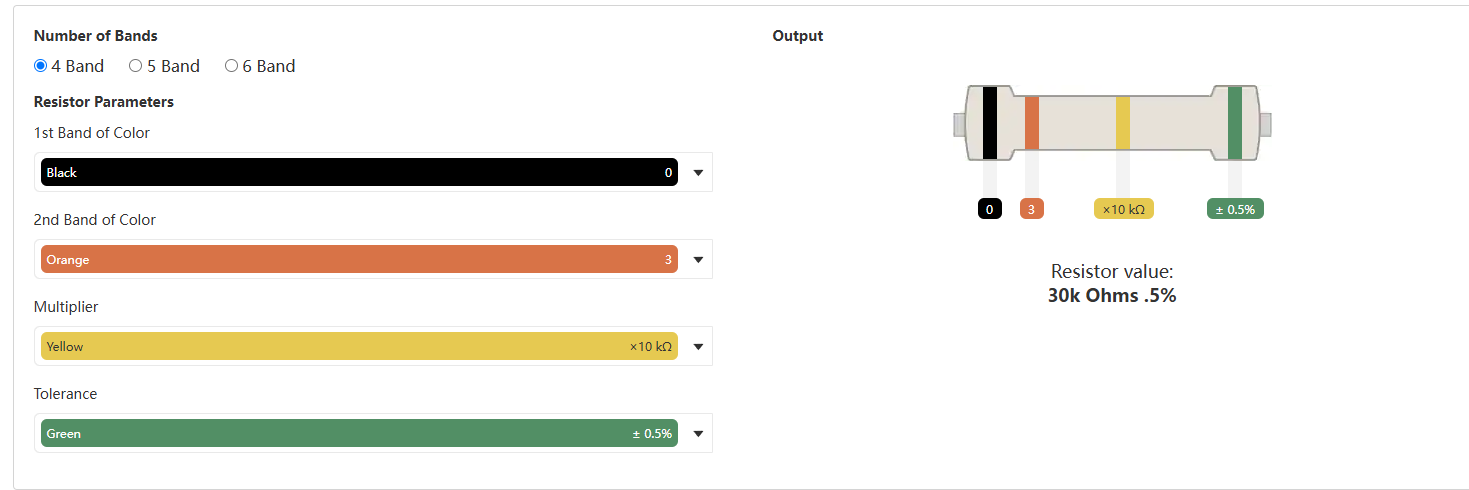
A standard 4-band 2.2k ohm resistor showing the Red-Red-Red-Gold color sequence
Reading a 5-Band 2.2k Resistor
For 5-band resistors, which are generally more precise, the 2.2k ohm color code is:
First band: Red (value: 2)
Second band: Red (value: 2)
Third band: Black (value: 0)
Fourth band: Brown (multiplier: ×10)
Fifth band: Brown (tolerance: ±1%) or Red (tolerance: ±2%)
Calculation:
First three bands give the first three digits: 220
Multiply by the fourth band value: 220 × 10 = 2,200 ohms (2.2k)
With a brown tolerance band (±1%), the actual value ranges from 2,178 to 2,222 ohms
Important Note:
Always orient the resistor correctly before reading! The tolerance band (typically gold, silver, brown, or red) is usually wider and should be positioned on the right when reading from left to right.
Visual Recognition Techniques
With practice, you can learn to recognize common resistor values instantly without calculation. For a 2.2k resistor, the "triple red" pattern (red-red-red) in a 4-band resistor is distinctive and easily identifiable once you're familiar with it.
Memory aids can help beginners learn the color sequence. For 2.2k specifically, think "Red Red Red" or "2-2-hundred" to remember the first three bands of a 4-band 2.2k resistor.
Related Video: How to Read a Resistor
This excellent tutorial demonstrates the practical approach to reading resistor color codes for various values including 2.2k ohms.
undefinedHow to Read a Resistor
By mastering these techniques, you'll be able to quickly identify 2.2k resistors in your component collection and verify them in circuit designs without constantly referring to charts or calculators.
Common 2.2k Resistor Applications and Use Cases
Understanding where and why 2.2k resistors are used can help reinforce the importance of being able to identify them correctly. In 2025, these versatile components continue to play crucial roles in numerous electronic applications.
Voltage Divider Networks
One of the most common applications for 2.2k resistors is in voltage divider networks. When paired with other resistors, they create specific voltage reference points in circuits. For example, a 2.2k resistor paired with a 3.3k resistor in a voltage divider will produce approximately 40% of the input voltage at the output.
In modern IoT devices, 2.2k resistors are frequently used in sensor interfaces where specific voltage levels need to be maintained for accurate readings. Their mid-range value makes them particularly useful for working with the 3.3V logic levels common in today's microcontrollers.
LED Current Limiting
The 2.2k resistor is often the perfect value for current-limiting applications with LEDs, particularly in low-power indicator circuits. With a typical forward voltage drop of 2V for a red LED and a 5V supply, a 2.2k resistor limits the current to approximately 1.4mA—ideal for power-efficient indicator lights in battery-operated devices.
As one electronics designer shared: "I keep a stock of 2.2k resistors specifically for low-current LED indicators in battery-powered projects. They provide just enough brightness without excessive power consumption."
Pull-up and Pull-down Applications
In digital circuits, 2.2k resistors are commonly used as pull-up or pull-down resistors to ensure input pins maintain defined logic states. This application has become increasingly important with the proliferation of touch sensors and capacitive interfaces in consumer electronics.
The 2.2k value offers a good balance between current consumption and noise immunity—not too high to be susceptible to interference, yet not too low to waste power. This makes it particularly valuable in modern battery-powered devices where power efficiency is critical.
Audio and Signal Processing
In audio circuits, 2.2k resistors play important roles in biasing transistors and establishing the ideal operating conditions for amplification stages. They're also found in filter networks where specific frequency responses are required.
Recent advancements in home audio equipment have actually increased the demand for precision resistors like the 2.2k ohm value, particularly in high-end analog circuits where sound quality depends on precise component values.
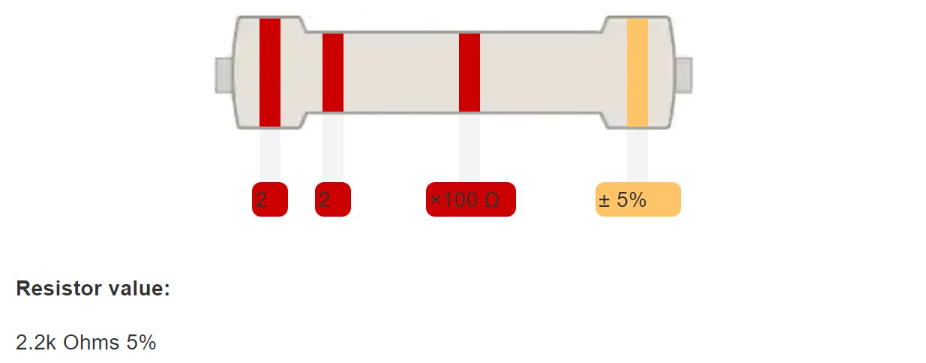
Diagram showing common applications for 2.2k resistors in electronic circuits
The versatility of the 2.2k resistor ensures its continued relevance in electronic design, making it an essential component to recognize and understand in your electronics journey.
Digital Multimeter Methods to Verify 2.2k Resistors
While color code reading is an essential skill, verifying resistor values with a digital multimeter (DMM) is equally important, especially when working with older components or when color bands are difficult to read.
Setting Up Your Multimeter
Modern digital multimeters in 2025 offer impressive accuracy for resistor measurements. To properly measure a 2.2k resistor:
Set your multimeter to the resistance (Ω) function
Select an appropriate range (typically 20kΩ or auto-range)
Ensure the resistor is not connected to any circuit
Touch the multimeter probes to the resistor leads (polarity doesn't matter for resistors)
Pro Tip:
For the most accurate readings, hold the probes against the resistor leads with consistent pressure and avoid touching the metal parts of the probes with your fingers, as this can affect the measurement.
Interpreting Measurement Results
When measuring a 2.2k resistor, your multimeter should display a value close to 2.2kΩ (or 2200Ω, depending on your meter's display format). Keep in mind that resistors have tolerance ranges:
A 5% tolerance 2.2k resistor can read between 2,090Ω and 2,310Ω
A 1% tolerance 2.2k resistor should read between 2,178Ω and 2,222Ω
If your reading falls outside these ranges, the resistor might be faulty or incorrectly identified.

Using a digital multimeter to verify a resistor's value - a standard practice for electronics work
Advanced Measurement Techniques
In 2025, many professional-grade multimeters include specialized features that can be helpful when working with resistors:
Four-wire (Kelvin) measurement: Eliminates lead resistance for ultra-precise measurements
Sorting functions: Automatically categorizes resistors by value and tolerance
Data logging: Records measurements over time to detect drift or temperature effects
For most hobbyist applications, however, a standard two-probe measurement is sufficient for verifying 2.2k resistors.
"While the color code gives you the theoretical value, a multimeter tells you the actual value. Both skills are essential for successful electronics work." - Professional Electronics Engineer
Always remember that temperature affects resistance. A 2.2k resistor measured in very cold or hot conditions may read slightly outside its expected tolerance range, so consider the ambient temperature when evaluating your measurements.
Related Video: Measuring Resistance with a Multimeter the EASY WAY
Learn practical techniques for measuring resistors accurately with any digital multimeter.
undefinedMeasuring Resistance with a Multimeter the EASY WAY
With these measurement techniques, you can confidently verify your resistor readings and ensure that your electronic projects function as intended.
Troubleshooting Common 2.2k Resistor Reading Mistakes
Even experienced electronics enthusiasts occasionally make mistakes when reading resistor color codes. Let's explore the most common errors specific to 2.2k resistors and how to avoid them.
Direction and Orientation Errors
One of the most frequent mistakes is reading the resistor bands in the wrong direction. Remember:
The tolerance band (gold, silver, brown, red, etc.) goes on the right
Reading begins from the opposite end
If there's no obvious tolerance band, look for a gap between bands; the side with the band closest to the edge is usually the first band
My Take:
After teaching electronics for years, I've found that having students always orient resistors with the tolerance band to the right creates a consistent habit that minimizes errors.
Confusion with Similar Values
2.2k resistors are sometimes confused with similar-looking values:
22k resistor: Red-Red-Orange (not Red-Red-Red)
220 ohm resistor: Red-Red-Brown (not Red-Red-Red)
2.2 ohm resistor: Red-Red-Gold (not Red-Red-Red)
The multiplier band is crucial for distinguishing these different values. For a 2.2k resistor, the third band should be red (×100), not orange, brown, or gold.
Color Discrimination Challenges
Some color pairs can be difficult to distinguish, especially in poor lighting:
Brown vs. Red
Blue vs. Violet
Orange vs. Red
Important Note:
When working with resistors, always use good lighting—preferably natural daylight or a daylight-balanced lamp. Some electronics enthusiasts with color vision deficiencies use digital color identifiers or multimeters as verification tools.
Common Mistakes to Avoid
Ignoring the tolerance band: The tolerance affects the acceptable range of the resistor's actual value
Confusing 5-band and 4-band systems: Remember that 5-band resistors have three value digits before the multiplier
Misinterpreting aged or discolored bands: Older resistors may have faded or discolored bands that are difficult to read accurately
Assuming all resistors follow the same standard: Some specialized or vintage resistors may use different coding systems
Quick Checklist for Correct 2.2k Resistor Identification
✓ Orient with tolerance band (usually gold or brown) to the right
✓ Verify the first two bands are both red (value: 2, 2)
✓ Confirm the third band is red for a 4-band resistor (multiplier: ×100)
✓ Check that the calculated value equals 2,200 ohms
✓ When in doubt, verify with a multimeter
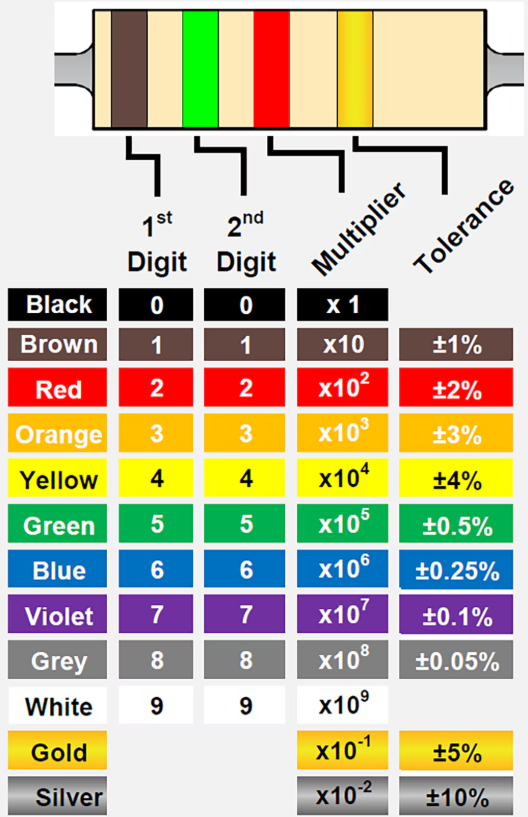
Standard resistor color code chart used to identify component values
By being aware of these common pitfalls and following a systematic approach to reading resistor values, you can avoid errors and build more reliable electronic circuits.
Future Trends in Resistor Technology Beyond 2025
While the humble resistor might seem like a fully mature technology, innovations continue to shape how these components are manufactured, marked, and used in electronic designs. Let's explore what the future holds for resistor technology beyond 2025.
Advanced Marking Technologies
The traditional color band system has served the electronics industry well, but newer marking technologies are gaining ground:
Laser etching: Direct numerical printing on resistor bodies
Digital identification: Tiny embedded NFC or RFID tags for automated inventory and verification
QR microcodes: Microscopic QR codes that can be read with specialized equipment
According to a recent industry report, by 2027, an estimated 35% of newly manufactured through-hole resistors may feature supplementary digital identification in addition to color bands. This dual-marking approach supports both traditional visual identification and automated assembly processes.
Material Science Improvements
Resistor technology is benefiting from advancements in material science:
Thin-film technology: Creating more stable and precise resistors with tolerances as tight as ±0.01%
Carbon nanotube resistors: Offering extreme temperature stability and reliability
Quantum-engineered materials: Developing resistors with predictable temperature coefficients and noise characteristics
These material improvements are particularly important for 2.2k resistors used in precision measurement applications, where stability and accuracy are paramount.
"The resistor market is projected to grow to $12.82 billion by 2029 at a CAGR of 3.8%, driven largely by innovations in materials science and the increasing demand for high-precision components in emerging technologies." - Market analysis report, 2025
Integration and Miniaturization
The trend toward miniaturization continues to influence resistor design:
Integrated networks: Multiple 2.2k resistors in single packages for space-efficient designs
3D-stacked resistors: Vertically arranged resistive elements to maximize board density
Flexible substrate resistors: Components that can conform to non-planar surfaces
For hobbyists and makers, these advancements mean more options for compact designs, though traditional through-hole 2.2k resistors with color bands will remain widely available for the foreseeable future.
Related Video: Reading Resistor Color Codes Fast
Learn expert techniques to quickly identify resistor values in modern electronic circuits.
undefinedReading Resistor Color Codes Fast, Tech Tips Tuesday
Despite these advancements, the fundamental principles of resistor operation remain unchanged, and the ability to read color codes for values like 2.2k will continue to be a valuable skill for anyone working with electronics for years to come.
Frequently Asked Questions About Resistor Color Codes
How do I remember the resistor color code sequence?
Many electronics enthusiasts use mnemonics to remember the color sequence (Black, Brown, Red, Orange, Yellow, Green, Blue, Violet, Gray, White). Some popular contemporary mnemonics include:
"Big Beautiful Roses Occupy Your Garden But Violets Grow Wild"
"Better Be Right Or Your Great Big Venture Goes Wrong"
These memory aids help you recall the sequence in order from 0 to 9, making it easier to translate colors to their corresponding values.
What if my 2.2k resistor measures slightly off from 2,200 ohms?
This is normal and expected due to resistor tolerances:
A ±5% tolerance 2.2k resistor can measure between 2,090Ω and 2,310Ω
A ±1% tolerance 2.2k resistor can measure between 2,178Ω and 2,222Ω
Unless your measurement falls outside these ranges, the resistor is functioning within specifications. Modern circuit designs account for these tolerance variations.
How should I store my 2.2k resistors for easy identification?
For efficient organization:
Use compartmentalized storage boxes with labeled sections
Store resistors in paper tape strips with values written on the tape
Group resistors by decade (all "k" values together)
Consider color-coded containers that match the first band of the resistor
Some electronics hobbyists use digital inventory systems with barcode labels to track their component collections.
Can environmental factors affect my 2.2k resistor readings?
Yes, several environmental factors can influence resistor measurements:
Temperature: Most resistors change value slightly with temperature (typically 0.01% to 0.1% per °C)
Humidity: Extremely high humidity can create surface leakage on resistors
Age: Resistors can drift in value over many years
Mechanical stress: Bending or stressing the resistor leads can alter their value
For critical applications, consider using resistors with lower temperature coefficients and appropriate environmental ratings.
Are there apps to help identify resistor color codes?
Yes, numerous smartphone apps can help identify resistor values from color bands. Some popular options in 2025 include:
ResistorScan Pro (uses camera to identify resistors)
ColorCode Calculator
Electronics Toolkit
Resistor Scanner AR (uses augmented reality technology)
While these apps are convenient, developing the skill to read resistor color codes manually remains valuable for any electronics enthusiast.
Conclusion
Mastering the ability to read the 2.2k resistor color code is an essential skill that will serve you well throughout your electronics journey. Despite advances in component marking and automated identification technologies, the traditional color band system remains widespread in 2025 and continues to be the primary identification method for through-hole resistors.
The distinctive Red-Red-Red-Gold pattern of a standard 4-band 2.2k resistor is worth committing to memory, as this value appears frequently in a wide range of electronic designs from simple LED circuits to complex signal processing systems.
As we look toward the future, resistor technology continues to evolve with improvements in materials, manufacturing techniques, and marking methods. However, the fundamental principles of resistor color coding remain unchanged, creating a bridge between vintage electronics and cutting-edge designs.
Whether you're a seasoned engineer, a hobbyist, or just starting your electronics journey, I hope this guide has provided you with the knowledge and confidence to identify 2.2k resistors quickly and accurately in your projects.
- 1.
What does the "k" in 2.2k resistor stand for?
The "k" in 2.2k stands for "kilo," meaning 1,000. Therefore, a 2.2k resistor has a resistance value of 2,200 ohms. This notation is a standard shorthand in electronics to make component values more readable and concise.
- 2.
Why are resistors color-coded instead of having printed values?
Resistors use color codes rather than printed values primarily because: Color codes are visible from any angle (unlike printed text) .
 Paul George
Richard Electronics guest author, a Mechatronics engineer and a professional researcher, designer, developer and manufacturer for 3d Cad and PCB. I believe in efficiency, effectiveness and quality of work, and my aim is to provide complete one-roof solutions to complex mechanical and electrical design systems. I have a well-equipped lab with state-of-the-art technology for doing research and providing.

07 May 2026
17 April 2026

02 April 2026

02 April 2026

19 January 2026