
With emerging innovations and technological advancements, so comes the race for storage of energy with efficiency and large energy density and capacity. Over the year, how we store energy has improved and changed depending on necessity. Batteries have evolved from simple batteries to more efficient ways of storing power, to a point where energy stored in batteries can be used to move cars and operate large plants.
Capacitors have also been used as an alternative method of storing electrical energy, although operating on a different principle. Batteries store energy in chemicals and then the energy is retrieved through an electrochemical process in which energy is released. On the other hand, capacitors store energy in an electric field, once connected the charges move from one terminal to another thus producing electrical energy. However, capacitors come with a few limitations, they have a low energy density and capacity whilst they also do not discharge steadily. For this reason, batteries are commonly used to store electric energy.
Although batteries have numerous advantages over capacitors and are vastly preferred for storage, they are still faced with several challenges. Large quantities of energy can be stored in batteries, but charging them takes a long time. On the other hand, capacitors charge almost rapidly but can only hold very little energy. In our electric-powered future, we'll probably use supercapacitors (also known as ultracapacitors), which combine the best of both worlds, when we need to store and release massive quantities of electricity extremely fast.
The idea of supercapacitors and combining the advantages of capacitors and those of batteries have existed since the 70s and 80s. In recent years, the idea of supercapacitors had drawn a lot of interest due to the advantages that the technology has to offer. These storage devices have an unlimited charge/ discharge cycle life, non-toxic, and have the potential to offer incredible energy storage with rapid charging.
Storing Electric Energy
Electricity can be stored in several ways, the most common being batteries and capacitors. Although they serve the same function, batteries and capacitors store electricity in very different ways.
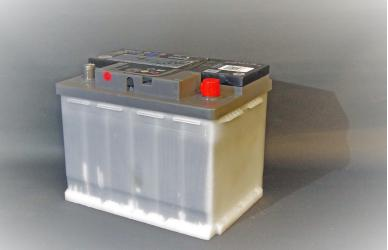
1. Battery
Batteries are one of the most common ways to store electric energy. They work by converting chemical energy into electrical energy, which can then be used to power devices. There are many types of batteries, including lead-acid, nickel-cadmium, lithium-ion, and more.
2. Capacitors
Capacitors typically consist of two metal plates separated by a dielectric material, such as air, paper, or ceramic. When a voltage is applied across the plates, an electric field is created in the dielectric, which stores electrical energy in the form of an electrostatic charge. Capacitors can store energy for a short period and release it quickly, but their energy density is relatively low compared to other storage devices.

Both capacitors and supercapacitors are categories of energy storage technologies that electrostatically store electric charge. But in terms of their design, functionality, and uses, they differ significantly from one another.
What is a supercapacitor?
Supercapacitors also known as ultracapacitors or electrochemical capacitors are electrochemical energy storage devices that store electric energy through an electrostatic charge separation process, also known as the double layer concept. The double-layer concept refers to the formation of a double layer at the interface between an electrode and an electrolyte, which creates a capacitance that can store electric charge.
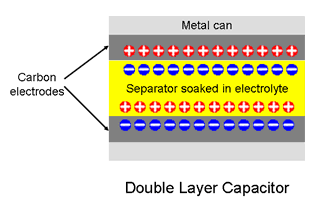
When an electrode with a large surface area, such as activated carbon, is submerged in an electrolyte solution, a double layer is created. The huge surface area offers a sizable contact area for the electrolyte, enabling ions to cling to the electrode's surface. As a result, an electric field is produced on the electrode's surface in the form of a layer of positive and negative charges.
The double layer is composed of two layers of charges: an inner layer of adsorbed ions that are firmly attached to the electrode surface and an outer layer of mobile ions that are unrestricted in their movement within the electrolyte. An electrostatic field is produced by the separation of charges between the two layers, which results in a potential difference, also known as voltage.
The double-layer potential is increased by the extra electric field produced when a voltage is supplied to the electrodes. As a result, the capacitance also rises in line with the increase in stored charge. Unlike batteries, which retain charge through chemical processes, electrostatic storage preserves the charge.
Due to their high-power density—the amount of energy that can be released per unit of time—supercapacitors can store and release electrical energy fast. Additionally, they have a high cycle endurance, which makes them perfect for use in high-power applications.
Benefits of Supercapacitors
Batteries and supercapacitors are both energy storage devices, but they differ in their construction, energy density, charge/discharge rate, and lifespan. Unlike batteries, which store energy through chemical reactions, supercapacitors store energy electrostatically. For this reason, supercapacitors have several advantages over traditional batteries.
1. High Power Density
Supercapacitors can transfer power considerably more quickly than batteries since they have a far greater power density. This makes them perfect for applications that call for brief spikes of high power, such as regenerative braking systems and electric automobiles.
2. Faster Charging
Supercapacitors can be charged considerably more quickly than batteries, which in some applications can be a big benefit. This is due to the fact that supercapacitors store energy electrostatically, which allows for rapid charging and discharging without the need for chemical processes like batteries do.
3. Longer Lifespan
In terms of lifespan, Supercapacitors can withstand many more charge/discharge cycles than batteries, despite the fact that batteries have a longer lifespan. Batteries can typically last for several years or even decades, while supercapacitors have a shorter lifespan due to the wear and tear on their electrodes. Supercapacitors can handle many more charge/discharge cycles than batteries. In some situations, this increases their cost-effectiveness during their lifespan.
4. Operating Temperatures
Wide Operating Temperature Range: Unlike batteries, which have a more constrained operating temperature range, supercapacitors may function across a wide temperature range, from -40°C to 85°C. Supercapacitors are hence perfect for usage in hostile situations.
5. Low Maintenance
Since supercapacitors lack the same deterioration processes as batteries, they require little to no maintenance. They are also more ecologically friendly and safer because they don't contain any dangerous components.
Overall, supercapacitors offer several advantages over batteries, particularly in applications that require high power output, fast charging, and a wide temperature range. However, their lower energy density and shorter lifespan make them less suitable for applications that require high energy storage capacity and a longer lifespan.
Applications of Supercapacitors
Regardless of supercapacitors being relatively new compared to other storage devices such as batteries and traditional capacitors, they are used in a wide range of applications. Supercapacitors are employed in many different applications, such as:
The automotive industry in its new face of electric cars, is one of the leading adopters of supercapacitors, by integrating their advantages into their system. Supercapacitors are used in electric vehicles to store energy during braking and to provide high-power bursts during acceleration.
Supercapacitors are used in energy harvesting to capture and store energy that is harvested in bursts and large amounts. The energy may be harvested from solar cells, wind turbines, ocean waves, and any other source of renewable energy. Supercapacitors are utilized in renewable energy systems to store and release energy from solar panels and wind turbines as needed.
Supercapacitors are utilized in consumer electronics to supply high-power bursts for equipment like cameras and spotlights or as backup power during power outages.
Applications in the industry: Supercapacitors are utilized in industrial settings to supply machines with high-power bursts or backup power for crucial systems. As one of the early uses of backup batteries for primary batteries was to smooth electrical flow or to bridge momentary power outages. Supercapacitors can be found in uninterruptible power supply (UPSs), wireless alarm systems, smart meters, and even solid-state drives (SSDs) in this still commonly utilized function.
Supercapacitors are also used in medical applications and medical devices. In order to supply backup power during power outages or to give high-power bursts for equipment like defibrillators, supercapacitors are utilized in medical equipment.
- 1.
How do supercapacitors differ from batteries?
Although both supercapacitors and batteries are energy storage systems, their design, energy density, charge/discharge rate, and lifespans are different. Supercapacitors can produce power significantly faster than batteries while having a far lower energy density. They are the best choice for applications that need brief bursts of high power since they can be charged and discharged considerably more quickly than batteries.
- 2.
What are the advantages of using supercapacitors?
Supercapacitors offer several advantages over batteries, including high power density, faster charging, longer lifespan, wider temperature range, and low maintenance. They are ideal for use in applications that require high power output, fast charging, and a wide temperature range.
- 3.
What are the disadvantages of using supercapacitors?
Supercapacitors have a lower energy density than batteries, which means they cannot store as much energy per unit of volume or weight. They also have a shorter lifespan than batteries due to the wear and tear on their electrodes.
- 4.
What are some common applications of supercapacitors?
Supercapacitors are commonly used in applications that require high power output and fast charging, such as in electric vehicles, regenerative braking systems, and power grid stabilization systems. They are also used in some consumer electronics, such as digital cameras and flashlights.
- 5.
How are supercapacitors charged?
Supercapacitors can be charged using a variety of methods, including constant voltage charging, constant current charging, and pulse charging. The specific charging method will depend on the application and the requirements of the supercapacitor.
- 6.
How do supercapacitors compare to other energy storage technologies, such as batteries and fuel cells?
Supercapacitors have advantages and disadvantages compared to other energy storage technologies. Compared to batteries, supercapacitors have a higher power density and faster charging time, but lower energy density and shorter lifespan. Compared to fuel cells, supercapacitors have a simpler design and lower cost, but lower energy density and longer charging time.
- 7.
Are supercapacitors environmentally friendly?
A: Supercapacitors are generally considered to be environmentally friendly, as they do not contain any hazardous materials and require little to no maintenance. However, like all electronic devices, they should be disposed of properly to prevent environmental damage.
View More
 Ling Tianhao
Ling Tianhao, with 20 years in R&D, has developed his skills at one of America's top ten chip manufacturers.His expertise goes beyond chip design and quality control, showing a strong understanding of PCB technology. His comprehensive knowledge of microchip and PCB technologies establishes him as a versatile professional in the semiconductor industry, driving advancements and solving complex problems.


04 September 2026
05 August 2026
04 July 2026
06 June 2026
07 May 2026