The current divider rule is the parallel circuit that enables the uniform distribution of the current in different paths and components in a uniform manner according to the resistance values. The working of the circuit is based on two main points: the voltage difference for each component in the parallel circuit is the same, and the resistance is inversely proportional to the current. We’ll also learn to drive the main equations of this rule, and these will be based on Ohm’s law and Kirchoff’s current law. In the end, we’ll have a detailed discussion on the applications of current divider circuits in different electronics. This is going to be a detailed article, and we’ll start the discussion from scratch.
Current Divider Introduction
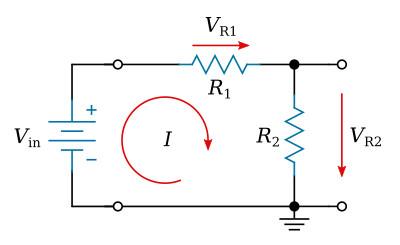
Current dividers are parallel circuits designed to divide the source or supply current into multiple parallel branches. The circuit consists of two or more resistors connected parallel across the voltage source, and the current flowing through each path is inversely proportional to the resistor connected to the path. We know that the main characteristic of parallel circuits is that the current flowing through different branches may be different, but the voltage across each branch is always the same. Mathematically,
VR1 = VR2 = VR3, and so on.
A circuit contains multiple components such as resistors, inductors, capacitors, etc. Understanding the current division between all these is crucial to efficiently designing a circuit and analyzing its efficiency. Let’s discuss its basic characteristics; some of them were mentioned before, but here are the details of each point.
Current Divider Key Characteristics
The current divider circuit is straightforward, but for the efficient designing process, it is crucial to study the basic characteristics of this circuit:
Parallel Connection
The components in the current divider circuits are always parallel, which means all of them share the same two nodes of the voltage for their connection in the circuit.
Total Current Distribution
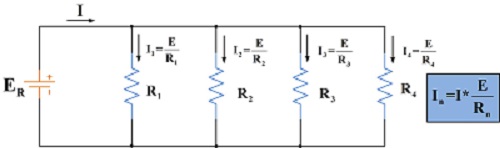
The total current flowing through the circuit is divided into different components according to the resistance values. In other words, the sum of the values of each component results in the total current value.

Inverse Proportionality
The current flowing through individual components is inversely proportional to the component’s resistance; hence, the component with the highest resistance has the lowest current values, and vice versa.
Voltage Value
The voltage of the electrical components is the potential difference between their terminals. The voltage value of each individual component in the current divider circuit is the same as the voltage source.
Current Divider Rule
The current divider rule (CDR) is the fundamental principle in circuit analysis and is utilized to calculate the current flow through each branch of the parallel circuit (also termed the current divider circuit). This rule is derived from Kirchoff’s rule and Ohm’s law; therefore, before deriving the current rule, it is better to understand these two:
Kirchhoff's Current Law (KCL)
Kirchhoff's Current Law(KCL) states that:
“The algebraic sum of the currents flowing through a node or a junction must be equal to zero.“
Mathematically:
∑Iin=∑Iout
Here,
Iin= sum of all the currents entering the node.
Iout= sum of all the current leaving the node.
Usually, the current entering the junction or node is considered the positive current value. By the same token, the current leaving the node is considered the negative current value. As a result, the calculation result for these values must always be zero in a perfectly designed circuit.
Ohm’s Law
The OHM’s law is fundamentally important in electrical engineering, and it provides the relationship between current, voltage, and resistance in the circuit. This forms the basis of the analysis and design of the electrical circuits. It states that:
Current flowing through a conductor is directly proportional to the voltage difference between two points and is inversely proportional to the conductor’s resistance. Mathematically,
V=IR
Where,
V= Voltage across the conductor represented in volts
I= Current flowing through the conductor, represented in amperes
R= Resistance of the conductor, represented in Ohms
For the power calculation in the circuit, Ohm’s law is defined as:
P=IV
Here,
P= Power of the circuit
I= Current flowing in the circuit
R= Circuit resistance
Current Divider Rule Derivation
The parallel circuit has more than one path, so the derivative of current divider rule include the circuit having multiple branches. For the convenience of the readers, I am going to show you the simplest parallel circuit with two branches only.
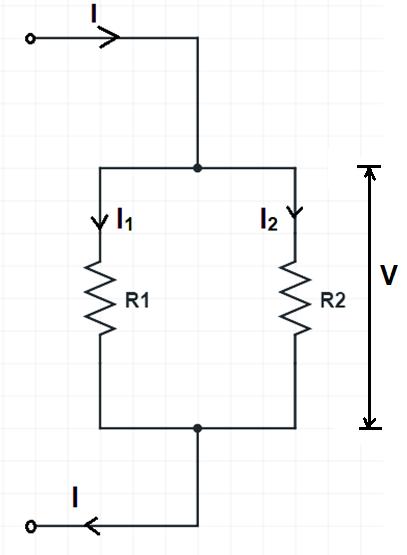
According to the above image:
I1= current flowing to the path one
I2= current flowing through the path two
R1= resistance of the path one
R2= resistance of the path two
I= total current passing through the circuit
V= total potential difference of the circuit
Applying Ohm’s law in the circuit above gives us the following equations:
I1 = V / R1 ……….(eq. 1)
I2 = V / R2 ……….(eq. 2)
Applying Kirchoff’s rule, the total is the sum of all the current flowing in the circuit hence:
Itotal=I1+I2 ……….(eq. 3)
Incorporating equations 1 and 2 into equation 3 gives us the following output:
Itotal=V / R1+V / R2 ……….(eq. 4)
Itotal = V (1/R1 + 1/R2) ……….(eq. 5)
Therefore, if we want to know the total potential difference of the circuit, the following equation is utilized:
V = Itotal x [(R1 R2) / (R1+ R2)] ……….(eq. 6)
Equations 5 and 6 are considered the current divider rule.
Substituting the equation 6 into equation 1:
I1 = (Itotal x [(R1 R2) / (R1+ R2)] )/R1 ……….(eq. 7)
Similarly,
I2 = (Itotal x [(R2 R1) / (R2+ R1)] )/R2
Generally, we can turn the above formula into the following form:
In=Itotal(Rtotal/Rn)
Where n is any path number.
In this way, the same rule can be utilized to get the current values passing through a single node in the parallel circuit.
Current Divider Rule Example
A parallel resistor has two paths, P1 and P2. The resistance of P1 is 50 Ohm, and for P2, the resistance value is 100 Ohm. If a 50A current source is attached to the circuit, then find the current passing through each path.
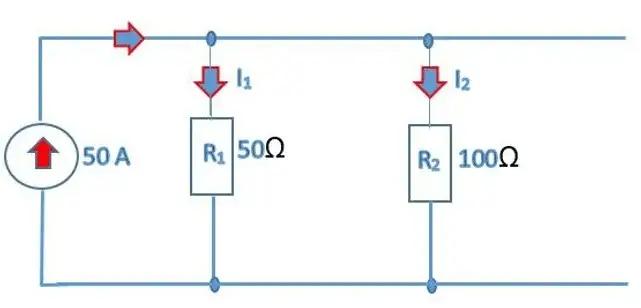
Solution:
Here,
Itotal=50A
R1=50 ohm
R2=100 ohm
I1=?
I2=?
Applying the equation 7
I1 = (Itotal x [(R1 R2) / (R1+ R2)] )/R1
I1 = (50x [(50x 100) / (50+ 100)] )/50
I1 = 33.333 A
Similarly,
I2 = (Itotal x [(R2 R1) / (R2+ R1)] )/R2
I2 = (50 x [(100x50) / (100+ 50)] )/100
I2 = 16.67 A
Current Divider Rule Example 2
A parallel circuit has three resistors labeled R1, R2, and R3. The values of resistors are 200 ohm, 300 ohm, and 400 ohms, respectively. The circuit is connected to a 100V battery source and arranged as shown in the below figure. Apply the current divider rule and show the total current flowing through the circuit and the current passing individually through each path.
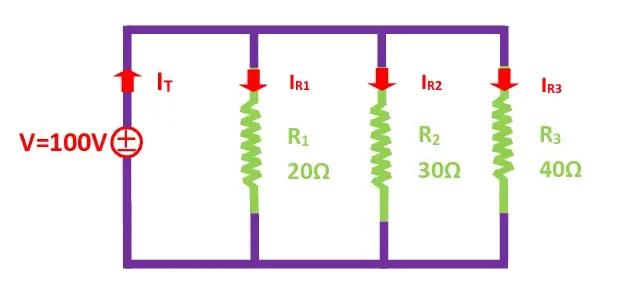
Solution
R1 = 20Ω
R2 = 30Ω
R3 = 40Ω
V = 100 V
Using the equation 6:
V = Itotal x [(R1 R2) / (R1+ R2)]
100= Itotal x [(20x 30x 40) / (20+ 30+40)]
100= Itotal x [(24000) / (90)]
100=Itotall×266.67
Itotal=100/266.67
Itotal≈0.375 A
Similarly, let’s find the I1
I1 = (Itotal x [(R1 R2R3) / (R1+ R2+R2)] )/R1
I1 = (0.375x [(20 x 30x 40) / (20+ 30+40)] )/20
Calculate the resistance combination:
I1 = (0.375x [(2400) / (90)] )/20
I1=0.5
Now,
I2 = (Itotal x [(R2 R1 R3) / (R2+ R1+ R3)] )/R2
I2 = (0.375 x [(2400) / (90)] )/30
I2 =0.3333 A
Now, let’s find I3
I3 = (Itotal x [(R3 R2 R1) / (R3+ R2+ R1)] )/R3
I3 = (0.375l x [(40x30x20) / (40_30_20)] )/40
I3=0.009375 A
To verify our results, let’s use Kirchoff’s current rule:
∑Iin=∑Iout
0.375=0.5+0.3333+0.009375
0.375=0.375
In this way, we utilized the current divider rule to find the total current and the current passing through each path and verified the results.
Applications of the Current Divider Circuit
The current divider rule is of fundamental importance in current analysis, and many circuits we use in our daily lives utilize this rule. Here are some common examples of current divider applications.
Current Divider for Current Sensing in Electronic Circuits
The basic utilization of the current divider rule is in finding the current separately in different paths by dividing the current into different components. As a result, the users can discover if the components of different paths are getting the right amount of current at the perfect level or not. This is crucial to maintaining the circuit components' health.
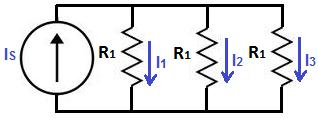
Current Divider in Biasing Transistors in Amplifiers
The transistor biasing utilizes the current divider circuits to provide the necessary biasing current to the transistor. For instance, this circuit has the role of setting the quiescent current in a common-emitter amplifier circuit. As a result, it stabilizes the transistor’s operating point and maintains the circuit functions.
Current Divider in Analog Signal Processing
The analog signals are those having continuous values, and current dividers are essential in the analog signal process because of the following reasons:
● The analog circuit requires precise current control, so the current divider circuit divides the total current into small ones to maintain the performance.
● When a portion of the small current is diverted using the shunt resistor in analog signal processing circuits, it is converted into the current-sensing circuit. This helps in the careful control and monitoring of analog current.
● Current dividers can change the analog current condition, such as current attenuation or amplification. By carefully adjusting the resistor values in the current divider circuit, users can control the current distribution and amplify the path’s current values by handling the other path's current.
In addition to these, current dividers have applications in the biasing and current-voltage referencing of analog signals. The same applies to the analog filter circuit and affects the overall signal response.
Current Divider in LED Current Control
When applied to the LED circuit control, the current divider circuit can be utilized to control the amount of current passing through the LEDs and control the brightness. The LED with more current has more brightness than the one with the low current. Moreover, the careful control of the current ensures that no LED is getting more current than its tolerance.
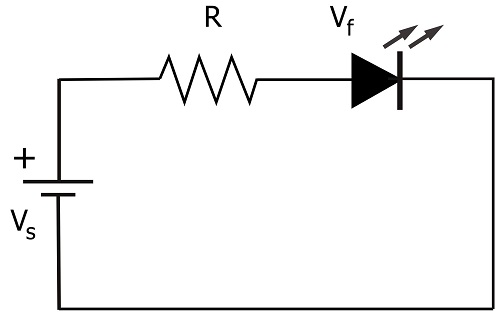
Current Dividers in Thermister
We know that the resistance of the metal increases with the increase in temperature. The current divider circuit plays a role in temperature sensing because the current is divided according to the resistor values that change according to the temperature. For instance, in a temperature monitoring system, the current divider circuit translates the resistance change in the circuit through voltage drop measurement. Hence the temperature changes in the thermister can be identified easily.
Current Divider for Impedance Matching
In the circuit where the impedance has a major effect, the current divider circuit is an essential component. The current divider measures the impedance in each component and helps to ensure maximum power transfer for the least signal reflection in the circuit. An example of such an application is the radio frequency circuits, where the current divider circuit may measure the impedance of the antenna with the transmission line to check the signal integrity and transmission.
Current Divider in Analog to Digital Converter
In analog to digital converters (ADC), the current dividers are used to scale the input signals and their values to guarantee the circuit's health by applying accurate current and voltage values.
Conclusion
The current divider rule is one of the fundamental concepts in circuit analysis, and it makes the current and voltage measurements easily and more accurate. It is derived by combining the concepts of Kirchoff’s rule and Ohm’s law and can be applied to measure the overall current or the current passing through a single path. The same can be applied to the voltage measurement by carefully controlling the equation. This rule is applied to the basic measurement and control in different circuit types such as biasing transistors, current measurement, analog sensing, LED current control, impedance control, an analog to digital-converter, and other circuits of the same kind. Not only for the control of the current but the circuit is utilized in designing and maintaining the health of the circuits and each component.
- 1.
In a parallel circuit, is the voltage difference the same for each component?
Yes, the voltage difference is the same for each component in a parallel circuit.
- 2.
In a parallel circuit, is the resistance inversely proportional to the current?
Yes, the resistance is inversely proportional to the current in a parallel circuit.
 Sophie
Sophie, an accomplished electronic designer from Canada, holds a Bachelor's degree in Electrical Engineering from McGill University. She excels in developing advanced control systems that integrate mechanical, electrical, and computer engineering technologies. Her expertise particularly lies in working with electronic components. Notably, she has distinguished herself in conducting research involving Arduino and Raspberry Pi.


06 October 2026

04 September 2026

05 August 2026

04 July 2026

06 June 2026