Arduino vs. Raspberry Pi - Which is best?
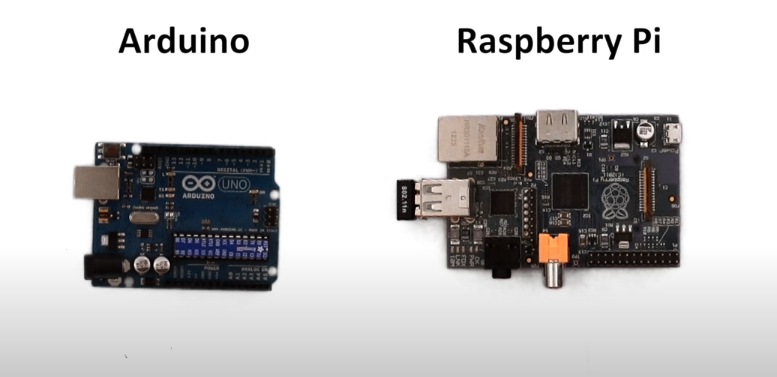
That’s why we have compared Pi vs. Arduino, demystifying their performance, applications, and unique characteristics so you can make an informed decision.

What is Arduino?
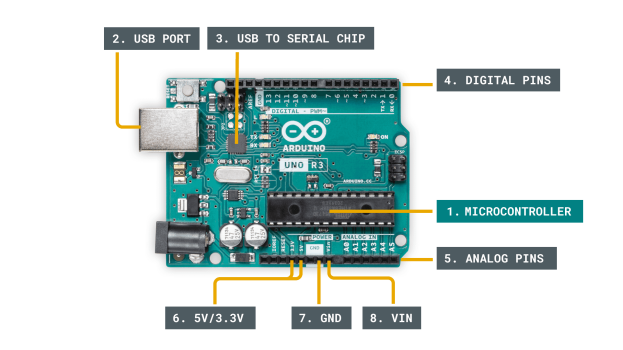
Arduino is an open-source electronic tool that has both hardware and software components. It contains a small circuit board with input and output pins for supporting various sensors, actuators, and other electronic components. It helps the circuit developers to design and build innovative electronics projects.
History
It was first developed by Massimo Banzi et al. at the Interaction Design Institute in Ivrea, Italy. The main purpose of creating Arduino was to assist the students in programming and digital projects. It was also aimed to provide a user-friendly and cost-effective option for building electronic devices.
How does it work?
Arduino boards are microcontroller devices and can execute C or C++ programs present in their firmware. They are not completely developed computers and lack an operating system. To program the Arduino, you can deploy a software application such as the Arduino IDE.
It offers a convenient interface for writing, compiling, and uploading code to the Arduino board. Moreover, this development board is capable of reading a diverse range of inputs and then responding by generating an output.
What is Raspberry Pi?
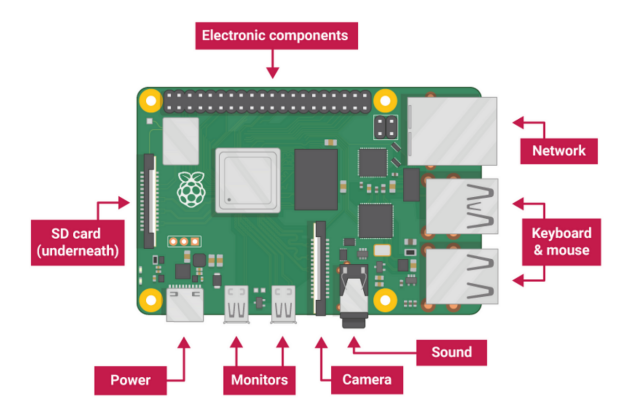
Raspberry Pi is a series of small, affordable, single-board computers that offer computing capabilities similar to a regular PC. These debit-card-sized computers are designed to promote computer science education and enable DIY projects in various fields.
History
In 2012, Raspberry Pi Foundation, a UK charity, developed this electronic tool to foster computer literacy. It was conceived as a low-cost solution to bring accessibility to computing to a broader audience. Now, they are being used worldwide. Raspberry Pi Foundation’s annual review in 2021 showed that 45 million Pi computers have been sold to this date all around the world.
How does it work?
Raspberry Pi integrates components like a PC computer. For instance, it integrates a processor, memory, graphics driver, USB ports, HDMI, output/input pins, and even an operating system. It supports hardware add-ons, such as cameras, sensors, and displays.
Unlike Arduino, the Raspberry Pi board can use more than one programming language. It may include Python, C++, and Java. Also, you can share files via Bluetooth, ethernet, and Wi-Fi connectivity by tailoring Pi computers.
Pi vs. Arduino
At first sight, both of the options seem similar, but they differ significantly in functionality and purpose. When deciding between Arduino vs. Pi, you must know their strengths and weaknesses against each other. Let's look into some basic differences between Pi and Arduino.

Working Principle
Arduino operates as a microcontroller that potentially accommodates everything required to execute computing tasks. It’s a black integrated circuit unit containing a microprocessor, memory, timer, and I/O parts.
This tiny chip makes it easy for the MCU to communicate with the outer digital medium. In the Arduino board, the microcontroller is the core part that performs the main electronics tasks. However, the Arduino software is also dedicated to interface with it. It’s ideal for tasks requiring precise timing and low-level hardware control.
Meanwhile, Raspberry Pi works as a desktop computer and features a Broadcom CPU and graphics processing unit. The Broadcom CPU is the core element of Pi that performs the computer's core functions. It runs on the operating system and offers a graphical interface to the user. Pi executes general-purpose computing tasks and runs applications like computers.
Operating System
One of the major differences between Pi vs. Arduino is having an operating system. Arduino does not have a dedicated operating system. It employs a firmware program or specialized programming language that directly runs on the microcontroller.
Contrarily, the Pi has its own operating system known as Raspbian, a standard version of Linux. Unlike Arduino, it can run several programming languages. It can even run other third-party OS like Android, RISC OS, and more.
Power Supply
The decision between Raspberry Pi vs. Arduino also depends on the power management systems. Generally, both controller boards are low-power tools. But Arduino offers more flexibility with power management. It can be powered directly through a USB, battery pack, or an external power source.
Pi requires more stable power than Arduino. So, you don't employ a battery pack and may require a higher voltage power supply or a wall adaptor.
Costs
When it comes to Pi vs. Arduino costs, Raspberry Pi is a bit more expensive than Arduino. The cost varies depending on the model and included features.
Contrarily, Arduino is a cost-effective option. Various models with different prices are available.
Applications
Prior to purchasing a development board, it's crucial to outline your project's requirements. This initial planning allows you to identify the most suitable board between Pi vs. Arduino for your task.
As highlighted earlier, Raspberry Pi functions similarly to a complete computer. Therefore, if your project involves multiple program executions, opting for Raspberry Pi over Arduino would be the more fitting choice.
On the other hand, Arduino is ideal for uncomplicated projects with minimal coding complexities. It’s widely deployed in the following domains:
· Medical Instrument
· Emergency Light for Railways or Traffic Lights
· Robotics
· Controlling LEDs and Motors
· Home and Industrial Automation
· Embedded systems
· Sensor interfacing
· Wearable technology
· Educational projects
Whereas Raspberry Pi has the following applications:
· Home automation
· Media centers
· Desktop computing projects
· Wireless Usage
· Game Servers
· Retro Gaming Machine
· Robot Controller
· Stop motion or Time-lapse Camera
Clock Speed Performance
When embracing the clock speed differences between Pi vs. Arduino, Raspberry Pi excels. It typically offers a clock speed of 1.8GHz, which is much higher than Arduino.
Arduino offers clock speeds of 16 MHz or 48 MHz, and it also depends on the microprocessors deployed. The latest version, Portenta H7, can run up to 480 MHZ and is the fastest model available.
Conclusion
In short, the choice between Raspberry Pi and Arduino hinges on the specific needs of your project. Understanding the differences between Pi vs. Arduino helps you to make an informed decision for successful DIY electronics projects.
- 1.
Does Arduino have an operating system?
No, Arduino does not have a dedicated operating system. It uses a firmware program or specialized programming language that runs directly on the microcontroller.
- 2.
Which is more suitable for multiple program executions, Arduino or Raspberry Pi?
Raspberry Pi is more suitable for multiple program executions as it functions like a complete computer, while Arduino is better for uncomplicated projects with minimal coding complexities.
 Sophie
Sophie, an accomplished electronic designer from Canada, holds a Bachelor's degree in Electrical Engineering from McGill University. She excels in developing advanced control systems that integrate mechanical, electrical, and computer engineering technologies. Her expertise particularly lies in working with electronic components. Notably, she has distinguished herself in conducting research involving Arduino and Raspberry Pi.


04 September 2026

05 August 2026

04 July 2026

06 June 2026

07 May 2026