
How Relays Work - Basic working principle electronics engineering electrician amp
Power Relay:
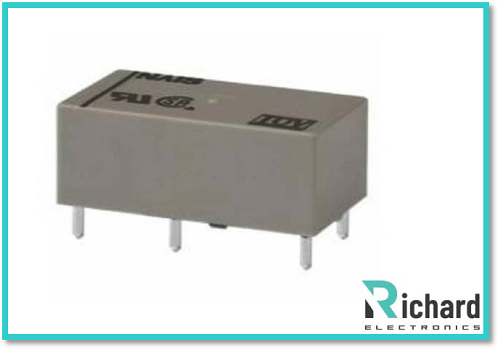
To open and close the circuit electromagnetic is used by the power relay when the input coil is correctly excited. Between the control signal and the output which are coil and contacts respectively high level of isolation is provided by these coils and typically 4 to 6kV of rated impulse voltage. This type of relay may have change over which is just normally open contacts or both normally open and normally closed contact. When only the normally open contacts are provided. A greater contact gap means normally open contacts are provided its required in some specific applications. When it comes to the higher current switching the power relays are reliable problem solvers.
Working of Power Relay:
The power relay’s basic design consists of an armature, an electromagnet which is coil and iron core), one or more pairs of contacts, and a spring. The electromagnet will be activated when it has normally open (NO) contacts. The magnetic field generated attracts the armature resulting in moving the contacts together allowing the large current to flow and complete the circuit. It is reversed in the case of the normally closed NC relay and when the contacts are closed by the return spring.
Power relay applications:
· Power relays have a number of applications across diverse industries due to their versatility here we will discuss some important applications of power relays
· To control motors, fans, and various machines the power relays are extensively used in industrial automation. The high power load switching can be performed with the help of power relays that allow seamless control and operation.
· Power relays play a vital role in the category of home appliances such as regulating water pumps, heaters in homes built in cold environments, and compressors. Home appliances such as ovens, refrigerators, and washing machines are responsible for reliable on-off switching.
· HVAC systems rely mostly on power relays for their functions. The fans, heaters, and conditioning units are precisely controlled with the help of power relays. The comfortable indoor environment and the efficient operations of the systems are ensured by the power relay.
· In security and alarm equipment, power relays are integrated into control access points, surveillance equipment, and alarms. The premises' security is ensured with the help of the power relay and their vital role in this regard.
Solid State Relay:
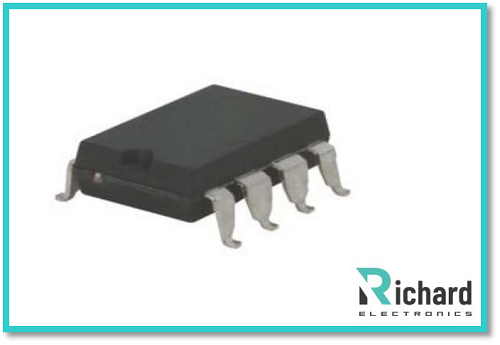
The type of switching relay that uses no mechanical part for its working is known as the solid state relay. These type of relays has a longer lifespan than other common electromechanical relays because of the absence of mechanical parts. The world has been taken by storm by the solid state relays which revolutionized power distribution in almost every industry. Every industry from automation to agriculture was revolutionized by these relays in terms of power distribution.
Solid State Relay Working:
These relays are typically designed as simple as an on/off switch equipped with the load terminal and the power terminal. When an eternal control signal through other terminals is passed to the relay the switching is performed by these relays. The load is given power mostly with the help of MOSFET power, and when a signal is passed, the switching happens very quickly. Both AC and DC switching capacity models of these relays can be designed in case of these relays but for either scenario, the configuration can be modified. With the source and drain connected to power and load DC relays operate with a single MOSFET whereas the pass gate is connected with the control signal. On the other hand, two transistors are required for AC switching of solid state relays because one MOSFET is not enough to inhibit the current in both directions when the solid state relay is in the off state.
Applications of Solid State Relay:
· High-frequency temperature control in furnaces, textiles, residential heating, etc required solid-state relays. These relays enable high-precision temperature control in a number of different types of industrial applications.
· Motor control is one of the most common applications of solid-state relays. From small motors in the home to large industrial AC and DC motors with the help of SSRs can be controlled by the solid-state relays.
· For the switching loafs such as LED arrays solid state relays are used. The fast switching speed required for certain lighting effects is achieved with the help of these relays.
· The medical equipment required a specialized control system due to its critical nature to turn the power on and off. For this requirement, the solid-state relay switches are perfect because of their ability to use very low input signals and they are very reliable.
· Solid state relays play a vital role in the automotive industry such as in engine management systems these relays are rapidly replacing the older mechanical relays.
Automotive Relay:
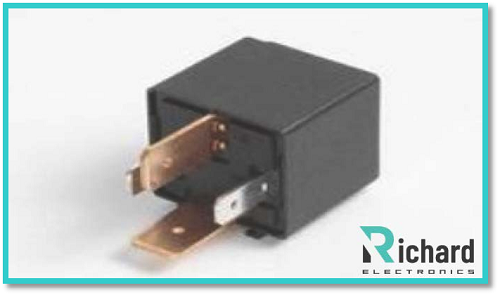
Cars, trucks, and almost all types of automobiles are equipped with automotive relays of all shapes and sizes. These relays are generally used in turning on and off headlights. Using one input to switch multiple things at once in an automobile is also possible through relays.
Working of Automotive Relay:
The automotive relays attract the contractor through magnetism when current passes through their terminals. The passing current through the terminal causes the relay to repeat which ensures the smooth flow of current. Premature damage to electrical components of the car is also prevented through the automotive relays.
Application of Automotive Relay:
· Overheating in can is prevented with the help of an automotive relay which extends the lifespan of switches in a car. The main purpose of this protection is to ensure that car light switches wont, melt due to excessive heat.
· The electrical current strength of the car can be enhanced by adding the relays to the cars. As the electrical current can flow optimally the relays provide brighter car lights.
· The performance of electromagnetic components is affected by the electrical resistance in cars such as weak horn sound and dim car lights. To prevent this phenomenon we add relays for different components of cars.
· The locking mechanism of the car is another main function of the relay and plays the vital role of automatically connecting and disconnecting electrical current.
- 1.
What are the main components of a power relay?
The main components of a power relay include an electromagnet (coil and iron core), an armature, one or more pairs of contacts, and a return spring.
- 2.
What are the advantages of solid-state relays (SSR) compared to traditional electromechanical relays?
Solid-state relays have no mechanical parts, offering longer lifespan, faster switching speeds, and the ability to handle high-frequency operations with low-power input signals.
- 3.
What are the common applications of automotive relays in vehicles?
Automotive relays are used to prevent overheating in switches, enhance electrical current strength for brighter lights, improve the performance of electromagnetic components, and control car locking mechanisms.
View More
 Paul George
Richard Electronics guest author, a Mechatronics engineer and a professional researcher, designer, developer and manufacturer for 3d Cad and PCB. I believe in efficiency, effectiveness and quality of work, and my aim is to provide complete one-roof solutions to complex mechanical and electrical design systems. I have a well-equipped lab with state-of-the-art technology for doing research and providing.


04 September 2026
05 August 2026
04 July 2026

06 June 2026

07 May 2026