What is STM32 Nucleo-32?
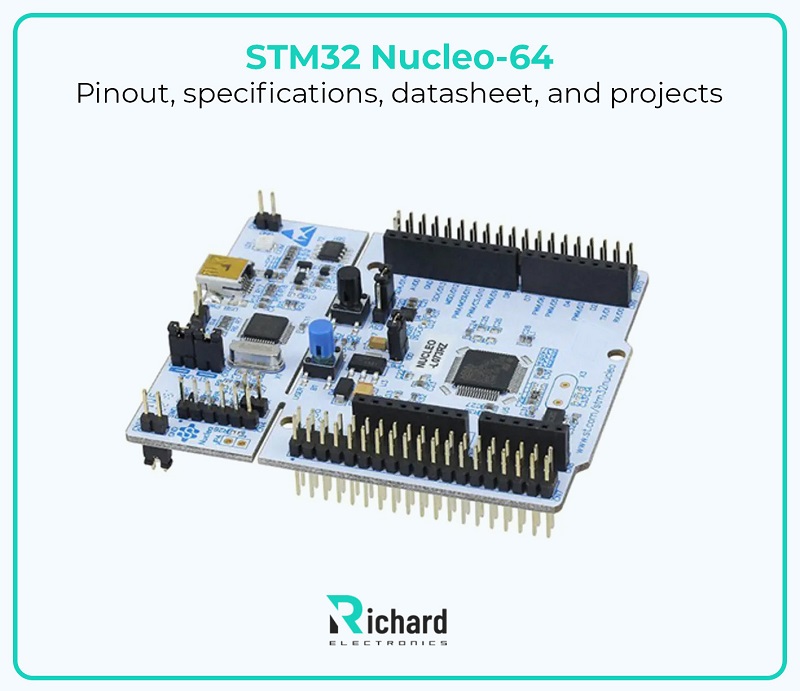
The STM32 Nucleo-32 development board is a compact and low-cost board made for fast prototyping with STM32 microcontrollers. With an Arduino Nano-compatible form factor, users can easily incorporate it into existing projects. Different STM32 MCUs like STM32L432KC and STM32F303K8 provide quite a powerful ARM Cortex-M0/M3/M4 core running at a clock rate of about 80 Hz, memory up to 256 KB Flash, and 64 KB RAM. It supports multiple protocols such as I2C, SPI, UART, and PWM with 5V tolerant I/O for flexibility. An onboard ST-Link/V2-1 debugger has removed the need for an external programmer.

The power and programming can be tackled by a USB connection. Both beginner and advanced users can use the Nucleo-32 for IoT, robotics, industrial control, and low-power applications. There is extensive STM32Cube firmware support, HAL libraries, and Arduino compatibility that would combine for easy and seamless building and testing of embedded systems.
Development boards generally feature the most common basic projects, which include one or more LED blinking, sensor interfacing, motor control, or wireless communication. Its small size and excellent performance are good reasons this platform is said to suit an engineer, student, or hobbyist searching for an effective microcontroller development tool. The STM32 Nucleo-32 enables a powerful choice of microcontroller depending on the application requirements.
In this article, you will find pinouts, datasheets, specifications, features, and projects of the STM32 Nucleo-32. Let’s dive.
Datasheet STM32 Nucleo-32

Features | Details |
Microcontroller Options | STM32L432KC (Cortex-M4, 80 MHz), STM32F303K8 (Cortex-M4, 72 MHz), STM32F091RC (Cortex-M0, 48 MHz) |
Architecture | ARM Cortex-M (M0, M3, M4 depending on model) |
Core Frequency | 48 MHz (Cortex-M0), 72 MHz (Cortex-M4), 80 MHz (Cortex-M4 with DSP & FPU support) |
Flash Memory | 32 KB – 256 KB (varies by MCU model) |
SRAM (RAM) | 8 KB – 64 KB |
EEPROM | No dedicated EEPROM (EEPROM emulation via Flash) |
Bootloader | USB DFU (Device Firmware Update) supported |
Power Supply | 5V (via USB or VIN), 3.3V onboard regulator |
Operating Voltage | 3.3V (I/O pins are 5V tolerant) |
Current Consumption | Run Mode: ~10 mA (typical), Standby Mode: ~2.5 µA |
Low-Power Modes | Sleep, Stop, and Standby modes |
GPIO Pins | Up to 25 configurable digital/analog I/O pins |
Digital I/O Pins | 25 |
Analog Inputs (ADC) | 12-bit ADC, up to 10 channels, sampling rate up to 1 Msps |
PWM Channels | Multiple PWM outputs supported via timers |
DAC Outputs | Available on specific models (e.g., STM32L432KC) |
Communication Interfaces | 3x USART/UART, 2x I2C, 2x SPI, USB 2.0 Full-Speed |
Timers | Advanced, General-Purpose, and Basic Timers, including watchdog timers |
USB Interface | USB 2.0 Full-Speed (Device Mode Only) |
Clock Sources | Internal 16 MHz RC, External 32.768 kHz crystal (for RTC) |
Real-Time Clock (RTC) | Yes, with backup battery support |
Watchdog Timer (WDT) | Yes, with independent and windowed watchdog timers |
Interrupts & DMA | Nested Vectored Interrupt Controller (NVIC), Direct Memory Access (DMA) supported |
Programming & Debugging Interface | ST-Link/V2-1 (SWD, Virtual COM Port, drag-and-drop programming) |
Software Development Support | STM32CubeIDE, Keil MDK, IAR Embedded Workbench, Arduino IDE, Mbed OS |
Compatible Shields | Arduino Nano-compatible shields (limited compatibility) |
Oscillator Options | Internal RC oscillator or external crystal |
Security Features | Memory protection unit (MPU), CRC calculation unit, hardware random number generator (RNG) (available in some models) |
Onboard LEDs | 1x User LED (on PA5), 1x Power LED |
Onboard Button | 1x Reset Button |
External Interrupts | Available on multiple GPIO pins |
I2C Pull-up Resistors | Required externally (not included on board) |
Operating Temperature | -40°C to +85°C |
Storage Temperature | -55°C to +150°C |
Humidity Tolerance | 5% to 95% RH (non-condensing) |
Board Dimensions | 18 mm x 45 mm |
Weight | ~10g |
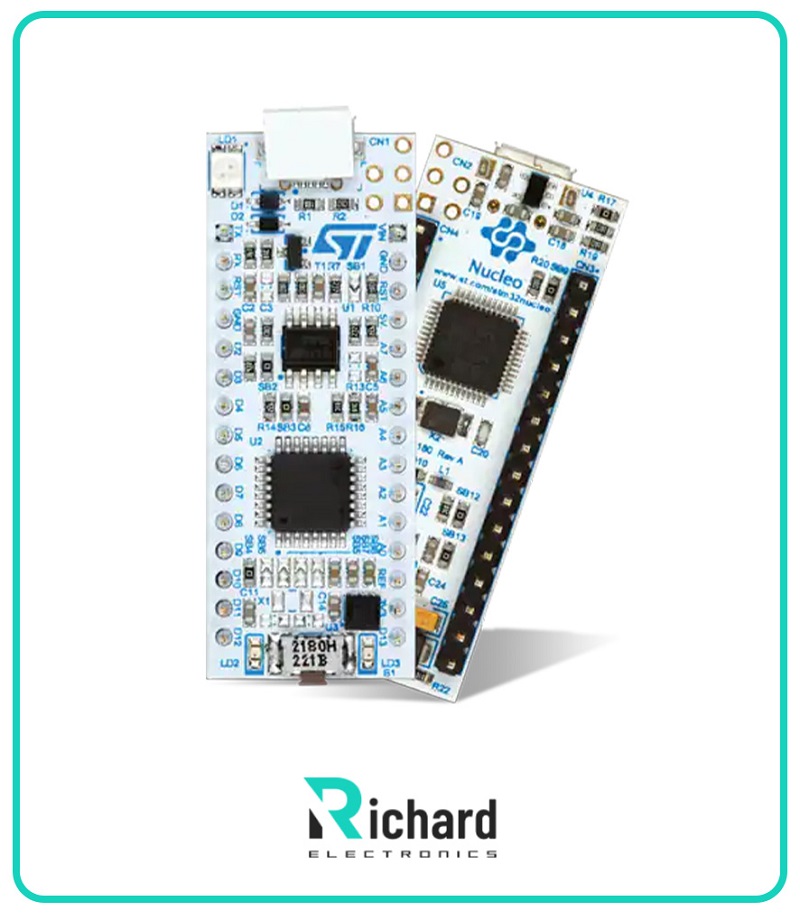
Pinouts of STM32 Nucleo-32
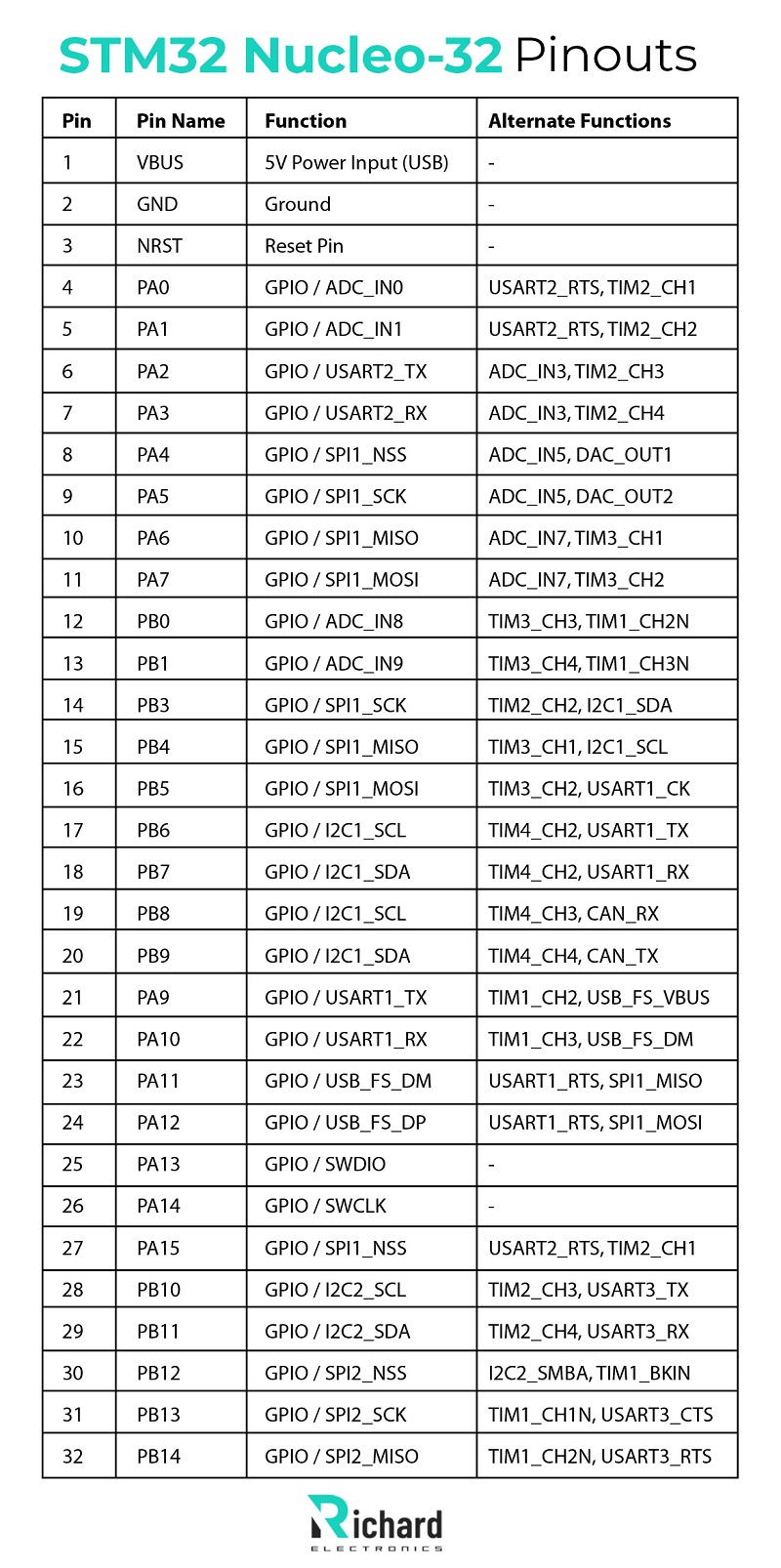
Pin | Pin Name | Function | Alternate Functions |
1 | VBUS | 5V Power Input (USB) | - |
2 | GND | Ground | - |
3 | NRST | Reset Pin | - |
4 | PA0 | GPIO / ADC_IN0 | USART2_RTS, TIM2_CH1 |
5 | PA1 | GPIO / ADC_IN1 | USART2_RTS, TIM2_CH2 |
6 | PA2 | GPIO / USART2_TX | ADC_IN3, TIM2_CH3 |
7 | PA3 | GPIO / USART2_RX | ADC_IN3, TIM2_CH4 |
8 | PA4 | GPIO / SPI1_NSS | ADC_IN5, DAC_OUT1 |
9 | PA5 | GPIO / SPI1_SCK | ADC_IN5, DAC_OUT2 |
10 | PA6 | GPIO / SPI1_MISO | ADC_IN7, TIM3_CH1 |
11 | PA7 | GPIO / SPI1_MOSI | ADC_IN7, TIM3_CH2 |
12 | PB0 | GPIO / ADC_IN8 | TIM3_CH3, TIM1_CH2N |
13 | PB1 | GPIO / ADC_IN9 | TIM3_CH4, TIM1_CH3N |
14 | PB3 | GPIO / SPI1_SCK | TIM2_CH2, I2C1_SDA |
15 | PB4 | GPIO / SPI1_MISO | TIM3_CH1, I2C1_SCL |
16 | PB5 | GPIO / SPI1_MOSI | TIM3_CH2, USART1_CK |
17 | PB6 | GPIO / I2C1_SCL | TIM4_CH2, USART1_TX |
18 | PB7 | GPIO / I2C1_SDA | TIM4_CH2, USART1_RX |
19 | PB8 | GPIO / I2C1_SCL | TIM4_CH3, CAN_RX |
20 | PB9 | GPIO / I2C1_SDA | TIM4_CH4, CAN_TX |
21 | PA9 | GPIO / USART1_TX | TIM1_CH2, USB_FS_VBUS |
22 | PA10 | GPIO / USART1_RX | TIM1_CH3, USB_FS_DM |
23 | PA11 | GPIO / USB_FS_DM | USART1_RTS, SPI1_MISO |
24 | PA12 | GPIO / USB_FS_DP | USART1_RTS, SPI1_MOSI |
25 | PA13 | GPIO / SWDIO | - |
26 | PA14 | GPIO / SWCLK | - |
27 | PA15 | GPIO / SPI1_NSS | USART2_RTS, TIM2_CH1 |
28 | PB10 | GPIO / I2C2_SCL | TIM2_CH3, USART3_TX |
29 | PB11 | GPIO / I2C2_SDA | TIM2_CH4, USART3_RX |
30 | PB12 | GPIO / SPI2_NSS | I2C2_SMBA, TIM1_BKIN |
31 | PB13 | GPIO / SPI2_SCK | TIM1_CH1N, USART3_CTS |
32 | PB14 | GPIO / SPI2_MISO | TIM1_CH2N, USART3_RTS |
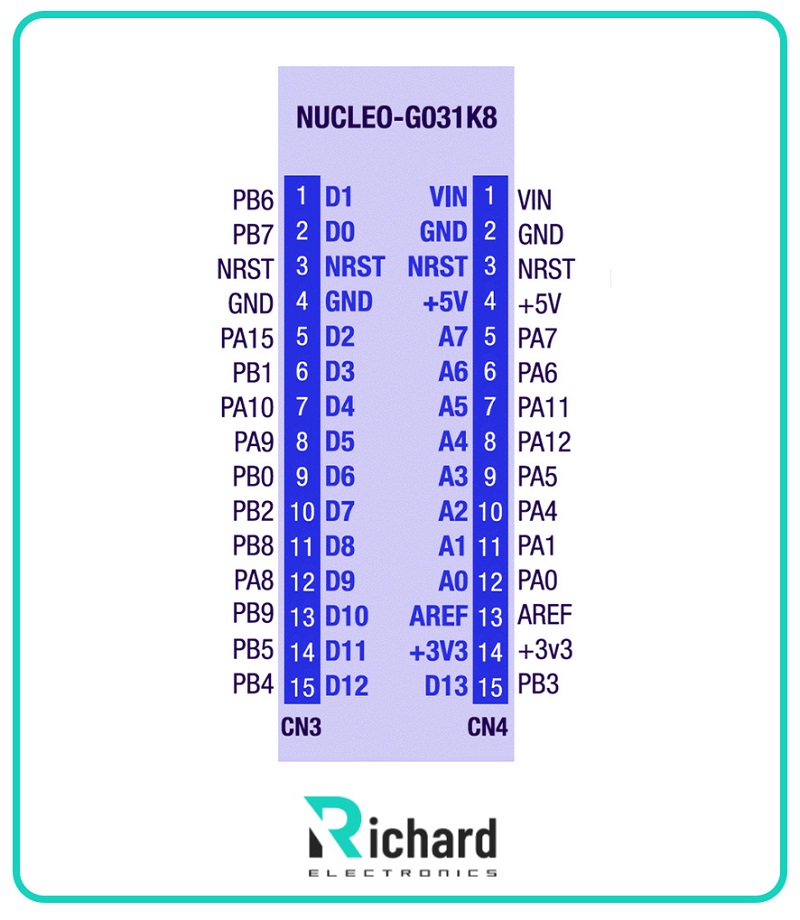
Specifications of STM32 Nucleo-32

Microcontroller Options:
The STM32 Nucleo-32 is offered with various microcontrollers, enabling the developer to pick the model that would best fit the needs of a given project. Among the most popular variants are:
● STM32L432KC (Cortex-M4, 80 MHz, 256 KB Flash, 64 KB RAM) - Excellent for low-power applications.
● STM32F303K8 (Cortex-M4, 72 MHz, 64 KB Flash, 16 KB RAM) - Best for signal processing and motor control.
● STM32F091RC (Cortex-M0, 48 MHz, 256 KB Flash, 32 KB RAM) - Economical for general-purpose usage.
Each of these microcontrollers has varying levels of performance with custom configurations in terms of memory size, processing speed, and peripheral features.
Processing Capabilities:
The Nucleo-32 boards are based on STM32 microcontrollers based upon ARM Cortex-M0, M3, and M4 architectures. These cores, described with very low drink, real-time, and high-performance tasks, run with a maximum clock frequency from 48 MHz in the Cortex-M0 variants to 80 MHz in the Cortex-M4 types, thus giving a fine balance between power efficiency and processing capabilities In most of the cases, the DSP and motor control tasks are expected to be enhanced with the floating point unit (FPU) thereby making the Cortex-M4 variants superior for complex mathematical calculations.
Support for Thumb-2 instructions further optimizes program code size and execution speed for embedded applications. The deep low power-down modes also render these microcontrollers able to operate on their battery pool very efficiently.
Memory & Storage:
The STM32 Nucleo-32 comes with different memory configurations to meet different application requirements.
● Flash: 32 KB to 256 KB, depending on the microcontroller model. The range of this non-volatile memory includes storing firmware and application codes.
● RAM: from 8 to 64 KB - Maintain real-time task execution with ease.
● EEPROM Emulation: There are no specific memories for EEPROM on these microcontrollers, but they can do it through emulation on flash memory.
● Furthermore, the board supports Device Firmware Update (DFU) over USB, thus allowing firmware updates without an external programmer.
Input/Output Pins:
The STM32 Nucleo-32 offers a considerable number of GPIOs, thus becoming versatile in several applications. The number of available I/O pins depends on the microcontroller in question but generally includes:
● Digital I/O Pins: Up to 25 configurable pins for general-purpose applications.
● Analog Inputs: Multiple ADC channels (10-bit or 12-bit resolution).
● PWM Outputs: A variety of pins support PWM for motor control and LED dimming.
● External Interrupts: Configurable on multiple pins for handling real-time events.
The above I/O pins are also 5V tolerant, further enabling interfacing with a standard variety of sensors and modules outside.
5. Communication Interfaces:
The STM32 Nucleo-32 is equipped with several communication interfaces for attaching different peripherals, sensors, and other devices. These are:
● UART/USART: serial communication, debugging, and interfacing devices including Bluetooth modules and GPS receivers.
● I2C: It allows the connection to low-speed peripherals like the sensors and EEPROMs.
● SPI: permits high-speed communication to SD cards, displays, and RF modules.
● USB: Certain models of Nucleo boards include a port to enable a USB interface for data transfer and programming.
With these interfaces, connecting the board to different external devices is very easy, and the capabilities for embedded systems applications become wider.
6. Power Supply Options:
● Very adaptable for relevant applications, the STM32 Nucleo-32 offers many different power sources.
● USB Power: The board gets power from the Micro-USB port, supplying 5V input.
● VIN Pin: Here you can attach an external power source (battery or adapter) to the VIN pin.
● 3.3V output: This board is provided with an onboard 3.3V regulator, which can be used to power external components.
The board can also be designed to operate with low power consumption so that it consumes reduced battery power, making it the best candidate for both portable and "Internet of Things" applications.
7. On-board Debugger & Programming:
One of its multiple high-end characteristics is programming and debugging without needing an external debugger, making it much less complicated to set up as the ST-Link/V2-1 debugger is inside the STM32 Nucleo-32. Some of the most relevant features that the ST-Link/V2-1 debugger has are as follows:
● Drag-and-Drop Programming: Update the firmware by dragging and dropping files to the board over USB.
● SWD (Serial Wire Debug) Interface: It can provide real-time debugging and performance analysis.
● Serial interface for debugging messages: Virtual COM port.
These are just some of the features the STLink comes with, and they will have support for STM32CubeIDE, Keil, IAR, and Arduino IDE.
8. Development Environment & Software Support:
The STM32 Nucleo-32 works with many development tools and software libraries, and most importantly, it can get people started very easily with embedded programming.
● STM32CubeIDE: STMicroelectronics offers the following official development environment featuring HAL libraries and debugging tools.
● Arduino IDE Support: The board can also be programmed in the Arduino IDE, making it an easy-to-handle board for a beginner.
● Mbed OS Compatibility: Real-time operating system (RTOS) support, for instance, Mbed OS compatibility, is a boon for complex applications.
● HAL & LL Libraries: Hardware Abstraction Layer (HAL) and Low-Level (LL) drivers are provided by STMicroelectronics for efficient programming.
Thus, they can build applications and deploy them with ease without mastering low-level programming.
Projects of STM32 Nucleo-32
1. LED Blinking (Getting Started Project):
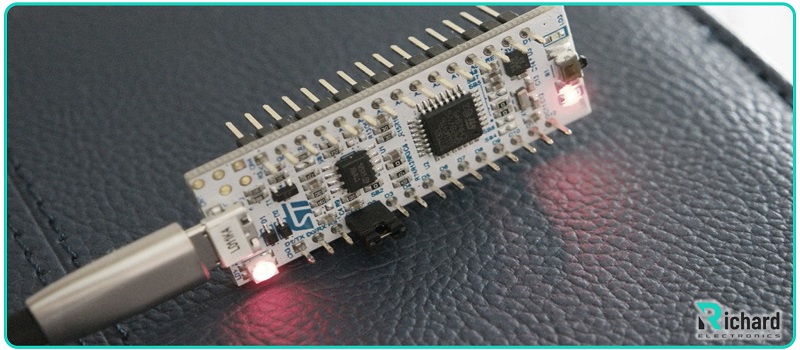
The LED blinking is the simplest project to begin with using STM32 Nucleo-32. You can write a simple GPIO control code-switching the LED on and off for certain time intervals with the onboard LED using HAL (Hardware Abstraction Layer) libraries in STM32CubeIDE.
2. Button-Controlled LED:
In this project, the state of an LED is toggled by a push button. The microcontroller reads the GPIO input state from the button and turns the LED on or off accordingly. Debouncing techniques may be used to ensure reliability in button press exercises.
3. Temperature Monitoring System:
This system measures temperature in real-time using DS18B20 or DHT11 temperature sensors interfaced to an STM32 Nucleo-32 and displays it on the LCD or OLED of 16x2 size. The project also introduces the concepts of ADC (analog-to-digital conversion) and I2C/SPI communication.
4. PWM-based DC Motor Speed Control:
Control the speed of a DC motor using STM32 Nucleo-32 with Pulse Width Modulation (PWM). This project consists of generating PWM signals controlling the motor speed as a response to some user input from a potentiometer or sensor feedback.
5. Serial Communication with UART:
With this project, an STM32 Nucleo-32 is interfaced to the computer using UART (Universal Asynchronous Receiver-Transmitter) to send and receive data through a serial monitor (like PuTTY or Arduino Serial Monitor). This project is extremely useful for debugging and logging of data in real-time.
6. RTC-I2C Interface:
Interfacing the RTC module(like DS3231) with Nucleo-32 helps to keep track of time when power is turned off. The status may be displayed on an LCD or saved to memory for timestamping logs.
7. IoT Based Weather Monitoring:
The STM32 Nucleo-32 with Wi-Fi modules like ESP8266 can upload sensor data (temperature, humidity) to the cloud for remote monitoring. This gives insight into IoT and HTTP/MQTT communication.
Conclusion:
The STM32 Nucleo-32, a small, powerful, and low-cost development board targeted toward hobbyists of various levels in the embedded systems industry, is an untapped treasure. Compact and Arduino Nano-compatible, complete with ST-LINK/V2-1 built-in debugger, and highways for interfacing other peripherals via I2C, SPI, UART, ADC, and PWM, it has enough versatility to suit all industrial applications such as IoT, automation, robotics, and sensor-based applications.
The low power consumption, coupled with high processing efficiency, and simple programming via STM32CubeIDE or Arduino IDE, make these boards also attractive to developers switching from other platforms. Projects vary from the basics to the more advanced, including LED control, motor speed control, real-time logging, cloud applications, etc.
Support from STMicroelectronics and an active developer community provide an excellent framework for troubleshooting and enhancing projects. All in all, the STM32 Nucleo-32 would be simply perfect for rapid prototyping, academic research, and industrial development for putting embedded system innovations within immediate reach.
- 1.
What makes the STM32 Nucleo - 32 suitable for low - power applications?
The STM32L432KC variant with a Cortex - M4 core at 80 MHz is excellent for low - power use. Also, its deep low power - down modes enable efficient battery operation.
- 2.
How can I program the STM32 Nucleo - 32? Answer: You can use development tools like STM32CubeID
You can use development tools like STM32CubeIDE, Keil MDK, IAR Embedded Workbench, Arduino IDE, or Mbed OS. The onboard ST - Link/V2 - 1 debugger supports drag - and - drop programming and SWD interface for real - time debugging.
 Paul George
Richard Electronics guest author, a Mechatronics engineer and a professional researcher, designer, developer and manufacturer for 3d Cad and PCB. I believe in efficiency, effectiveness and quality of work, and my aim is to provide complete one-roof solutions to complex mechanical and electrical design systems. I have a well-equipped lab with state-of-the-art technology for doing research and providing.

06 October 2026

04 September 2026
05 August 2026
04 July 2026
06 June 2026