
A flyback transformer is a multi-winding inductor coupled together. The gap exists between the coupled inductors stores energy when voltage is applied to its primary coil. Later this energy is supplied to secondary winding where energy is provided to the load. Voltage transformation and circuit isolation in flyback converters are done by the flyback transformers. For higher efficiency and cost-effectiveness of isolated power supply, the flyback transformers are the most popular choice (up to 120 W). These transformers provide us with the possibility of positive or negative output voltages, circuit isolation, and the potential for multiple outputs. We can regulate flyback transformers over a wide range of load conditions and input voltage. This article discusses the design and application of flyback transformers in detail.
What is a flyback?
In the flyback topology, during the first half cycle of the switching cycle energy is stored in the magnetic field, and during the second half cycle, this energy is released to the secondary winding that is connected to the load. The gapped core construction design of the flyback transformer provides higher energy storage without core saturation.
Working of Flyback Transformer:
The flyback topology is as same as a buck-boost converter with a transformer that provides the circuit isolation and voltage transformation by turn ratio. The figure below illustrates a flyback circuit.
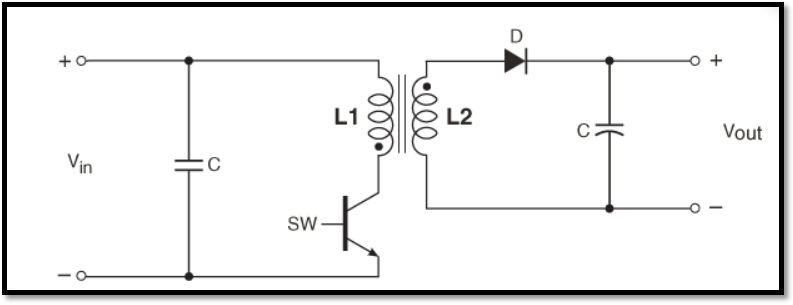
Figure 1 A Typical Flyback Transformer
MOSFETS are the most commonly used switches in flyback converter circuits. On the other hand, GaN ( Gallium Nitride) and a bipolar transistor are used occasionally. To achieve the required output voltage the flyback controller opens and closes the switch with an appropriate duty cycle. The duty cycles in this case are up to 0.5. Multiple output voltages can be generated through various combinations of turns ratio and duty cycles as per our requirements by using the following equation.
Vout = Vin x ( Ns/Np) x (D/(1-D))
Where
Vout = Output voltage
Vin = Input voltage
Ns = Number of secondary turns
Np = Number of primary turns
The basic flyback cycles are divided into two categories
I. When the FET Switch is closed
When the FET switch is on, the input current is connected at the primary end of the transformer. This creates a magnetic field and energy is stored in it. When the switch is closed to ensure that no energy is transferred to the secondary end of the transformer the combination of a magnetic winding polarity reverse biases the output diode that can be identified by the polarity dots. The current in the primary is ramping up over time during this cycle to store the energy that is equal to 1/2LI2.
II. When the FET Switch is opened
When the FET switch is opened, the energy is transferred to the secondary winding and then to the load after the magnetic field collapses. At this stage, the current at the secondary end is at its peak and it gradually ramps down as the stored energy is transferred from the secondary end to load.
Components of the flyback transformer:
The components of the flyback transformers are similar to the other isolated transformers which include switches, output diodes or rectifiers, and capacitors at input or output ends.
I. Switches
As mentioned above the most commonly used switches in flyback converter circuits are MOSFET. These MOSFET switches consist of three terminals that help us to redirect and modify the electric signals. On the other hand, GaN (Gallium Nitride) and a bipolar transistor are used occasionally.
II. Coupled Inductor
A coupled inductor is formed by the coil in the flyback transformer that stores and transmits the energy. The primary end coil and the secondary end are linked through the electromagnetic induction phenomenon (the flow of energy in the secondary coil creates a magnetic link between the coil and generates voltage in the secondary coil). Voltage is modified through the coupled inductors. As well as to enhance the efficiency of electrical flow these can also be used.
III. Output diode
To Ensure the unidirectional flow of current from input to output end for the modification, current at the secondary coil diodes are used. As we know the fluctuation of current occurs in the transformer, the diodes tighter with the output capacitor ensure the outflow of current is steady.
Flyback Transformer Design:
Figures 2 and 3 below illustrate the waveforms for DCM and ACM also known as continuous mode and discontinuous mode operations. By multiplying primary and secondary currents with their respective winding turns, all the currents are normalized to their ampere turn. The definition of the duty cycle is required by the design of the flyback transformer and calculation losses. From this definition of duty cycle D, the transformer turns ratio, n calculated according to the following equations
n= (VIN/VO’) x (D/1-D) ; D= n.VO’/VIN + n.VO’
VO’ here represents the output voltage at the secondary coil plus switch, rectifier, and IR drops referred to as the secondary. The above equation usually applies to discontinuous mode operation.
I. Continuous Conduction Mode (CCM)
The figure below illustrates the flyback current waveform in the case of the CCM (also known as continuous current mode). The secondary coil of the transformer never reaches zero if the FET is turned on before all of the flyback energy is transferred to the secondary end. This phenomenon is known as continuous conduction mode or CCM.

Figure 2 Flyback current waveform in case of CCM
The core loss is usually not important in continuous mode operation, because compared with full load DC component the ac ripple component of the total inductor ampere-turns is smaller. During the on and off switch the individual current values of windings are transferring ampere turns back and forth from the primary to the secondary end. This resulted in a higher value of AC current components in the windings which later caused higher frequency winding losses. The DC current component of the secondary end is equivalent to the output current regardless of the input voltage VIN. The total inductor ampere-turns, peak currents, and primary DC are greatest at the low VIN. That’s why at the low VIN the worst-case conditions for winding losses and core saturations occur. Similarly at high VIN the total inductor ampere-turns and ac ripple component are greatest in values. But still, core losses have a minor significance because the core loss is usually negligible with the continuous mode operation.
II. Discontinuous Conduction Mode (DCM)
The secondary current reaches zero before the end of the period creating an idle time known as tidle if the stored energy in flyback is completely emptied to the secondary before the FET is turned back on this condition is called discontinuous conduction mode (DCM). The diagram below illustrates the example of DCM. Depending on the load condition and input voltage, flyback transformers may operate in both DCM and CCM.
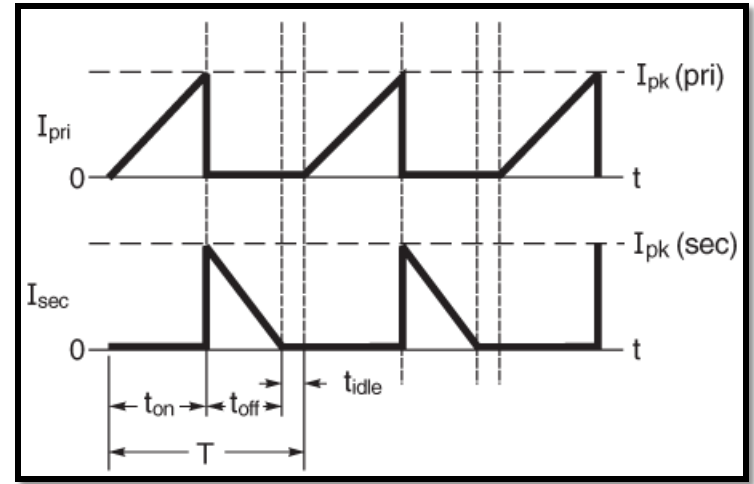
Figure 3 Flyback current waveform in case of DCM
Theoretically, regardless of VIN and VO a transformer-coupled flyback circuit can function with any turns ratio. However, avoiding high peak voltages and currents functions best. If we set the value of n that makes D=0.5(at mode boundary for discontinuous mode operation). Device ratings and circuit considerations could dictate a turn ratio that resulted in a duty cycle other than 0.5. The trade between primary and secondary peak voltages and currents is determined by the turn ratio. So changing in value of n will change the other parameters for example if we reduce the n it will reduce the duty cycle, decrease the peak rectifier current, and reduce the secondary peak voltage. On the other hand, it will increase the peak rectifier voltage and peak switch current.
III. Waveforms:
The calculations of AC and DC and total rms current components of each waveform must be calculated before the flyback transformer design is completed. Differing worst-case situations related to core losses, core saturation, and winding losses, current values must be calculated at each of them. The equation below can be used to calculate the dc, ac, and rms values of waveforms (during continuous mode operation).
Idc= D x (( Ipk + Imin) / 2) = D x Ipa
Where Ipa is the average peak value of the trapezoidal peak equivalent to (Ipk + Imin)/2
Application of flyback transformer:
Usually, the flyback transformer plays a vital role in applications that require voltage signals at higher frequencies. Nowadays flyback transformers are most suitable for AC-DC and DC-DC conversions. The applications that make flyback transformers a popular option amongst electronics users are given below,
I. Larger CRT (Cathode ray tubes) Tubes
In old times the picture of cathode ray tubes used in the television sets we greatly affected by the interrupted power from the flyback transformer. Now due to improvements in the techniques and material, we can maintain a reliable and constant supply of voltage continuously. All this is possible because of the flyback transformers.
II. Aeronautics and aviation appliances:
A very precise frequency is required for the aviation and aeronautics appliances or else they will malfunction, which will end up in serious consequences. To get a high, precise, and constant voltage electric supply the flyback transformer is used widely.
III. Invertors and converters:
USBs, electric converters, and inverters usually operate at highly fluctuating frequencies. The flyback transformers play a vital role in this phenomenon of immediately changing from low voltage to high voltage. To supply a constant supply of electricity to appliances like refrigerators, computers, and air conditioners flyback transformers are widely used.
IV. Communication devices:
The flyback transformers play a vital role in telecommunication devices and systems because these systems are highly dependent on flyback transformers for their conversion of electrical supply and power application.
V. Miscellaneous applications:
To boost performance and efficiency a wide range of industrial equipment is equipped with flyback transformers. Devices like generators, motors, and pumps widely used flyback transformers. For many industries, the switch mode power supply uses flyback transformers. This device was originally invented for cathode ray tubes but nowadays it is used in more latest technologies such as modern military jets. Which serves the purpose of storing energy and producing a higher or lower voltage with great efficiency.
In modern LED systems, the flyback transformers are being used in LED drives. These LED drives help the LED lighting systems regulate the output current coming from the power supply.
As flyback transformers have the ability to transmit energy and convert current, they play a vital role in applications related to the capacitor and battery charging systems.
Advantages of a flyback transformer:
As compared to the other converters the flyback transformers have several advantages discussed below,
I. Isolation of circuit
The isolation of the circuit is one of the key benefits of the flyback transformer. That provides better safety and plays a vital role in the prevention of electrical hazards which is particularly important for high-energy electrical systems.
II. Compact in size
As compared to the other transformers for similar applications the flyback transformers are simpler in design making their construction lighter, smaller, and much easier to install. These abilities make the flyback transformers a better fit for different kinds of electrical systems.
III. Economical
The converter systems equipped with flyback transformers are economical and cost-effective as compared to the same systems equipped with other kinds of transformers. On the other hand, they the are same in value as the other transformers.
IV. Convenience and accessibility
Multiple output voltages can be isolated and modified by using a single flyback transformer making them convenient in their operation.
Conclusion:
With diverse topologies and the ability to manage multiple loads, the flyback is like a backbone in modern electronics. From simple LED drivers to complex electrical systems their importance in different kinds of power supply designs makes them a vital source of technological advancements.
In the wide galaxy of electronic components, the flyback transformers stand as reliable components for the efficiency, stability, and safety of electrical systems.
ALSO SEE:All Online Conversion Calculators by Richard