
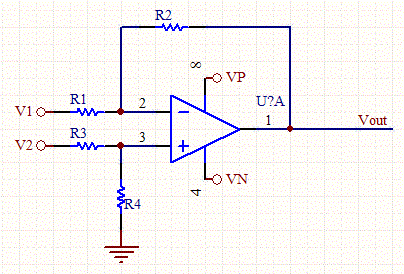

Op-Amp Voltage and Gain Calculator:
This type of calculator is used to determine the gain and output voltage of an operational amplifier (also known as op-amp). By having the DC input voltage and its resistor values we can calculate the output voltage and the gain of an op-amp. Whether the op-amp meter is in an inverting position or in a non-inverting position the output voltage value is independent of both conditions. In our article, we will try to explain the operational amplifier, its operations, characteristics, and calculations related to the op-amp voltage and gain calculator.
What is an Operational Amplifier?
An operational amplifier (often known as op-amp) is an electronic DC coupled amplifier that has differential input with single output mostly with high gain value. The op-amp is a vital and widely used component in analog circuits. These amplifiers are mostly used at domestic, industrial, and scientific levels. They can either be a component in the circuit or an element in integrated circuits that are more complex. These amplifiers fall in the category of differential amplifiers. The figure below represents the circuit diagram for an op-amp.
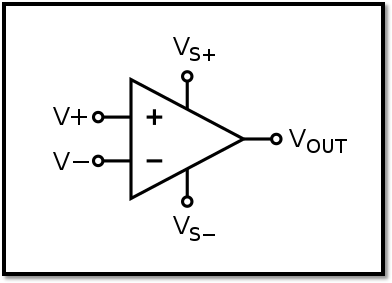
Figure 1 Op-Amp Circuit Diagram
Here is a detailed video related to op-amps to know more in detail.
Operation:
A non-inverting input (V+) and the inverting input (V-) are the inputs for op-amp. Whereas the Vs+ and Vs- are input voltages. The op-amp amplifies the voltage difference between V+ and V- ideally, that is known as differential input voltage. The output voltage (Vout) is calculated by the formula
Vout = AOL (V+ - V-)
AOL in the above equation is the gain of the operational amplifier which is known as the open loop gain, which refers to the absence of an external feedback loop from our output.
I.Open loop amplifier:
The magnitude for open loop gain AOL has a large value ranging from 100,000 and for integrated complex circuits up to +100dD. A very small voltage difference between V+ and V- of microvolts can drive the amplifier into saturation or clipping. Mostly the gain AOL for closed-loop amplifiers is not properly controlled during the manufacturing process, so using the open-loop amplifier as a stand-alone differential amplifier is not a good idea.
Using positive feedback for regeneration in an open loop op-amp, and without negative feedback, the op-amp acts as a comparator as shown in the figure below.

Figure 2 Open loop op-amp as a comparator
II.Closed-loop amplifier:
The negative feedback is used when predicted results are required for op-amp. For this purpose, a small portion of the output voltage is applied to the inverting output. This closed-loop circuit greatly reduces the gain value. The overall gain of the circuit is determined by the feedback network after applying the negative feedback rather than by the characteristics of the op-amp.
By a mathematical function (transfer function) we characterized the response of the op-amp circuit with its input, output, and feedback to an output. To have a desired transfer function while designing an op-amp is in the realm of electrical engineering. These transfer functions play a vital role in many applications of op-amps. The closed loop gain ACL is determined by the presence of negative feedback in a non-inverting amplifier via voltage divider Rf and Rg given by the equation.
ACL = Vout / Vin
At a certain stage when Vout is enough to pull the inverting input to the same voltage level as Vin an equilibrium will be established. So the overall gain for the complete circuit will be
ACL = 1+ Rf / Rg.
For example, if Vin = 2 volt and Rg=Rf the output voltage Vout will be 3 volt. As we have provided feedback through the Rf and Rg it’s a closed-loop circuit.
Applications of Op Amp:
Now we will discuss in detail the applications of Op Amp
As signal amplifier:
Op Amps are widely used in signal amplification. All types of Op Amps carry a certain amount of gain with them and the resulting output is the multiplier of that gain with the input value. This application of Op Amp has a major role in the modification of weak signals for a variety of purposes. The input is provided to the two input terminals which later is amplified by op-amp.
As Filters:
The op-amp is used as a filter in several circuits as low pass, high pass, band stop, and bandpass filters. Their high input impedance, low output impedance, and high gain characteristics make op amp useful as filters. We can block and pass specific frequencies as per our requirements following diagram illustrates the single-line diagram for an op-amp as a filter where L at the circuit has been used in this conversion with a mathematical formula.
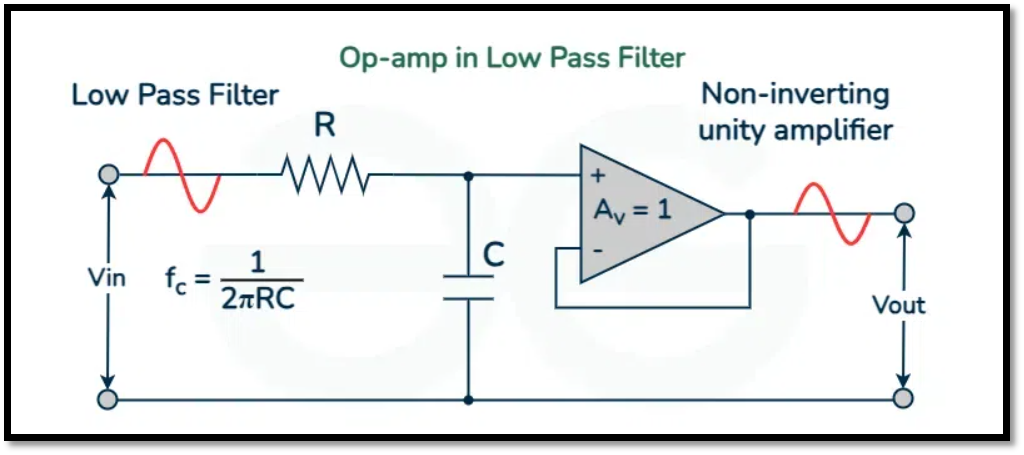
Figure 3 Op-amp as a filter
Gain(Av) = Vout / Vin
As a voltage comparator:
To compare the input voltages we can use the op amps as comparators. A digital input is generated of the input voltage to be compared when they are fed at the inverting and non-inverting terminals of the op-amp. In control systems, this application is used as window comparators, threshold detection, and zero crossing detectors as well as oscillators, and sensor interfaces. Whereas L at the circuit has been used in this conversion with a mathematical formula.

Figure 4 Op amp a comparator
Feedback fraction (β) = R1 / (R1 + R2)
As Oscillators:
In the manufacturing of oscillators, the op-amps are widely used. An oscillator generates waveforms e.g. sine waves, triangular and square waves by performing oscillations at periodic intervals which are periodic. For the devices equipped with periodic waveforms like auto oscillators and clock generators, we use op-amp as oscillators. Where L at the circuit has been used in this conversion with a mathematical formula.
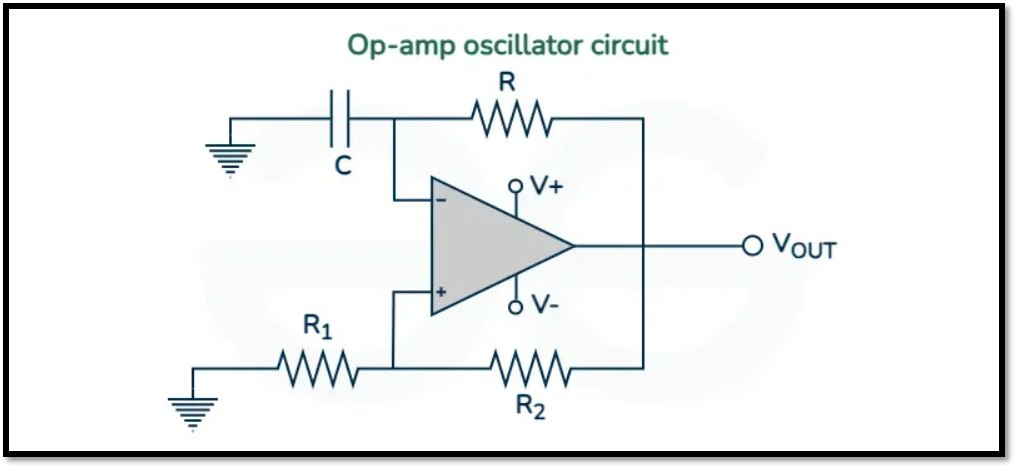
Figure 5 Op-amp as oscillators
RC frequency (f) = 1 / 2 π RC
As Differentiator:
Op amps are commonly used in differentiator circuits as well as in integrator circuits. A voltage that is proportional to the derivative of the input voltage is fed to the op-amp. For generating required signals and signal processing these circuits are commonly used. The figure below illustrates the circuit used in this conversion with a mathematical formula.

Figure 6 Op-amp as a differentiator
V0 = -d Vi / dt
As Integrator:
As mentioned above the amp is also used as an integrator. A voltage that is proportional to the integral of the input voltage is fed to the op-amp. For generating required signals and signal processing these circuits are commonly used. The figure below illustrates the circuit used in this conversion with a mathematical formula.
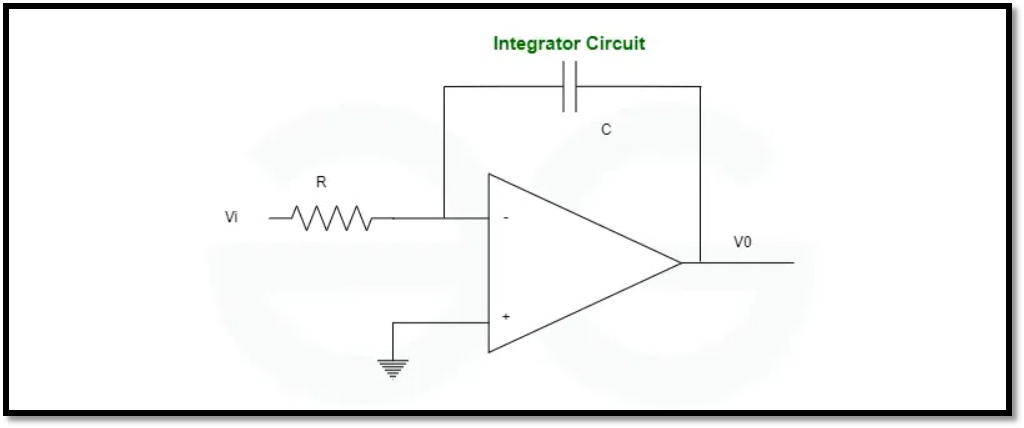
Figure 7 Op-amp as an integrator
V0 = -1 /RC ∫ Vt dt
Where C is the capacitance of the circuit, R is the resistor & Vo is the output voltage.
As voltage to current converter:
In voltage-to-current converter circuits the op-amps are widely used because of their property of converting input voltage to generate current. By applying a feedback circuit and using a certain resistance and current sources in an op-amp this can be achieved. The figure below illustrates the circuit used in this conversion with a mathematical formula.
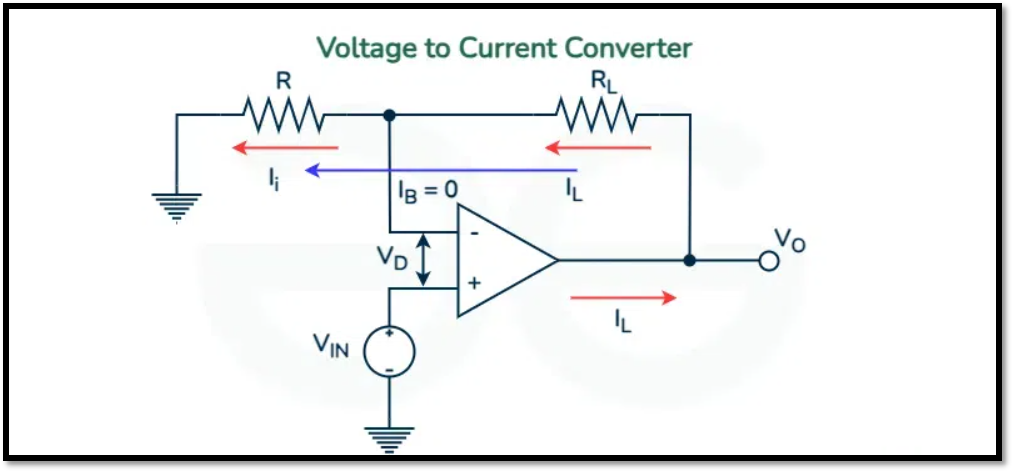
Figure 8 Op-amp as a voltage to current converter
Vin = VD + VF
Vin = IL x R
IL = Vin / R
As current to voltage converter:
In current-to-voltage converter circuits the op-amps are widely used because of their property of converting input voltage to generate voltage. By applying feedback circuits and using a certain resistance and current sources in an op-amp this can be achieved. The figure below illustrates the circuit used in this conversion with a mathematical formula.
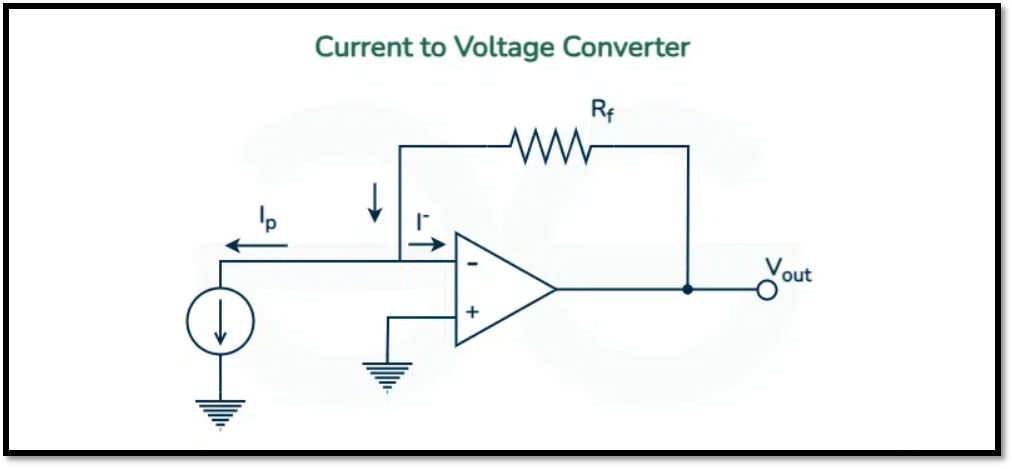
Figure 9 Op-amp as current to voltage converter
(Vout – V- ) / Rf = Ip+I-
Vout = Ip x Rf
As a logarithmic amplifier:
The op-amps can also be used as logarithmic amplifiers. As the name shows mathematical tasks such as logarithm and logarithms tasks performed by using op-amps have been done with logarithmic amplifiers along with the amplification of input signals. The output generated by the logarithmic amplifier is proportional to the input value's logarithm. The figure below illustrates the circuit used in this conversion with a mathematical formula.
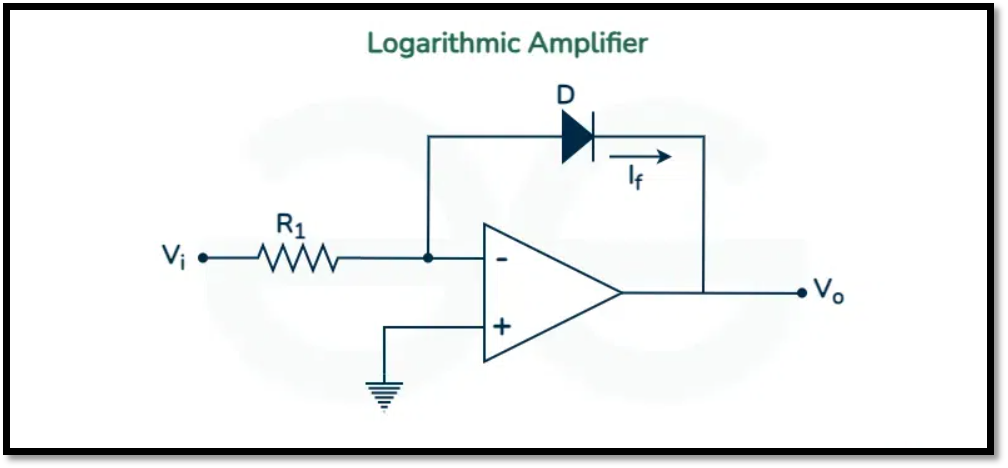
Figure 10 Op-amp as logarithmic amplifier
Choosing an operational amplifier as per your application:
There are certain considerations while selecting an operational amplifier for your application, those are discussed below in detail.
First of all, considering your operating voltage range is very important, this simply can be identified by looking at the op amp’s power supply voltages. This could be either a positive supply VDD(+) or ground supply. On the other hand, it can support both positive and negative supplies. If we need to support negative voltages the negative supply equipped op amp is useful for this application.
An op-amp’s GBP (also known as gain bandwidth) is the second most important factor to consider. Especially, when we are dealing with circuits with high frequencies one must go for an op amp with higher GBPs so it can provide higher performance and reduce distortion.
Certain applications may require lower power consumption, for this purpose, one must consider the op-amps with lower power consumption ability. Power consumption details can be found typically in the data sheets commonly listed as supply current and power consumption. The product of supply current and voltage also gives us the power consumption value. Both lower power consumption and GBPs are associated with the circuit performance. Lower the value of power consumption due to lower supply current have lower GBP. Hence corresponds with lower circuit performance.
Summary:
In many analog and power applications op amps play a vital role. As op amps are widely understood, supported well documented, and have easy implementation to circuits, thus using op amps has many benefits and applications as mentioned above in detail. Having a good understanding of key parameters for op amps and knowing common topologies related to operational amplifiers you can use them in complex circuits for their number of applications.
ALSO SEE:All Online Conversion Calculators by Richard


