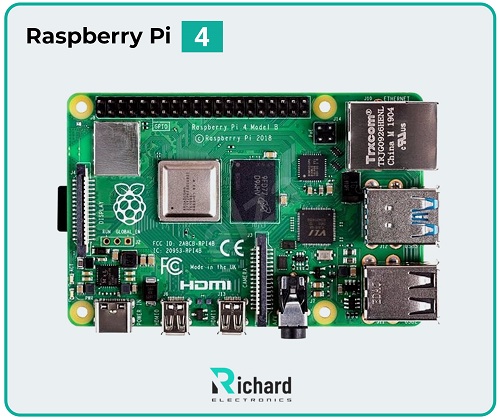
Raspberry Pi 4 is a single-board computer designed by the Raspberry Pi Foundation, as the most advanced and featured inversion in June 2019. It is a powerful reiteration of the Raspberry Pi series. It is a blend of efficient performance, attractive cost, and versatile functionality. It is specially designed to help hobbyists and professionals, become the mainspring in various projects including education, and embedded systems. It comes with multiple RAM that makes it ideal for simple and complex projects to handle simple and complex coding and programming easily. Pi 4 is power efficient and has powerful connectivity capability. It is the best desktop replacement and has various applications in many demanding fields including education, media centers, IoT, home automation, industries, networking, and robotics.
In this, I’m going to discuss Pi 4’s introduction, datasheet, features, pinouts, specifications, and applications. Moreover, this article will be very helpful for you and it adds more interesting information to your mind. Let’s dive into the topic.
Introduction:
● It was launched in June 2019 by the Raspberry Foundation.
● It contains Broadcom BCM2711 processor, features Quad-core Cortex-A72 (ARM v8), 64-bit resolution.
● It runs at a clock speed of 1.5 GHz.
● It contains multiple RAM like 1GB, 2GB, 3GB, or 4 GB.
● USB boot options and a MicroSD card slot are used for storage.
● It supports wireless connectivity.
● It is affordable with low cost.
● It contains CSI for efficient connectivity of camera modules to make clear pictures.
● Pi 4 supports USB ports to connect with peripheral devices like keyboard and mouse.
● Pi 4 contains a 40-pin GPIO header.
● It requires 5V/3A power to operate smoothly for efficient results.
● It offers flexibility and friendly budgets to its users whether they are beginners or experts.
● Its significant features make it best suited for several demanding projects like home automation, industrial automation, robotics, networking, education, and light gaming.
● It has a wide range of applications in media streaming and IoT projects.
Specification of Raspberry Pi 4
Processor
Pi 4 contains Broadcom BCM2711 processor, features Quad-core Cortex-A72 (ARM v8), having 64-bit resolution power. It operates at 1.5 GHz clock speed. Its design Cortex-A72 is enhanced for its efficiency and smooth performance. In comparison to Raspberry Pi 3 Cortex-A53, it is 3 times more efficient. It supports faster computational tasks with accuracy and brilliance. It is ideal in multitasking applications including video editing, software development, and AI inference. It offers virtualization of hardware, this feature makes them for lightweight virtual machines. It is powerful enough to run operating systems like Raspberry Pi OS, Ubuntu, and Windows IoT Core seamlessly. This makes it crucial for development purposes and efficiently handles servers and desktops.
Memory
Cortex-A72 offers multiple memory ranges including 1GB, 2GB, 4GB, or 8GB LPDDR4-3200 SDRAM. This makes it ideal for simple and complex projects. The LPDDR4-3200 allows users to transfer data at high speed and perform different tasks efficiently. This makes it ideal for handling resource-intensive tasks.
The 8GB memory range in Pi 4 is used by developers and experts for applications that require large memory capacity to hand data. 8GB is crucial to run Docker containers and large databases. Its memory feature makes it flexible to users according to their budget and the requirements of the project.
Storage
Broadcom BCM2711 uses a MicroSD card slot for primary storage. It allows UHS-I to enhance writing and reading speed which is helpful in the improvement of boot time and application performance. It is crucial in lightweight systems and basic operations.
USB Boot
● It supports booting from external devices. These external devices are connected by using USB 3.0 ports. This feature allows it for faster and more compatible storage options like SSD cards.
● It is crucial in applications like media servers and development environments, enhancing their storage capacity.
It is helpful for user to customize storage according to their projects’s needs and requirements.
Graphics and Multimedia
It contains a VideoCore VI GPU graphic unit. It allows OpenGL ES 3.1 to manifest complex 3D graphics. When connected with Vulkan 1.0, it offers modern graphics and compute APIs which are useful in advanced gaming and rendering applications.
It is used for decoding H.265 (HEVC) and allows 4K video playback.
Dual Display Output:
● It contains dual micro HDMI ports having resolution powers up to 4K at 60fps.
● It allows extended display setups which is suitable for multitasking, presentations, and digital signage.
It is ideal in projects for multimedia and desktop setups, even useful for light gaming.
Connectivity
It allows flawless internet access and connection with peripheral devices. This feature makes it perfect and ideal for smart home hubs, wireless communication, and educational tools.
Ethernet
It can be connected using wire and delivers data at high speed. It is crucial for complex data applications including file servers, media streaming, and IoT projects.
Dual-band Wi-Fi
It can smoothly operate in two bands:
● 2.4GHz
● 5GHz
It allows efficient, stable, and fast wireless connections in a diversified network environment.
Bluetooth 5.0
It is used for wireless connections in peripherals like keyboards, mice, and IoT devices to enhance its speed and range.
USB Ports
It has two types of USB ports:
● USB 2.0
There are 2 USB 2.0 ports in it. It allows harmony with legacy devices.
● USB 3.0
It allows users to transfer data at high speeds up to 5Gbps, allowing quick access to external storage and high-bandwidth peripherals.
Power delivery
It is used to supply power to peripheral devices like keyboards, mice, hard drives, or USB-powered displays. It is used to connect external devices like printers, cameras, and input devices.
Power
● It requires 5V/3A power by USB-C connector to perform smoothly.
● It is ideal for remote displays when connected with an optional PoE HAT, enabling Power over Ethernet (PoE).
● It provides enough power to the board, enabling it to easily operate with peripherals like USB devices and HDMI displays.
● It is used when work is heavily overloaded to function smoothly. It is also used with peripheral devices to handle complex data.
Camera Interface
It contains CSI (Camera Serial Interface) and features 1080p30 video recording and photography with high resolution. It operates with official Raspberry Pi Camera Modules to improve the quality of the camera. This feature makes it ideal for applications including surveillance systems, time-lapse photography, and computer vision.
Audio and Peripheral Interfaces
Audio Output:
● It is highly used to combine analog audio and composite video in a single 3.5mm jack.
● It is capable of supporting digital audio using HDMI for higher-quality output.
DSI (Display Serial Interface):
● It allows Pi 4 to connect with official Raspberry Pi touchscreen displays, making it perfect for projects including kiosks or handheld gaming consoles.
● It offers versatility in media for audio and visual projects.
Thermal management
When Pi 4 processes more data with complexity it releases heat.
● It is cooled passively by using heatsinks.
● Active cooling is done by fans. It is more accurate for high performance.
Operating System and Software
● It contains Raspberry Pi OS (formerly Raspbian), based on Debian.
● It is used to operate in various operating systems including Ubuntu, Fedora, and even Windows IoT Core.
● When connected with Docker it allows programming languages like Python, C++, and JavaScript.
● It offers flexibility for users for development, education, and deployment in various environments.

Raspberry Pi 4 Datasheet
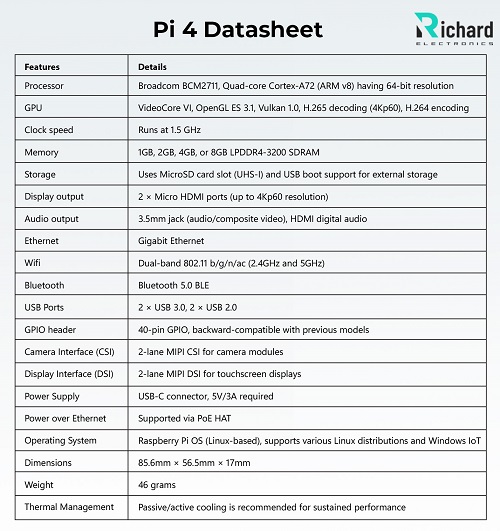
Download the Raspberry Pi 4 Datasheet
Features | Details |
Processor | Broadcom BCM2711, Quad-core Cortex-A72 (ARM v8) having 64-bit resolution |
GPU | VideoCore VI, OpenGL ES 3.1, Vulkan 1.0, H.265 decoding (4Kp60), H.264 encoding |
Clock speed | Runs at 1.5 GHz |
Memory | 1GB, 2GB, 4GB, or 8GB LPDDR4-3200 SDRAM |
Storage | Uses MicroSD card slot (UHS-I) and USB boot support for external storage |
Display output | 2 × Micro HDMI ports (up to 4Kp60 resolution) |
Audio output | 3.5mm jack (audio/composite video), HDMI digital audio |
Ethernet | Gigabit Ethernet |
Wifi | Dual-band 802.11 b/g/n/ac (2.4GHz and 5GHz) |
Bluetooth | Bluetooth 5.0 BLE |
USB Ports | 2 × USB 3.0, 2 × USB 2.0 |
GPIO header | 40-pin GPIO, backward-compatible with previous models |
Camera Interface (CSI) | 2-lane MIPI CSI for camera modules |
Display Interface (DSI) | 2-lane MIPI DSI for touchscreen displays |
Power Supply | USB-C connector, 5V/3A required |
Power over Ethernet | Supported via PoE HAT |
Operating System | Raspberry Pi OS (Linux-based), supports various Linux distributions and Windows IoT |
Dimensions | 85.6mm × 56.5mm × 17mm |
Weight | 46 grams |
Thermal Management | Passive/active cooling is recommended for sustained performance |
Raspberry Pi 4 Pinouts
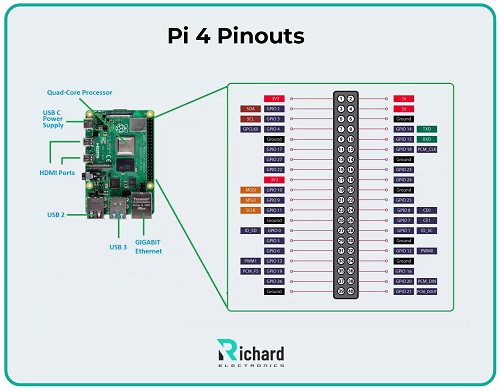
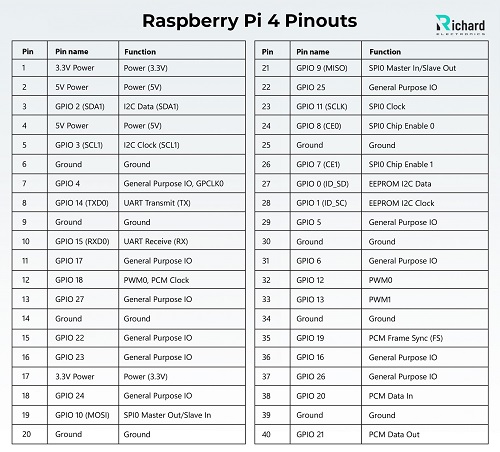
Pin | Pin name | Functions |
1 | 3.3V Power | Power (3.3V) |
2 | 5V Power | Power (5V) |
3 | GPIO 2 (SDA1) | I2C Data (SDA1) |
4 | 5V Power | Power (5V) |
5 | GPIO 3 (SCL1) | I2C Clock (SCL1) |
6 | Ground | Ground |
7 | GPIO 4 | General Purpose IO, GPCLK0 |
8 | GPIO 14 (TXD0) | UART Transmit (TX) |
9 | Ground | Ground |
10 | GPIO 15 (RXD0) | UART Receive (RX) |
11 | GPIO 17 | General Purpose IO |
12 | GPIO 18 | PWM0, PCM Clock |
13 | GPIO 27 | General Purpose IO |
14 | Ground | Ground |
15 | GPIO 22 | General Purpose IO |
16 | GPIO 23 | General Purpose IO |
17 | 3.3V Power | Power (3.3V) |
18 | GPIO 24 | General Purpose IO |
19 | GPIO 10 (MOSI) | SPI0 Master Out/Slave In |
20 | Ground | Ground |
21 | GPIO 9 (MISO) | SPI0 Master In/Slave Out |
22 | GPIO 25 | General Purpose IO |
23 | GPIO 11 (SCLK) | SPI0 Clock |
24 | GPIO 8 (CE0) | SPI0 Chip Enable 0 |
25 | Ground | Ground |
26 | GPIO 7 (CE1) | SPI0 Chip Enable 1 |
27 | GPIO 0 (ID_SD) | EEPROM I2C Data |
28 | GPIO 1 (ID_SC) | EEPROM I2C Clock |
29 | GPIO 5 | General Purpose IO |
30 | Ground | Ground |
31 | GPIO 6 | General Purpose IO |
32 | GPIO 12 | PWM0 |
33 | GPIO 13 | PWM1 |
34 | Ground | Ground |
35 | GPIO 19 | PCM Frame Sync (FS) |
36 | GPIO 16 | General Purpose IO |
37 | GPIO 26 | General Purpose IO |
38 | GPIO 20 | PCM Data In |
39 | Ground | Ground |
40 | GPIO 21 | PCM Data Out |
Raspberry Pi 4 Applications:
DIY Projects
● Home automation: has many applications in home automated projects including controlling lights, thermostats, or other IoT devices.
● Retro gaming console: highly used in Use RetroPie, Recalbox, or Batocera to imitate classic gaming consoles.
● Robotics: used as a brain in robots, drones, and remote-controlled devices.
● Camera projects: uses Pi camera to Build time-lapse cameras, wildlife monitors, or security cameras.
Media Centers
It is used in software like Kodi or Plex for media streaming. It is ideal for audio streaming to set up a Hi-Fi audio system with tools like Volumio or Moode Audio.
Programming and Development
● It is ideal for students to learn programming like Python, Scratch, or JavaScript.
● With the help of Flask, Django, or Node.js it can smoothly handle web applications.
● It is used for testing software applications as a lightweight server.
Networking
● It supports personal VPN to ensure your privacy.
● It offers a file-sharing system by using OpenMediaVault or Samba.
● It supports the installation of a Pi-hole which is useful for blocking ads and trackers across your network.
● It is efficient for monitoring network performance using software like software like Nagios or Zabbix.
Education
It is ideal in an educational environment. It offers great tools for teaching coding, electronics, and computer science concepts. It hosts your own Minecraft game. It deals in electronic prototyping interfacing with Arduino, sensors, and other peripherals to learn electronics.
Industrial Use
It is ideally used in industrial systems and sensors to collect and analyze data. It is perfectly used in small businesses for creating affordable POS solutions.
AI and Machine Learning
● Pi 4 is used in language processing and object recognition by using frameworks like TensorFlow Lite.
● It is used to build your own Alexa or Google Assistant clone.
Conclusion
The Raspberry Pi 4 contains a Broadcom BCM271 Quad-core Cortex-A72 (ARM v8) processor, having 64-bit resolution. It has multiple memory ranges, making it ideal for both beginners and experts. It has versatile connectivity options with wire and wirelessly via wifi and Bluetooth. It can handle complex data efficiently. It is a blend of efficient performance, attractive cost, and versatile functionality. It is specially designed to help hobbyists and professionals, become the mainspring in various projects including education, and embedded systems. The 40-pin GPIO header allows its interaction with sensors, displays, and other peripherals. It offers flexible functionality and high affordability, making it ideal for educational, industrial, and personal projects. It is efficiently used for learning programming and hosting web servers smoothly with great performance.
Related Articles:
 Ling Tianhao
Ling Tianhao, with 20 years in R&D, has developed his skills at one of America's top ten chip manufacturers.His expertise goes beyond chip design and quality control, showing a strong understanding of PCB technology. His comprehensive knowledge of microchip and PCB technologies establishes him as a versatile professional in the semiconductor industry, driving advancements and solving complex problems.


04 September 2026

05 August 2026
04 July 2026
06 June 2026
07 May 2026