Pi Zero does not feature full-sized USB or HDMI ports, opting for micro ports to maintain a slim profile. It is an ideal choice for projects and applications that require compact and efficient computing powers. It is the best platform for the applications of IoT. It is more affordable than the Rasberry Pi 1 and Raspberry Pi 2.
It has vast applications in many fields like education, and hobbyists, and is highly used for innovations. Due to its low cost, it is highly demanding in developing regions to make unique products for better use. It is also used in basic automation projects and complex and sophisticated projects.

Introduction of Pi Zero:
● Raspberry Pi Zero has a Broadcom BCM2835 processor.
● Zero’s processors operate at the clock speed of 1 GB.
● Broadcom BCM2835 has 512 MB LPDDR2 SDRAM.
● The main purpose of designing Raspberry Pi Zero is to make computers affordable and easily accessible with versatile features.
● It is launched in the market with 5$ price, which is unparallel in the market of computers.
● Its measuring size is 65mm × 30mm × 5mm.
● Zero is much more powerful can handle Linux-based operating systems easily and performs basic programming tasks efficiently. Moreover, in creative and innovative projects it serves as a core component.
● It needs 0.5-1.5 Watts of power to perform function smoothly.
● Zero’s unique features make it ideal for applications including home automation, security systems, environmental monitoring, robotics, wearable technology, education, retro gaming, network tools, and prototyping.
Hardware Features of Pi Zero:
Raspberry Pi Zero is small but offers many functions. Despite it has a low price and compact size, it contains all the features for various applications. This feature makes it ideal for portable devices.
The specifications of the Zero are mentioned below.
Processor:
Raspberry Pi Pico has a BCM2835 SoC processor, based on the architecture ARM11 (ARMv6). It operates at the clock speed of 1 GHz.
CPU that is improved with Pi Zero, performs efficiently and smoothly. It can easily handle tasks like:
● Smoothly runs lightweight web servers.
● Efficiently executes basic programming scripts.
● Can handle multimedia playback at 1080p resolution.
Memory:
Pi Zero offers 512 MB LPDDR2 SDRAM. It is enough memory to perform functions and tasks efficiently in a low-power environment. It is used for multitasks like running small Python scripts and lightweight web servers. Its memory makes it ideal for operating basic systems including Raspberry Pi OS Lite. Pi Zero is suitable for handling crucial operations like management of GPIO-based applications, IoT device monitoring, and running of headless setups.
Its memory cannot handle complex and intensive applications but is ideal for education purposes and small-scale automation.
Storage:
Storage in Pi Zero is provided using a microSD card slot. These cards function as the main storage of user data and for operating systems. The microSD card slot offers cards having large capacity, and the flexibility to install various operating systems. It is used to store files such as data logs, media, and gaming ROMs.
Connectivity:
Micro USB Ports:
The Raspberry Pi Zero has two ports:
● Power input: Zero accepts 5V from standard micro USB adapters using this port. It offers OTG functionality.
● Data port: this port is used to connect Zero with peripheral devices including keyboards, mice, and storage devices. It is crucial for enhancing the capability of devices.
Wireless connectivity:
It connects wirelessly via wifi or Bluetooth.
● Wi-Fi (802.11n): it provides attested internet connectivity which is suitable for applications where the display is not necessary like IoT projects and headless setups.
● Bluetooth 4.1: is used to pair wireless devices. It offers connections with peripheral devices like keyboards, mice, and sensors, improving the adaptability of devices in wireless environments.
GPIO:
40-Pin Header:
The 40-pin header allows access to GPIO pins for interlinking with hardware. It supports users in controlling devices including motors and sensors. It is used to connect various peripheral devices like OLED displays or cameras. It allows users to match the header to fix its connections.
Additional GPIO Features:
● I2C and SPI Protocols:
Pi Zero uses these protocols to connect hardware devices such as digital sensors and displays.
● PWM (Pulse-Width Modulation):
It is ideal for applications to control speed and for dimming LEDs.
● UART:
Universal Asynchronous Receiver/Transmitter allows for serial communication with other devices.
Camera Connectivity:
It has a compact CSI-2 camera port which is used to connect the Raspberry Pi Camera Module. It has the following features:
● It captures high-quality images.
● Ideal in applications including time-lapse photography, security cameras, or vision-based robotics.
Form Factors:
Physical size:
● Dimensions: 65mm x 30mm x 5mm.
● Weight: without accessories, it weighs around about 9g.
● Portability: it is ideal for small portable projects like drones, wearables, or compact IoT devices.
Minimalist Design:
● It is best suited for space-restricted projects.
● It favors compact connectors like mini HDMI, and micro USB eliminating full-sized connectors.
Power Efficiency:
● It is power-efficient as it is small in size. It consumes 0.5 to 5.5 Watts to function smoothly. It is ideal for battery-based projects and for solar-based applications.
● Power is supplied to it using a micro USB adapter, power bank, or alternative energy sources.
Software Features:
Operating Systems:
Pi Zero is used to operate various systems that include:
● Raspberry Pi OS: it is specially optimized for the Raspberry family. It offers a rich desktop experience.
Special distribution:
● Retro Pi: it is used for retro gaming.
● Kali Linux: it is used to handle ethical hacking and cybersecurity tasks.
● Pi-hole: used for network-wide ad-blocking.
Programming Environment:
It provides a compatible programming environment. It is compatible with languages including Python, Scratch, and C++, which makes it a flexible tool for developers and educators.
Headless Operation:
It is easily arranged to operate without monitor and accessed remotely using:
● SSH (Secure Shell): is used for secure terminal access.
● VNC (Virtual Network Computing): it is used for graphical interface access.
Variation in Pi Zero:
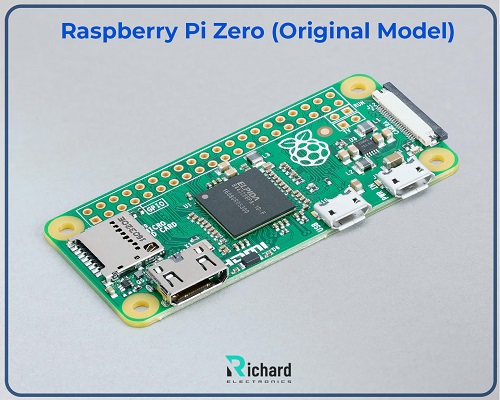
Raspberry Pi Zero (Original Model):
It was released in November 2015. It has a Broadcom BCM2835 (ARM11) processor that operates at 1 GHz of clock speed, having 512 MB LPDDR2.
It has ports:
● Micro USB (OTG)
● 1x Micro USB (power)
● Mini HDMI
It has no wireless networking( wifi or Bluetooth). It has a 40-pin header GPIO. It operates at 5V using micro USB. It is best suited for lightweight, basic applications with low processing needs.
Raspberry Pi Zero W:
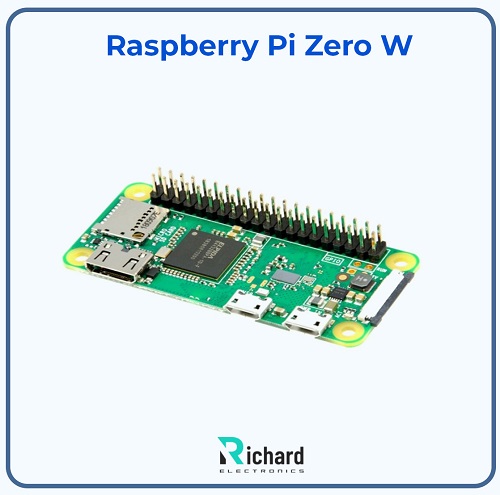
● Release: in February 2019
● Processor: Broadcom BCM2835 (ARM11) processor, runs at a clock speed of 1 GHz single-core
● RAM: 512 MB LPDDR2
● Ports:
Micro USB (OTG)
1x Micro USB (power)
Mini HDMI
● Networking: allows the use of Wi-Fi 802.11n, and Bluetooth 4.1 BLE for wireless connection.
● GPIO: It contains an unpopulated 40-pin header
● Power: it requires 5V power to operate using a micro USB.
● Use Case: its wireless networking feature makes it ideal for IoT projects and devices requiring internet connectivity.
Raspberry Pi Zero 2 W:
● Release: it is released on October 21.
● Processor: it contains Broadcom BCM2710A1 (Cortex-A53, Quad-core) processor, running at a clock speed of 1 GHz
● RAM: it contains 512 MB LPDDR2 memory.
● Ports:
Micro USB (OTG)
1x Micro USB (power)
Mini HDMI
● Networking: allows wireless networking using Wi-Fi 802.11n, Bluetooth 4.2 BLE.
● GPIO: contains an unpopulated 40-pin header
● Power: it requires 5V power to operate using a micro USB.
● Use case: allows efficient performance with a quad-core processor. It is best suited for demanding tasks like media centers or retro gaming.

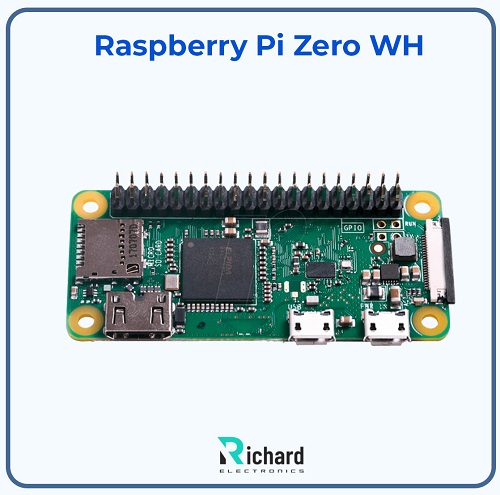
Raspberry Pi Zero WH:
● Release: in 2018
● Processor: Broadcom BCM2835 (ARM11), runs at a clock speed of 1 GHz single-core.
● RAM: it contains 512 MB LPDDR2 memory.
● Ports: contains 1x Micro USB (OTG), 1x Micro USB (power), and Mini HDMI.
● Networking: does not offer wireless connection.
● GPIO: contains a pre-soldered 40-pin header
● Use Case: it is the same as zero but with a pre-soldered GPIO header for easier prototyping.
Datasheet of Pi Zero:
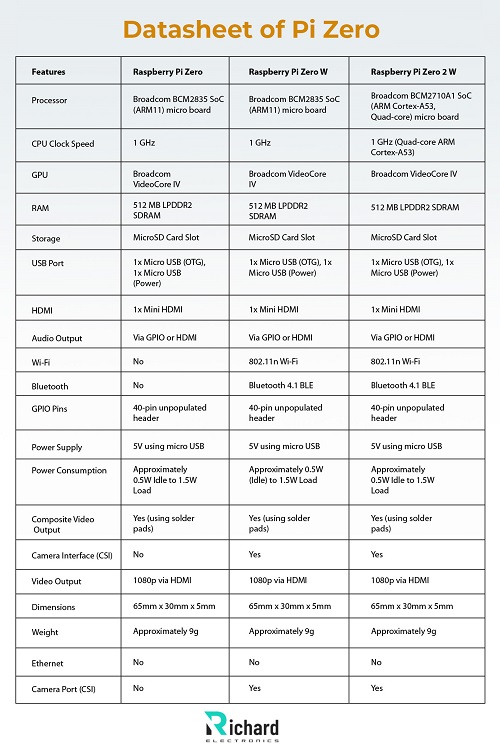
Features | Raspberry Pi Zero | Raspberry Pi Zero W | Raspberry Pi Zero 2 W |
Processor | Broadcom BCM2835 SoC (ARM11) micro board | Broadcom BCM2835 SoC (ARM11) micro board
| Broadcom BCM2710A1 SoC (ARM Cortex-A53, Quad-core) micro board
|
CPU Clock Speed | 1 GHz | 1 GHz | 1 GHz (Quad-core ARM Cortex-A53) |
GPU | Broadcom VideoCore IV | Broadcom VideoCore IV | Broadcom VideoCore IV |
RAM | 512 MB LPDDR2 SDRAM | 512 MB LPDDR2 SDRAM | 512 MB LPDDR2 SDRAM |
Storage | MicroSD Card Slot | MicroSD Card Slot | MicroSD Card Slot |
USB Port | 1x Micro USB (OTG), 1x Micro USB (Power) | 1x Micro USB (OTG), 1x Micro USB (Power) | 1x Micro USB (OTG), 1x Micro USB (Power) |
HDMI | 1x Mini HDMI | 1x Mini HDMI | 1x Mini HDMI |
Audio Output | Via GPIO or HDMI | Via GPIO or HDMI | Via GPIO or HDMI |
Wi-Fi | No | 802.11n Wi-Fi | 802.11n Wi-Fi |
Bluetooth | No | Bluetooth 4.1 BLE | Bluetooth 4.1 BLE |
GPIO Pins | 40-pin unpopulated header | 40-pin unpopulated header | 40-pin unpopulated header |
Power Supply | 5V using micro USB | 5V using micro USB | 5V using micro USB |
Power Consumption | Approximately 0.5W Idle to 1.5W Load | Approximately 0.5W (Idle) to 1.5W Load | Approximately 0.5W Idle to 1.5W Load |
Composite Video Output | Yes (using solder pads) | Yes (using solder pads) | Yes (using solder pads) |
Camera Interface (CSI) | No | Yes | Yes |
Video Output | 1080p via HDMI | 1080p via HDMI | 1080p via HDMI |
Dimensions | 65mm x 30mm x 5mm | 65mm x 30mm x 5mm | 65mm x 30mm x 5mm |
Weight | Approximately 9g | Approximately 9g | Approximately 9g |
Ethernet | No | No | No |
Camera Port (CSI) | No | Yes | Yes |
Pi Zero Pinout:
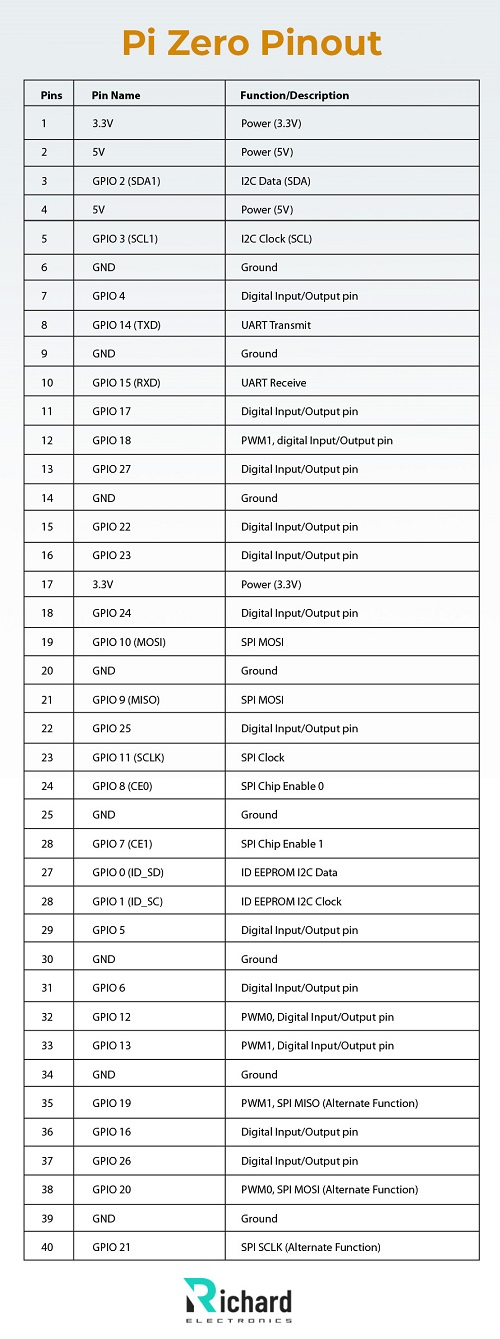
Pins | Pin Name | Function/Description |
1 | 3.3V | Power (3.3V) |
2 | 5V | Power (5V) |
3 | GPIO 2 (SDA1) | I2C Data (SDA) |
4 | 5V | Power (5V) |
5 | GPIO 3 (SCL1) | I2C Clock (SCL) |
6 | GND | Ground |
7 | GPIO 4 | Digital Input/Output pin |
8 | GPIO 14 (TXD) | UART Transmit |
9 | GND | Ground |
10 | GPIO 15 (RXD) | UART Receive |
11 | GPIO 17 | Digital Input/Output pin |
12 | GPIO 18 | PWM1, digital Input/Output pin |
13 | GPIO 27 | Digital Input/Output pin |
14 | GND | Ground |
15 | GPIO 22 | Digital Input/Output pin |
16 | GPIO 23 | Digital Input/Output pin |
17 | 3.3V | Power (3.3V) |
18 | GPIO 24 | Digital Input/Output pin |
19 | GPIO 10 (MOSI) | SPI MOSI |
20 | GND | Ground |
21 | GPIO 9 (MISO) | SPI MOSI |
22 | GPIO 25 | Digital Input/Output pin |
23 | GPIO 11 (SCLK) | SPI Clock |
24 | GPIO 8 (CE0) | SPI Chip Enable 0 |
25 | GND | Ground |
28 | GPIO 7 (CE1) | SPI Chip Enable 1 |
27 | GPIO 0 (ID_SD) | ID EEPROM I2C Data |
28 | GPIO 1 (ID_SC) | ID EEPROM I2C Clock |
29 | GPIO 5 | Digital Input/Output pin |
30 | GND | Ground |
31 | GPIO 6 | Digital Input/Output pin |
32 | GPIO 12 | PWM0, Digital Input/Output pin |
33 | GPIO 13 | PWM1, Digital Input/Output pin |
34 | GND | Ground |
35 | GPIO 19 | PWM1, SPI MISO (Alternate Function) |
36 | GPIO 16 | Digital Input/Output pin |
37 | GPIO 26 | Digital Input/Output pin |
38 | GPIO 20 | PWM0, SPI MOSI (Alternate Function) |
39 | GND | Ground |
40 | GPIO 21 | SPI SCLK (Alternate Function) |

Applications of Pi Zero:
Features of Pi Zero are mentioned below:
Educational Tools:
Pi Zero has a compact size and low cost, making it suitable for educational purposes as it supports simple programming and basic operations.it is affordable kit for students and highly used for teaching purpose.
Embedded systems:
It is small in size and can be embedded in space-restricted projects. It is ideal for drones, wearable devices, or portable gadgets.
Media and Gaming:
● Retro Pi is used as a retro gaming console.
● It is best suited as a lightweight media server or streaming device.
Prototyping and Industry:
● It is highly useful for engineers as it helps in rapid prototyping.
● It is highly useful for process automation and powers industrial monitoring systems.
Conclusion:
The Raspberry Pi Zero is small in size and affordable yet it is versatile in functionality. It allows basic operations and simple programming. It consumes low power and highly demanding in battery-based and portable projects. It needs 0.5-1.5 Watts of power to perform function smoothly. It has 40 GPIO pins that make it flexible to use.
Its size is 65mm × 30mm × 5mm which makes it ideal for applications like drones, wearable technology, remotes, and sensors. It is ideal for applications that require efficient computing power. It has variations in its model to make it more powerful and demanding. It is ideal for students for educational purposes and hobbyists. It extends industrial and IoT applications with its small form factors and efficient performance. Pi Zero with its low cost and compact size challenges other traditional norms by showing powerful, transformative tools.
Related Articles:
 Ling Tianhao
Ling Tianhao, with 20 years in R&D, has developed his skills at one of America's top ten chip manufacturers.His expertise goes beyond chip design and quality control, showing a strong understanding of PCB technology. His comprehensive knowledge of microchip and PCB technologies establishes him as a versatile professional in the semiconductor industry, driving advancements and solving complex problems.


04 September 2026
05 August 2026
04 July 2026
06 June 2026
07 May 2026